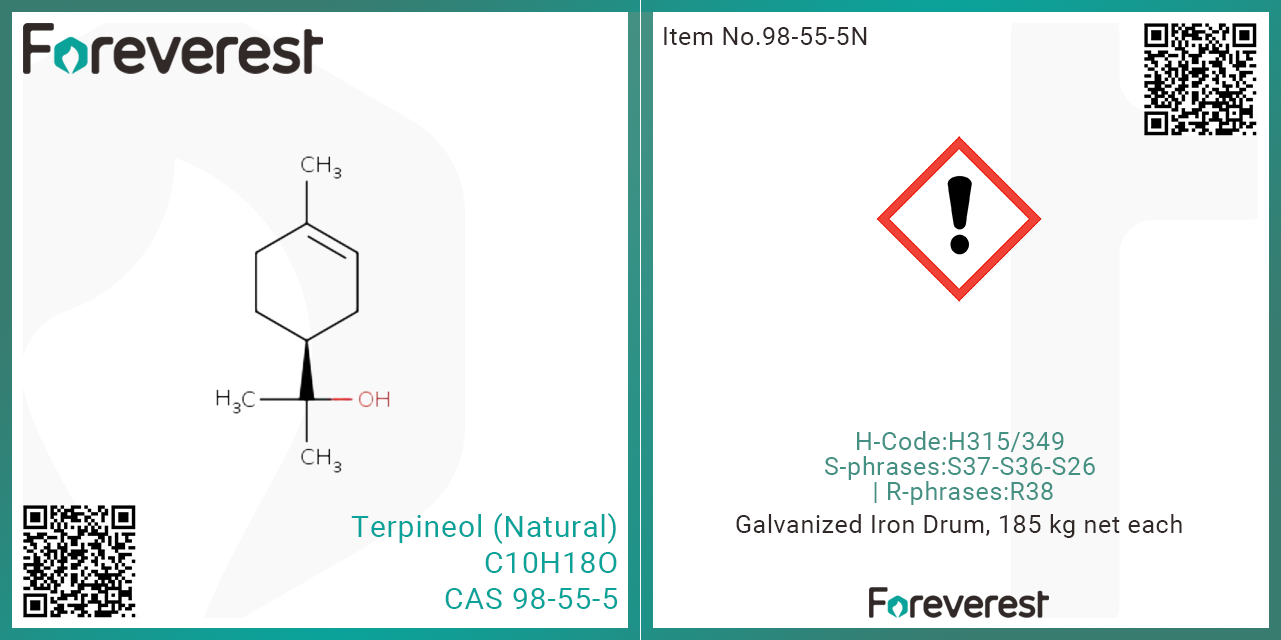
Terpineol Natural
Terpineol is naturally found in pine oil, lavender oil, orange leaf oil, neroli oil and other plant oils.
α-Terpineol, β-Terpineol, γ-Terpineol, and terpinen-4-ol are four isomers of terpineol. α-terpineol is the major component.
Terpineol is a viscous liquid with pine-like and clove-like odor.
Terpineol is widely used in the fragrance formulation, especially in soaps and synthetic detergent.
Substance Identification
| Synonyms | Foreverest | ρ-1-Menthen-8-ol |
| CAS | 98-55-5 |
| EINECS | 232-268-1 |
| FEMA | 3045 |
| HS.CODE | 2906 |
| Molecular Formula | C10H18O |
| Molecular Weight | 154.25 |
Application & Uses
- It is a common ingredient in perfumes, cosmetics, and flavors, detergent, household cleaner such as DETTOL.
- Terpineol is widely used for Solvent for ethylcellulose, Plasticizer for Epoxy resin, Fragrance, Electronic Cleaner (Flat Display Panel Industries, PDP).
Features & Benefits
- Colorless sticky oily transparent liquid with a pleasant odor similar to lilac
Sales Specification
| ITEM | VALUE | TEST METHOD & UNIT |
|---|---|---|
| Appearance | Pale yellowish thickness liquid | |
| Odor | Lilac like fragrance | |
| Assay, as cineole | 35 to 45 | % |
Q&A
How do the four terpineol isomers differ in odour profile and functional properties, and why does the natural grade's α-terpineol dominance matter for fragrance buyers?
Terpineol occurs as four isomers—α‑, β‑, γ‑terpineol and terpinen‑4‑ol—with distinct odour profiles: α‑terpineol gives the desired lilac‑type floral note with pine and citrus facets, γ‑terpineol is also floral‑lilac, whereas β‑terpineol smells more pungent, earthy‑woody and terpinen‑4‑ol has a peppery, medicinal, tea‑tree‑like character that is generally less suitable for fine fragrance. In natural terpineol from pine oil, α‑terpineol typically dominates the terpene alcohol fraction (often around two‑thirds of total terpineols), with γ‑terpineol in the low‑teens and only minor amounts of β‑terpineol and terpinen‑4‑ol, so the bulk odour naturally leans towards a clean lilac‑floral character rather than earthy or medicinal off‑notes. This isomer balance explains why natural‑grade terpineol has long been favoured as a lilac‑type ingredient in soap and detergent fragrances, and it also means that fragrance buyers benefit more from specifying the α‑terpineol share and the combined β‑ plus terpinen‑4‑ol content, rather than relying solely on a single "total terpineol" figure when sourcing for perfumery use.
How does α-terpineol's antimicrobial efficacy compare with terpinen-4-ol, and why does this matter for disinfectant formulation when specifying natural-grade terpineol?
Both α‑terpineol and terpinen‑4‑ol are broad‑spectrum antimicrobial agents, but α‑terpineol often shows slightly lower MICs than terpinen‑4‑ol against key Gram‑positive pathogens such as Staphylococcus aureus, indicating higher antibacterial potency in some models (Raman, 1995; Carson, 1995). Terpinen‑4‑ol, by contrast, is particularly well documented for quorum‑sensing inhibition and anti‑biofilm activity in organisms like Pseudomonas aeruginosa, giving it a distinct antivirulence profile (Bose, 2020; Valenzuela, 2025). Recent work has also shown that defined combinations of α‑terpineol and terpinen‑4‑ol can act synergistically against ESKAPE pathogens, outperforming either component alone (Johansen, 2022). For disinfectant formulators, this means that the α‑terpineol / terpinen‑4‑ol ratio in natural‑grade terpineol is functionally important: α‑terpineol bias tends to favour strong membrane‑disruptive and antifungal effects, whereas higher terpinen‑4‑ol content adds anti‑biofilm and anti‑QS benefits, so specifying isomer composition is more informative than quoting only total terpene alcohol content when designing targeted antimicrobial claims.
Why is natural terpineol used as both a fragrance ingredient and functional solvent in household cleaning products, and what specification parameters matter most for this dual role?
Natural terpineol plays a dual role in household cleaners because its lilac‑floral, pine‑like odour delivers the “clean” scent consumers expect, while its terpene‑alcohol structure provides real solvency for oils, light resins and greasy soils, so it contributes both fragrance and functional cleaning power rather than acting as a purely decorative note. In pine‑scented disinfectants and multi‑surface cleaners, terpineol (or high‑terpineol pine oil) helps dissolve oily/ resinous soils and supports wetting and deodorising, while also supplying the characteristic floral‑pine top note that many legacy brands are built around. For procurement teams, the most critical specifications for this dual‑purpose use are the total terpene‑alcohol content (as a proxy for both solvent strength and fragrance load), the α‑terpineol percentage (as a marker of lilac‑floral odour quality), and the level and nature of the non‑alcohol fraction (unreacted monoterpenes, cineole‑type components), which can shift both the odour profile and solvency character of the finished cleaning product.
Similar Specs
GHS Hazard Statements
| H-Code | H227/315/319 |
| P-Code | P210/264/280 |
| Response | PP302+P352 P305+P351+P338 P332+P313 P337+P313 P362+P364 |
| Storage | P403+P233 P405 |
| Disposal | P501 |
Storage
- flammable materials should be stored in a separate safety storage cabinet or room
- ground all equipment containing material
- keep away from heat
- keep away from sources of ignition
- keep container tightly closed
- keep in a cool, well-ventilated place
Relation Products
Relation Articles
- New Product Recommendation - Head Cut Terpineol
- Efficacy of Angelica archangelica essential oil, phenyl ethyl alcohol and α- terpineol against isolated molds from walnut and their antiaflatoxigenic and antioxidant activity
- Pine Oil & Terpineol applied to disinfectants and household cleaners
- Terpinen-4-ol and alpha-terpineol (tea tree oil components) inhibit the production of IL-1beta, IL-6 and IL-10 on human macrophages
- Dipentene, a low-cost substitute or extender for Citrus D-Limonene
- Terpenes (C5H8)-medicinal molecules and important building blocks in nature
- The Antitranspirant Adjuvants Also Effect The Plant Diseases Control
Remark
The above information is believed to be accurate and represents the best explanation currently available to us. However, no liability is assumed for any consequences arising from the use of this content. The technical standards for our products are developed and updated jointly by our customers and ourselves; where any changes occur, the latest specification shall prevail and will be confirmed in the relevant contract.All suggestions and data provided are based on information we consider to be reliable and are offered in good faith, but without any guarantee, as the conditions and methods of use of our products are beyond our control. Foreverest® makes no warranties, whether express or implied, regarding the accuracy, completeness or suitability of this information, and expressly disclaims any implied warranty of fitness for a particular purpose. Prospective users should conduct their own tests and evaluations to determine the suitability of Foreverest® materials and any recommendations for their intended applications before adoption, and, where appropriate, should obtain confirmation or approval from the relevant regulatory authorities.Any references in this page to patents or patented technologies, including descriptive material derived from patents or citations of specific patent numbers, are provided for information only. They must not be interpreted as a recommendation to use our products in a manner that could infringe any third‑party patent, nor as a grant of any licence or permission to use patents owned by Foreverest®.
Start Purchasing
-

Minimum Order Quantity
Quote required -

Lead Time
Quote required -

Available Incoterms
Quote required -

Regional Availability
Quote required