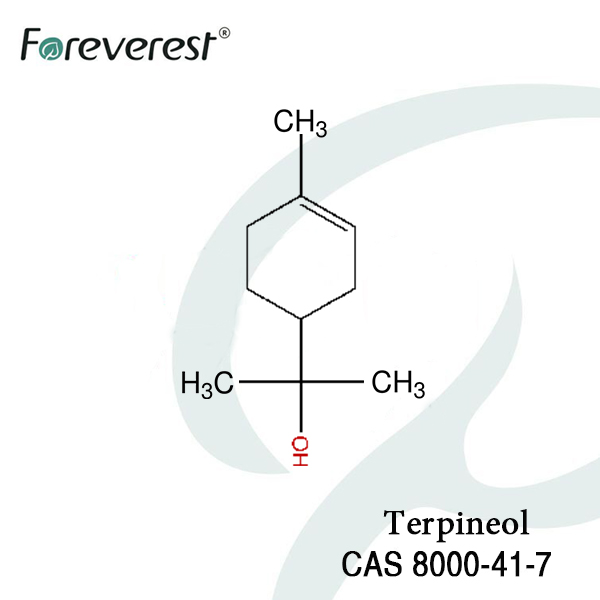
Terpineol Electric
Terpineol Electric Grade is specially designed as a cleaning agent. It has ultra-low moisture content and special removing flux solder from the printed circuit board surface.
Substance Identification
| Synonyms | α-Terpineol | ρ-1-Menthen-8-ol |
| CAS | 8000-41-7 |
| EINECS | 232-268-1 |
| FEMA | 3045 |
| HS.CODE | 290619 |
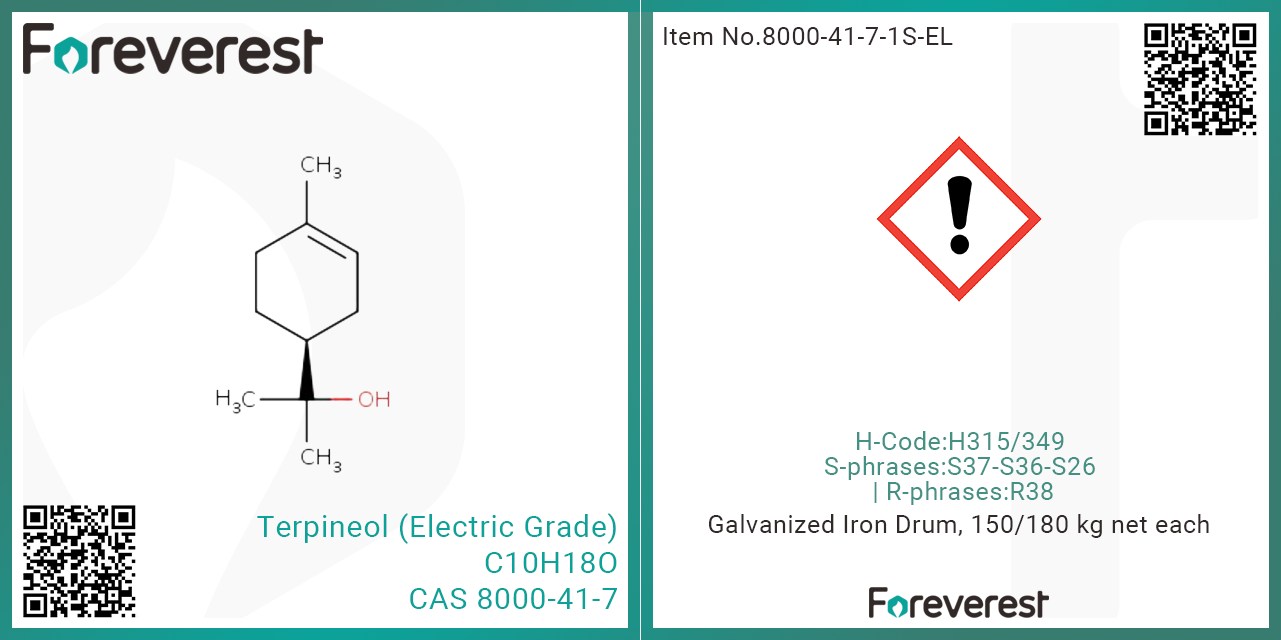
| Molecular Formula | C10H18O |
| Molecular Weight | 154.25 |
Toxicological Information
| LD50 oral, rat | 4.3g/kg min |
| LD50 dermal, rabbit | 3g/kg min |
Application & Uses
- Used as cleaning agent to remove flux solder in printed circuit board surface cleaning
Features & Benefits
- Specialised for PCB flux removal
- Designed for removing solder flux residues from PCB surfaces, especially rosin- and resin-rich deposits that are difficult to clean with water or alcohol alone.
- Ultra-low moisture for electronics reliability
- Its controlled ultra-low moisture level helps reduce the risk of ionic contamination, corrosion, and insulation-resistance loss on high-reliability circuit assemblies.
- Strong solvency with material compatibility
- The terpene-alcohol structure provides effective solvency for flux films while remaining compatible with common PCB materials and non-corrosive to metal circuitry under proper use conditions.
- High boiling point for controlled cleaning
- With its relatively high boiling point and slow evaporation profile, Terpineol Electric allows longer contact time on stubborn residues and supports more controllable cleaning performance.
- Suitable as solvent or cosolvent
- It can function as either a primary cleaning solvent or a cosolvent in terpene-based and water-based electronics cleaning formulations
- Consistent grade for precision processes
- Compared with general-purpose terpineol, the electric grade is better aligned with electronics manufacturing needs where purity, residue control, and batch consistency are critical.
Sales Specification
| ITEM | VALUE | TEST METHOD & UNIT |
|---|---|---|
| Color | 2 to 3 | @Standard No., # |
| Odor | Lilac like fragrance | |
| Refractive Index | 1.4825 to 1.4855 | @n20/D |
| Relative Density | 0.9310 to 0.9350 | @d20/4 |
| Solubility | Soluble 2 volumes of 70% alcohol | @25°C |
| Moisture Content | 0.1 max | @KF, % |
| α-Terpineol | 60 to 72 | @G.C, % |
| β-Terpineol | 3 to 10 | @G.C, % |
| γ-Terpineol | 5 to 20 | @G.C, % |
Q&A
Why is electric‑grade terpineol used as a dedicated solvent for PCB flux residue removal, and what differentiates it from general‑purpose cleaning solvents in electronics manufacturing?
Terpineol electric grade is used for PCB flux residue removal because its terpene‑alcohol structure gives strong solvency for rosin‑type flux residues, polymerised flux films and resin‑rich soils that are difficult to remove with water or isopropanol alone, while remaining non‑corrosive to copper circuitry and compatible with common PCB substrates such as FR‑4. Compared with many low‑boiling petroleum or halogenated solvents, terpineol’s relatively high boiling point and slow evaporation allow longer contact time on stubborn flux deposits without necessarily requiring heated cleaning cycles, and it can be used as a primary solvent or cosolvent in terpene‑based and water‑based flux‑removal formulations described in patents and commercial products. Electric‑grade terpineol is further differentiated by controlled low moisture and ionic contamination levels verified by Karl Fischer and related tests, which helps minimise residues and corrosion risk on high‑reliability circuit assemblies where insulation resistance and leakage current are critical, distinguishing it from general‑purpose or fragrance‑grade terpineol.
Why is α‑terpineol widely used as the organic vehicle solvent in conductive silver pastes for photovoltaic and thick‑film electronics, and which properties make it particularly suitable compared with other high‑boiling solvents?
α‑Terpineol is widely used as the organic vehicle solvent in conductive silver pastes for photovoltaic cells and thick‑film circuits because its high boiling point (around 217–219 °C) supports controlled, gradual evaporation during screen printing and drying, preventing premature surface skinning and helping maintain line definition and particle dispersion. Unlike more volatile solvents, α‑terpineol maintains a stable rheology and thixotropic profile under squeegee shear—flowing readily through the screen but holding its shape after deposition—which is critical for fine, well‑defined conductors on ceramic, glass and LTCC substrates. In a comparative study of silver oxide pastes, α‑terpineol was the only high‑boiling candidate that simultaneously offered high solubility for silver carboxylate binders (about 47.8 g per 100 g solvent), low PDMS blanket swelling (≈4.6%), and high sintered conductivity (≈1.8 × 10⁵ S/cm at 150 °C for 30 min), meeting key printability and stability criteria (Kim et al., 2011, J. Electron. Mater.). Subsequent work on LTCC silver pastes has shown that α‑terpineol‑based mixed vehicles (for example α‑terpineol:BCA:DBP ratios such as 7:2:1 or 5:2:3) deliver favourable volatility profiles, pseudoplasticity and thixotropic recovery for high‑resolution screen printing (Gao et al., 2022, Materials). For procurement, this means that both the α‑terpineol content and purity in an electronic‑grade terpineol directly influence the processing window and print performance of silver pastes, so the GC‑determined α‑terpineol percentage is a functional specification parameter rather than a purely analytical figure.
How is α-terpineol being explored as a green solvent additive in perovskite solar cell fabrication, and what performance improvements have been reported?
α‑Terpineol is being explored as a green solvent additive in one‑step solution‑processed perovskite solar cells as a low‑toxicity, bio‑based alternative to conventional, more hazardous solvent additives used alongside DMF and DMSO in perovskite precursor solutions. A 2021 study in ACS Applied Electronic Materials showed that adding a small amount of α‑terpineol (on the order of 5 mg/mL) to a CH₃NH₃PbI₃‑xClx precursor solution increased the power conversion efficiency from about 16.1% to around 17.5%, reduced current–voltage hysteresis, and improved film‑to‑film reproducibility and device stability, with α‑terpineol‑treated cells retaining roughly three‑quarters of their initial PCE after several hundred hours of storage compared with only about three‑fifths for control devices (La Mantia et al., 2021). These improvements were attributed to the high boiling point and viscosity of α‑terpineol, which modify crystallisation kinetics to produce more uniform, highly crystalline perovskite films with fewer defects and lower non‑radiative recombination. However, the effective concentration window is narrow: higher additive levels led to non‑uniform films with striation defects and degraded performance, underscoring the need for precise dosing control. For procurement teams tracking emerging photovoltaic chemistries, this suggests that α‑terpineol content and purity in commercial terpineol grades could become a relevant specification parameter if this green additive strategy is adopted at scale in perovskite manufacturing.
Similar Specs
GHS Hazard Statements
| H-Code | H227/315/319 |
| P-Code | P210/264/280 |
| Response | P302+P352 P305+P351+P338 P332+P313 P337+P313 P362+P364 |
| Storage | P403+P233 P405 |
| Disposal | P501 |
Storage
- keep container tightly closed in a dry and well-ventilated place
- store in cool place
Relation Products
Relation Articles
- Efficacy of Angelica archangelica essential oil, phenyl ethyl alcohol and α- terpineol against isolated molds from walnut and their antiaflatoxigenic and antioxidant activity
- Pine Oil & Terpineol applied to disinfectants and household cleaners
- Terpinen-4-ol and alpha-terpineol (tea tree oil components) inhibit the production of IL-1beta, IL-6 and IL-10 on human macrophages
- Terpenes (C5H8)-medicinal molecules and important building blocks in nature
- Ten questions concerning air fresheners and indoor built environments
Remark
The above information is believed to be accurate and represents the best explanation currently available to us. However, no liability is assumed for any consequences arising from the use of this content. The technical standards for our products are developed and updated jointly by our customers and ourselves; where any changes occur, the latest specification shall prevail and will be confirmed in the relevant contract.All suggestions and data provided are based on information we consider to be reliable and are offered in good faith, but without any guarantee, as the conditions and methods of use of our products are beyond our control. Foreverest® makes no warranties, whether express or implied, regarding the accuracy, completeness or suitability of this information, and expressly disclaims any implied warranty of fitness for a particular purpose. Prospective users should conduct their own tests and evaluations to determine the suitability of Foreverest® materials and any recommendations for their intended applications before adoption, and, where appropriate, should obtain confirmation or approval from the relevant regulatory authorities.Any references in this page to patents or patented technologies, including descriptive material derived from patents or citations of specific patent numbers, are provided for information only. They must not be interpreted as a recommendation to use our products in a manner that could infringe any third‑party patent, nor as a grant of any licence or permission to use patents owned by Foreverest®.
Start Purchasing
-

Minimum Order Quantity
Quote required -
Lead Time
Quote required -
Available Incoterms
Quote required -
Regional Availability
Quote required