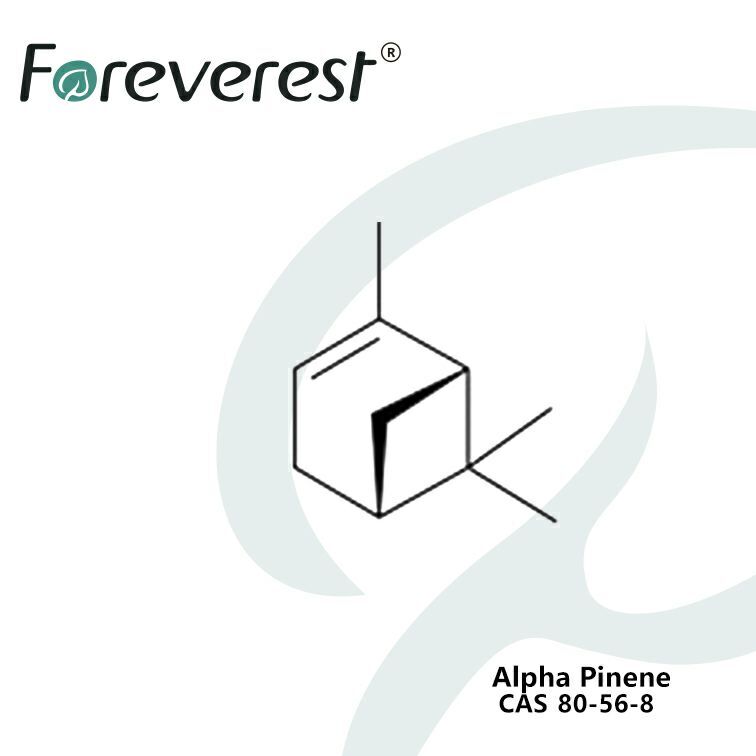
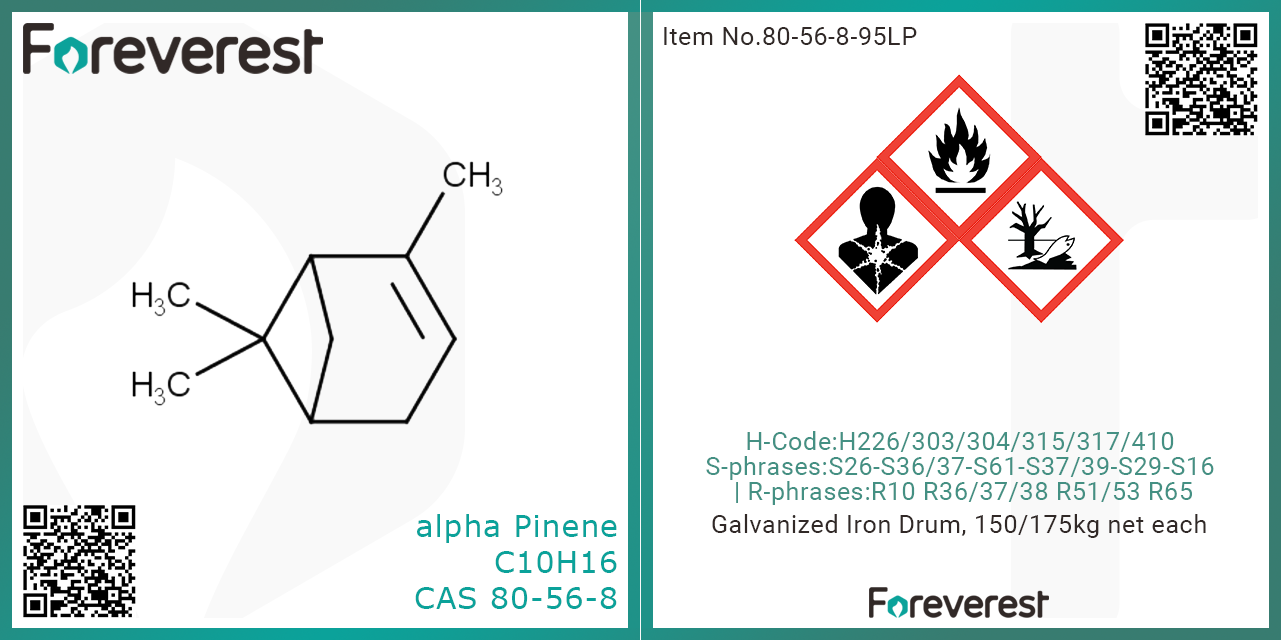
alpha-Pinene
alpha-Pinene is an important monoterpene naturally occurring in nature, known for its distinctive pine scent. It is a primary component of Gum turpentine and is widely found in over 400 types of natural essential oils, including those from pine, fir, eucalyptus, rosemary, sage, and frankincense.
Industrially, high-purity alpha-Pinene is primarily extracted through the fractional distillation of gum turpentine, ensuring its quality and stability.
In the flavor and fragrance industry, alpha-Pinene is primarily used to synthesize compounds such as Terpineol, Linalool, and other sandalwood fragrances. It is also used as a flavoring agent in daily chemicals, with a typical content of less than 2%.
Substance Identification
| Synonyms | α-Pinene |
| CAS | 80-56-8 |
| EINECS | 201-291-9 |
| FEMA | 2902 |
| HS.CODE | 290219 |
| Molecular Formula | C10H16 |
| Molecular Weight | 136.24 |
Toxicological Information
| LD50 oral, rat | 1.9g/kg min |
| LD50 dermal, rabbit | 2.4g/kg min |
Application & Uses
- Key Aroma Chemical Intermediate: alpha-Pinene serves as a crucial starting material in the flavour and fragrance industry, extensively used for the synthesis of various valuable aroma chemicals such as Terpineol, Linalool, Camphor, and for creating sandalwood-type fragrances.
- Direct Application in Flavours & Fragrances: As a unique aromatic component, it is directly incorporated into fragrance formulations to impart fresh, woody, and pine-needle-like notes. In daily chemicals, it is also commonly used as a flavouring or enhancing agent, typically at concentrations of less than 2%.
- Other Industrial Applications: alpha-Pinene also acts as an important chemical intermediate in the synthesis of resins, adhesives, solvents, and within the pharmaceutical sector, for instance, it can be used in the preparation of terpene maleic anhydride (TMA).
Sales Specification
| ITEM | VALUE | TEST METHOD & UNIT |
|---|---|---|
| Appearance | Colorless to pale yellow liquid | |
| Odor | Woody | |
| Refractive Index | 1.464 to 1.474 | @n20/D |
| Relative Density | 0.855 to 0.870 | @d20/4 |
| Acid Value | 0.5 max | mgKOH/g |
Q&A
How do different pine species affect the composition and sensory profile of gum turpentine-derived α-pinene?
GC‑MS studies of turpentine from different pine species show that the relative proportions of α‑pinene and β‑pinene can vary markedly, with some species such as Masson pine (Pinus massoniana) typically exhibiting a clearly higher α‑pinene‑to‑β‑pinene ratio, while others like slash pine (Pinus elliottii) tend to contain comparatively more β‑pinene, and intermediate patterns being observed in species such as Simao pine (Pinus kesiya var. langbianensis). These compositional differences, together with species‑ and region‑dependent variations in the enantiomeric distribution of α‑pinene, influence the fine sensory character of the resulting α‑pinene fractions, since the two enantiomers can contribute subtly different odour nuances (for example, slightly fresher or more resinous pine notes) that are perceptible to trained fragrance evaluators. For procurement teams sourcing α‑pinene for fragrance or flavour applications, understanding the pine‑species and geographic origin of the turpentine feedstock helps to anticipate such subtle odour variations, which may still be noticeable in sensitive applications even when the α‑pinene has been fractionally distilled to around 95% purity.
Why is α‑pinene the preferred monomer for high‑performance terpene resins used in SBS hot‑melt pressure‑sensitive adhesives?
The bridged bicyclic structure of α‑pinene, with a six‑membered ring fused to a four‑membered ring and an internal double bond, favours cationic polymerisation pathways that generate highly branched, compact polymer architectures, leading to terpene resins with high glass transition temperatures, strong cohesion, and good thermal resistance. Under appropriate Lewis acid catalysis and process control, α‑pinene‑based terpene resins can be tailored to high softening points, often in the 115–130 °C range for premium grades used in demanding hot‑melt pressure‑sensitive adhesive applications, while maintaining light colour and low odour. These structural and rheological properties give α‑pinene terpene resins excellent compatibility with the mid‑block segments of SBS elastomers and provide a desirable balance of tack, cohesion, and heat resistance, which is why they are widely selected as key tackifiers in high‑performance label adhesives, hot‑melt PSAs, and high‑bond‑strength specialty tapes.
What storage and handling precautions should procurement teams prioritise when sourcing high-purity α-pinene?
α‑Pinene has a closed‑cup flash point of about 31–33 °C, placing it in the range of flammable liquids under GHS Hazard Statement H226 (“Flammable liquid and vapour”), meaning it can form flammable vapour–air mixtures at typical ambient temperatures and must be stored in a cool, well‑ventilated area with containers tightly closed, clearly labelled, and kept away from heat, hot surfaces, sparks, open flames, and all ignition sources. Safety data sheets also classify α‑pinene as an aspiration hazard (H304) and a skin sensitiser (H317), indicating that ingestion with subsequent aspiration into the lungs can cause serious harm and that repeated or prolonged skin contact may provoke allergic reactions in sensitised individuals, so procurement and operations teams should enforce appropriate personal protective equipment, closed transfer systems where possible, and careful handling procedures during filling, decanting, and processing. Because α‑pinene is volatile and susceptible to gradual autoxidation, especially if exposed to air, light, or elevated temperatures, it is advisable to verify key quality parameters (such as odour, purity, and peroxide content where relevant) before using material that has been stored for extended periods or in containers that may not have been perfectly sealed, as these changes can subtly alter its sensory profile and performance in fragrance, flavour, or resin applications.
Can the enantiomeric ratio of α‑pinene serve as a quality indicator for turpentine‑derived fragrance ingredients?
The two enantiomers of α‑pinene, (+)‑α‑pinene and (−)‑α‑pinene, contribute slightly different odour nuances, and their relative proportions in turpentine and pine essential oils have been shown to vary with pine species and geographic origin, which means that the enantiomeric ratio can provide useful information about the botanical and regional source of an α‑pinene fraction. Chiral gas chromatography of α‑pinene has been proposed and validated as a tool for authenticity control of pine essential oils, because the enantiomeric distribution of α‑pinene is often characteristic for a given species or raw material type and tends to be largely preserved during standard rectification processes, allowing quality and procurement teams to check whether a supplied α‑pinene‑containing ingredient is consistent with the declared pine species and to detect possible mislabelling, adulteration, or blending with material from different origins.
How does the turpentine origin route — gum turpentine versus crude sulphate turpentine — affect α-pinene quality for fragrance applications?
Gum turpentine (GT)–derived α‑pinene, obtained by tapping living pine trees and steam‑distilling the oleoresin, is produced without exposure to sulfide‑based pulping liquors and therefore does not introduce process‑derived sulphur compounds, while retaining the characteristic clean pine‑turpentine aroma of the resin feedstock, which makes it a natural fit for fragrance applications. Crude sulphate turpentine (CST)–derived α‑pinene, by contrast, is recovered as a by‑product of the kraft (sulfate) pulping process and can contain trace sulphur‑containing impurities (such as sulphides and mercaptans) if not properly desulfurised, so additional deodorisation and rectification steps are typically required to meet fragrance‑grade odour and purity specifications. For buyers sourcing α‑pinene for flavours and fragrances, confirming whether the feedstock originates from GT or CST helps to anticipate the likely odour cleanliness and whether extra purification or tighter sensory release testing may be needed for a given supply route.
Similar Specs
GHS Hazard Statements
| H-Code | H226//304/315/317/400/410 |
| P-Code | P210/233/240/241/242/243/261/264/272/273/280 |
| Response | P301+P310 P303+P361+P353 P331 P333+P313 P370+P378 P391 |
| Storage | P403+P235 P405 |
| Disposal | P501 |
Storage
- Environmental & Temperature Control:
- Store within the specified temperature range in a dry, well-ventilated area, and protect from light.
- A refrigerated room would be preferable for materials with a flash point lower than 37.8°C (100°F).
- Keep in a cool, well-ventilated place.
- Container Management & Prevention:
- Ensure containers are tightly closed and clearly labelled.
- Ground all equipment containing material to prevent static build-up.
- Hazard Isolation:
- Keep storage areas away from heat, sparks, open flames, and all sources of ignition.
- Flammable materials should be stored in a separate safety storage cabinet or room.
- Keep away from incompatible materials to prevent hazardous reactions.
- Safe Handling & Inspection:
- Handle carefully, and stack stably.
- After prolonged storage, always check quality before use.
- Compliance & Emergency Preparedness:
- Strictly comply with all safety regulations.
- Ensure emergency plans are in place for unforeseen circumstances.
Relation Products
Relation Articles
- [Internal Sharing Session Memo] Differences between Terpene Resins Synthesised from Different Pinene Monomers, Their Applications, and a Discussion on Resin Supply Chain Stability
- Industrial Pathways for α/β-Pinene Separation: Continuous Deep-Vacuum Distillation and High-Value Applications
- Terpenes (C5H8)-medicinal molecules and important building blocks in nature
- The Species of Pine Oleoresin in China
- Exploring the Benefits of Utilizing Turpentine in F&F
Remark
The above information is believed to be accurate and represents the best explanation currently available to us. However, no liability is assumed for any consequences arising from the use of this content. The technical standards for our products are developed and updated jointly by our customers and ourselves; where any changes occur, the latest specification shall prevail and will be confirmed in the relevant contract.All suggestions and data provided are based on information we consider to be reliable and are offered in good faith, but without any guarantee, as the conditions and methods of use of our products are beyond our control. Foreverest® makes no warranties, whether express or implied, regarding the accuracy, completeness or suitability of this information, and expressly disclaims any implied warranty of fitness for a particular purpose. Prospective users should conduct their own tests and evaluations to determine the suitability of Foreverest® materials and any recommendations for their intended applications before adoption, and, where appropriate, should obtain confirmation or approval from the relevant regulatory authorities.Any references in this page to patents or patented technologies, including descriptive material derived from patents or citations of specific patent numbers, are provided for information only. They must not be interpreted as a recommendation to use our products in a manner that could infringe any third‑party patent, nor as a grant of any licence or permission to use patents owned by Foreverest®.
Start Purchasing
-

Minimum Order Quantity
Quote required -

Lead Time
Quote required -

Available Incoterms
Quote required -

Regional Availability
Quote required