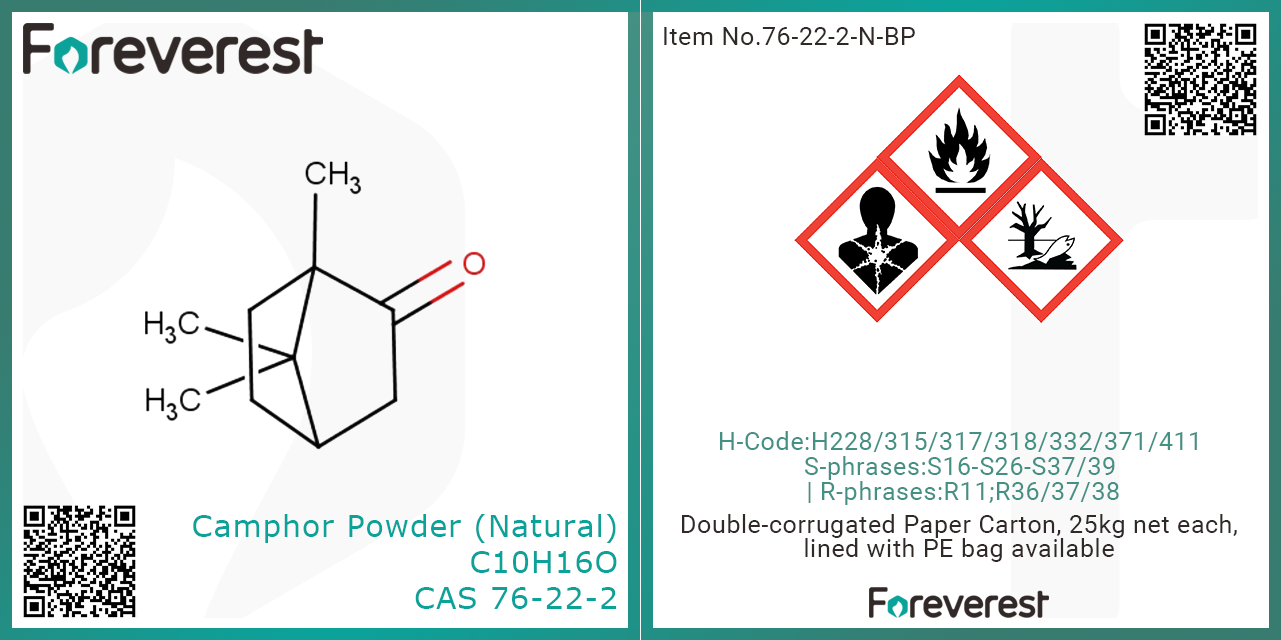
Natural Camphor Powder
Natural Camphor is a waxy white or transparent solid with a distinct strong aromatic fragrance, it is natural and distilled from plant extract.
Substance Identification
| Synonyms | Camphor powder | 2-Camphanone |
| CAS | 76-22-2 |
| EINECS | 200-945-0 |
| FEMA | N/A |
| HS.CODE | 291429 |
| Molecular Formula | C10H16O |
| Molecular Weight | 152.24 |
Application & Uses
- Used in fragrance, flavor or medical use.
- Used for skin treatment and relives pain from bug bites, cold sores, and mild burns. In addition to this, Camphor helps in curing cough and is also used in several vapor rubs.
Sales Specification
| ITEM | VALUE | TEST METHOD & UNIT |
|---|---|---|
| Appearance | White powder crystals | |
| Odor | Pungent and cool aroma | |
| Purity | 98 min | % |
Q&A
In camphor's pharmaceutical, personal‑care, and industrial uses, which applications genuinely justify the extra cost of natural single‑enantiomer camphor over synthetic racemic camphor?
Natural camphor's main commercially meaningful distinction is its enantiomeric composition: the natural material is predominantly (+)‑camphor, the (1R,4R) enantiomer, whereas conventional synthetic camphor obtained from α‑pinene is typically a racemic mixture, and pharmacopoeias such as Ph. Eur. maintain separate monographs for natural D‑camphor and racemic camphor. In pharmaceutical chemistry and regulated topical medicines where camphor serves as a chiral starting material or excipient under a specific monograph, using natural camphor can avoid resolution steps required for racemic material and simplify compliance with optical‑purity and related‑substance limits, making the raw‑material premium technically and regulatory worthwhile. By contrast, in general OTC counter‑irritant balms, household insect‑repellent blocks, or industrial solvent‑borne applications, efficacy, odour, and safety depend mainly on total camphor content and dose limits (for example the FDA's 3–11% camphor range in topical products), and natural versus synthetic origin has little practical impact, so cost‑sensitive users typically opt for synthetic racemic camphor. In practice, the applications that genuinely reward paying more for natural camphor are those where a defined pharmacopoeial enantiomer specification or a premium “natural, single‑enantiomer” positioning is central to the product's regulatory pathway or brand value; most bulk industrial and household uses do not require that level of differentiation.
How does a fragrance development team incorporate natural camphor into a perfume composition without the formula becoming too medicinal?
Natural camphor is an extremely high‑impact top‑to‑mid note that can quickly evoke mothballs or cough rub if overdosed, so perfumers usually treat it as a sub‑threshold modifier rather than a feature note, using it at very low levels. In fine fragrance, crystalline camphor is typically pre‑diluted in ethanol or dipropylene glycol to around 10% or less and then incorporated at roughly 0.01–0.1% of the concentrate, where it sharpens and lifts fougère, aromatic and herbal accords—rosemary, lavender, sage—without tipping the composition into overtly medicinal territory. Adding undissolved powder directly risks localised overdose and an unbalanced first impression, so gradual addition from a diluted stock, with repeated strip evaluation, is standard practice. Odour studies on chiral odorants suggest that the enantiomers of rigid molecules like camphor generally smell quite similar overall, and while some perfumers subjectively describe natural (+)‑camphor as slightly softer or more rounded than racemic synthetic camphor, such nuances matter mainly in high‑end compositions where the distinction between “medicinal” and “aromatic‑herbal” is finely tuned rather than driven by intensity alone.
When does natural camphor offer a decisive advantage over synthetic camphor as a starting material in chiral pharmaceutical synthesis?
Natural camphor becomes clearly advantageous when the target API requires a single enantiomer and the synthetic route introduces a significant chiral fragment through a camphor‑derived intermediate, because naturally sourced (+)‑camphor is available with high enantiomeric excess (typically above 95% ee) and can be used directly as a chiral‑pool building block instead of adding resolution or asymmetric steps to racemic synthetic camphor (Money, 1985, Nat. Prod. Rep.; Oreshko et al., 2022, Molecules). Omitting that resolution step not only avoids the associated yield penalty but also simplifies the impurity profile and chiral‑purity control that must be documented in the regulatory dossier, since under ICH Q11 the key impurity‑relevant transformations are then concentrated later in the synthesis where GMP controls and analytical strategies are already focused. Economically, the premium for natural camphor is easier to justify when the camphor skeleton is incorporated early and carried through multiple downstream transformations as a significant structural fragment of the API, allowing its higher starting‑material cost to be amortised across the full synthetic sequence. Recent patent families and medicinal chemistry studies have demonstrated camphor‑derived antiviral and CNS‑active candidates built on (+)‑camphor stereochemistry, illustrating how natural camphor can serve as a practical chiral‑pool starting material that aligns with ICH Q11's principles for well‑defined, structurally significant starting materials in complex drug‑substance processes.
Similar Specs
GHS Hazard Statements
| H-Code | H228/H315/H317/H318/H332/H371/H411 |
| P-Code | P210/240/241/260/264/270/271/272/273/280 |
| Response | P302+P352 P304+P340+P312 P305+P351+P338+P310 P308+P311 P333+P313 P370+P378 P391 |
| Storage | P405 |
| Disposal | P501 |
| Signal Word | Danger |
Storage
- flammable materials should be stored in a separate safety storage cabinet or room
- ground all equipment containing material
- keep away from heat
- keep away from sources of ignition
- keep container tightly closed
- keep in a cool, well-ventilated place
Relation Products
Relation Articles
- What is the Natural camphor and Synthetic camphor
- ANTI-VIRUS FUNCTION of ESSENTIAL OILS and PLANT EXTRACTS
- Biological function and mechanism of plant extracts(2)
- Development and Management of Biopesticides in China
- TERPENE ESSENTIAL OILS: The research and development direction of anti-virus drugs is concerned
- Terpenes (C5H8)-medicinal molecules and important building blocks in nature
- Terpenes from Forests and Human Health
- The benefits of Terpenes on health and well-being
- What are the natural terpenes (2)
- What is Terpene Resins?
Remark
The above information is believed to be accurate and represents the best explanation currently available to us. However, no liability is assumed for any consequences arising from the use of this content. The technical standards for our products are developed and updated jointly by our customers and ourselves; where any changes occur, the latest specification shall prevail and will be confirmed in the relevant contract.All suggestions and data provided are based on information we consider to be reliable and are offered in good faith, but without any guarantee, as the conditions and methods of use of our products are beyond our control. Foreverest® makes no warranties, whether express or implied, regarding the accuracy, completeness or suitability of this information, and expressly disclaims any implied warranty of fitness for a particular purpose. Prospective users should conduct their own tests and evaluations to determine the suitability of Foreverest® materials and any recommendations for their intended applications before adoption, and, where appropriate, should obtain confirmation or approval from the relevant regulatory authorities.Any references in this page to patents or patented technologies, including descriptive material derived from patents or citations of specific patent numbers, are provided for information only. They must not be interpreted as a recommendation to use our products in a manner that could infringe any third‑party patent, nor as a grant of any licence or permission to use patents owned by Foreverest®.
Start Purchasing
-

Minimum Order Quantity
Quote required -

Lead Time
Quote required -

Available Incoterms
Quote required -

Regional Availability
Quote required