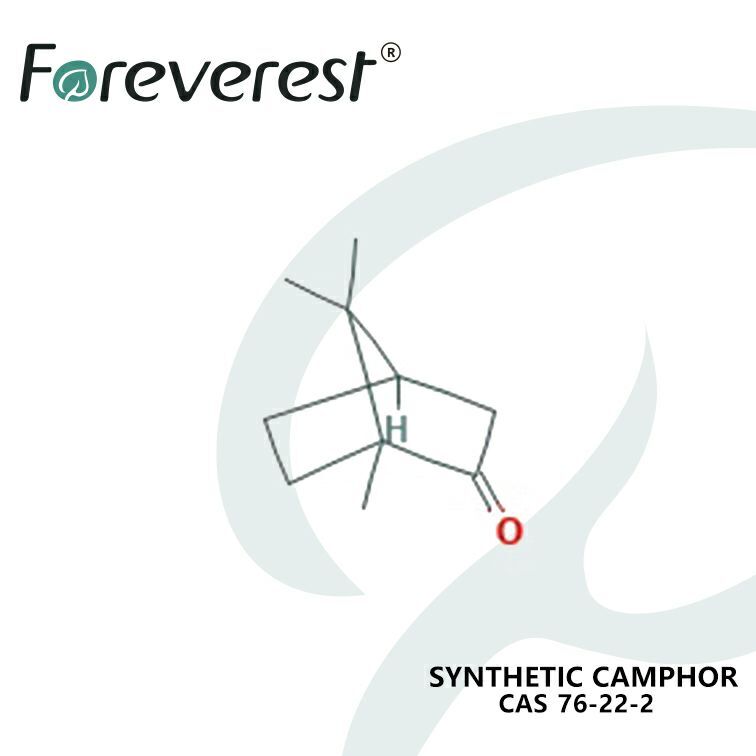
Synthetic Camphor
This product is applicable to the British Pharmacopoeia (BP) Standard.
Substance Identification
| Synonyms | 2-Campone | 1,7,7-Trimethylbicyclo [2.2.1] heptan-2-one |
| CAS | 76-22-2 |
| EINECS | 200-945-0 |
| FEMA | 2230 |
| HS.CODE | 290619 |
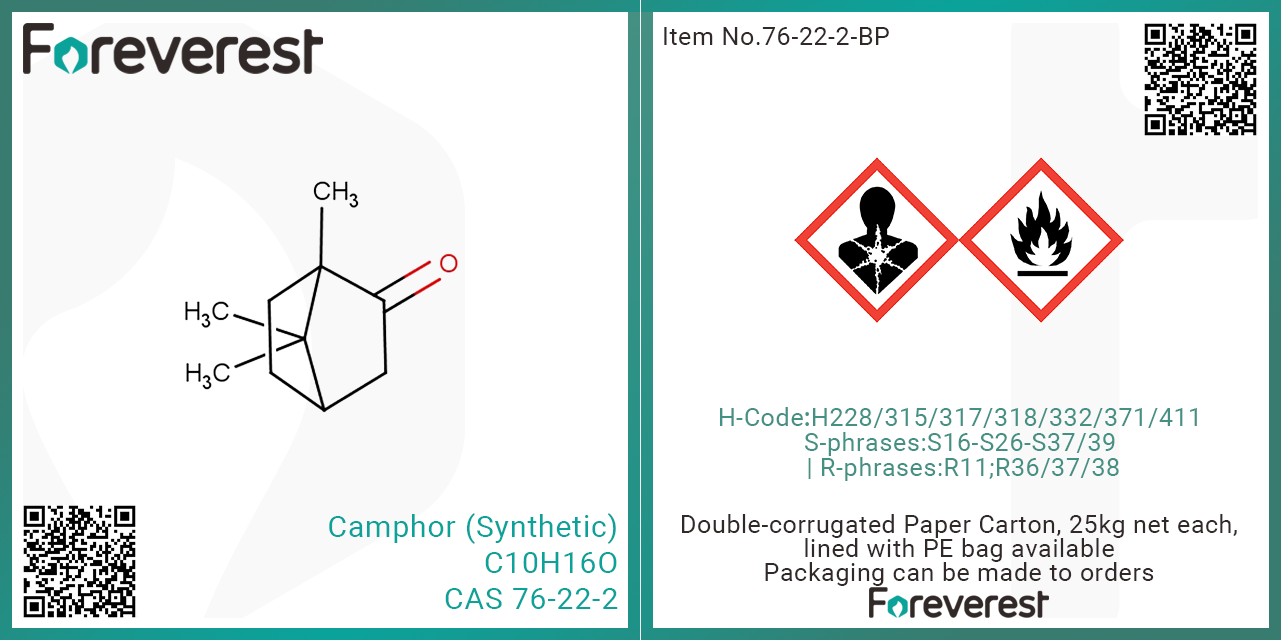
| Molecular Formula | C10H16O |
| Molecular Weight | 152.24 |
Toxicological Information
| LD50 oral, rat | 5g/kg min |
| LD50 dermal, rabbit | 5g/kg min |
Application & Uses
- Used as pharmaceutical raw material in balm
- Medical oil and inhalant for pain relieving
- As pharmaceutical raw material for Sodiam Camphorsulfonate
Sales Specification
| ITEM | VALUE | TEST METHOD & UNIT |
|---|---|---|
| Appearance | White powder crystals | |
| Content of Halogens | 100 max | PPM |
| Melting Point | 170 to 180 | °C |
| Purity, GC | 96 min | % |
| Optical Rotation | -0.15 to +0.15 | ° |
| Non-volatile Matter | 0.05 max | % |
| Related Substance, Single | 2.0 max | % |
| Related Substance, Total | 4.0 max | % |
Q&A
A formulator is sourcing camphor for a topical analgesic balm. Which BP specification parameters actually matter for the finished product?
The BP monograph for racemic camphor adds several controls beyond typical technical grades that are directly relevant to a leave‑on analgesic balm: a tight optical rotation window (about −0.15° to +0.15° in ethanol) to confirm a true racemate, a halogen limit of not more than 100 ppm, and defined limits on related substances, usually around 2.0% maximum for any single impurity and 4.0% total (British Pharmacopoeia Commission, 2023, British Pharmacopoeia). Optical rotation is important because drift away from the racemic range often indicates enrichment of one enantiomer or the presence of chiral by‑products from the α‑pinene–borneol–camphor route, which can change odour character and potentially alter irritancy or efficacy of the finished balm (Craven, 2005, Nature Reviews Neuroscience). The halogen limit is particularly relevant for products that remain on the skin, as prolonged contact increases the likelihood of sensitisation; since camphor itself is already a potential skin sensitiser, keeping halogenated residues very low helps avoid “stacking” additional sensitising impurities in a formulation that may be used repeatedly on compromised skin (Flinn Scientific, 2020, Camphor Safety Data Sheet). Finally, the related‑substances limits support batch‑to‑batch consistency in both safety and perception: the TRP‑channel modulation (TRPV1 activation and TRPA1 inhibition) that underlies camphor’s counterirritant effect is concentration‑dependent, so keeping structurally related impurities within a narrow window helps ensure a predictable cooling–warming profile from one batch of balm to the next (Moran et al., 2005, Journal of Neuroscience; Craven, 2005, Nature Reviews Neuroscience; Modulation of TRP channels by plant‑derived compounds, 2023, Frontiers in Pharmacology).
A formulator is developing a camphor‑based medical inhalant and needs consistent vapour delivery batch to batch. Which BP‑grade specification items are most relevant to that goal?
For an inhalant where vapour delivery drives the therapeutic effect, three BP‑grade controls are especially important: the GC assay (typically not less than about 95–96% camphor), the limits on related substances, and the tight optical rotation window confirming racemic composition (British Pharmacopoeia Commission, 2023, British Pharmacopoeia). The BP description of racemic camphor as "highly volatile even at room temperature" reflects its readiness to sublime; keeping the camphor content at or above the specified GC minimum and capping total impurities (for example, around 2.0% max for any single impurity and 4.0% total) helps ensure that the vapour phase is dominated by camphor rather than by more or less volatile by‑products, stabilising the headspace concentration that drives TRPV1 activation and TRPA1 modulation in the nasal mucosa (Moran et al., 2005, Journal of Neuroscience; Stinson et al., 2023, Respiratory Research). The related‑substances limits also restrict levels of borneol, camphene and other turpentine‑derived impurities that have different vapour pressures and can introduce harsh or resinous off‑notes, which is critical for a product that must be acceptable when inhaled repeatedly. Finally, the optical rotation range of about −0.15° to +0.15° in ethanol confirms a true racemate; although the two camphor enantiomers have broadly similar odour thresholds, maintaining a consistent enantiomeric composition protects both regulatory compliance and batch‑to‑batch consistency of the characteristic camphor odour and vapour profile (Brookes et al., 2008, Chemical Senses; Poucher et al., 1999, Journal of Essential Oil Research).
Similar Specs
GHS Hazard Statements
| H-Code | H228/332/315/317/318/371/411 |
| P-Code | P210/240/241/260/264/270/271/272/273/280 |
| Response | P302+P352 P304+P340+P312 P305+P351+P338+P310 P308+P311 P333+P313 P362 P370+P378 P391 |
| Storage | P405 |
| Disposal | P501 |
| UN Number | UN 2717 4.1/PG III |
Storage
- avoid all possible sources of ignition (spark or flame)
- do not store above 23°C (73.4°F)
- keep container in a cool, well-ventilated area
- keep container tightly closed and sealed until ready for use
Relation Products
Remark
The above information is believed to be accurate and represents the best explanation currently available to us. However, no liability is assumed for any consequences arising from the use of this content. The technical standards for our products are developed and updated jointly by our customers and ourselves; where any changes occur, the latest specification shall prevail and will be confirmed in the relevant contract.All suggestions and data provided are based on information we consider to be reliable and are offered in good faith, but without any guarantee, as the conditions and methods of use of our products are beyond our control. Foreverest® makes no warranties, whether express or implied, regarding the accuracy, completeness or suitability of this information, and expressly disclaims any implied warranty of fitness for a particular purpose. Prospective users should conduct their own tests and evaluations to determine the suitability of Foreverest® materials and any recommendations for their intended applications before adoption, and, where appropriate, should obtain confirmation or approval from the relevant regulatory authorities.Any references in this page to patents or patented technologies, including descriptive material derived from patents or citations of specific patent numbers, are provided for information only. They must not be interpreted as a recommendation to use our products in a manner that could infringe any third‑party patent, nor as a grant of any licence or permission to use patents owned by Foreverest®.
Start Purchasing
-

Minimum Order Quantity
Quote required -

Lead Time
Quote required -

Available Incoterms
Quote required -

Regional Availability
Quote required