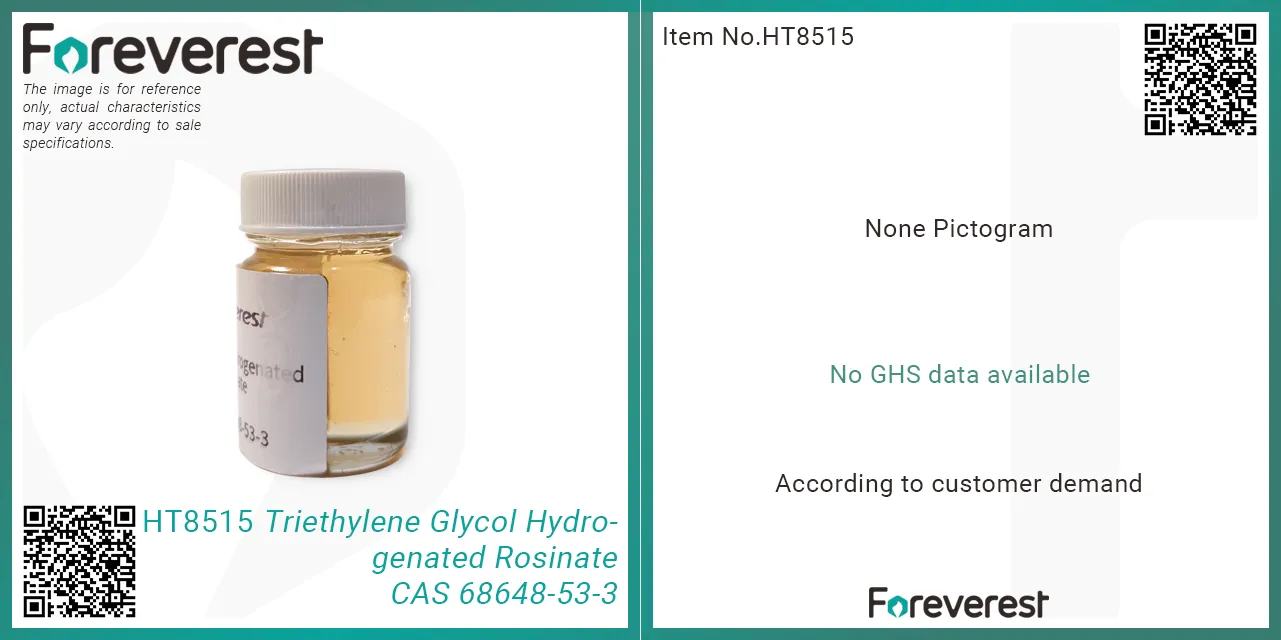
Triethylene Glycol Hydrogenated Rosinate
Triethylene Glycol Hydrogenated Rosinate is a pale, viscous, balsamic liquid with the resistance to oxidation. In general, it finds use where there is a need for a pale, non-oxidizing, color-stable, highly tacky liquid resin. It is widely used in personal care, such as the component in depilatory waxes and other personal care preparations.
| Substance Name | |
| EN: | Resin acids and Rosin acids, hydrogenated, esters with triethylene glycol |
| DE: | Harzsäuren und Kolophoniumsäuren, hydriert, Ester mit Triethylenglykol |
| ES: | ácidos resínicos y ácidos de colofonia, hidrogenados, ésteres con trietilenglicol |
| FR: | acides résiniques et acides colophaniques hydrogénés, esters avec le triéthylèneglycol |
Substance Identification
| Synonyms | Staybelite Ester | Triethylenglykol | Triglykol |
| CAS | 68648-53-3 |
| EINECS | 271-996-4 |
| FEMA | N/A |
| HS.CODE | 3806 |
| Molecular Formula | N/A |
| Molecular Weight | N/A |
Application & Uses
- used in cosmetics as viscosity controlling agents
- used in personal care product, such as the component in depilatory waxes
Sales Specification
| ITEM | VALUE | TEST METHOD & UNIT |
|---|---|---|
| Appearance | A pale, viscous, liquid | |
| Acid Value | 15 | mgKOH/g |
| Colour | 8 max | |
| Viscosity | 75 to 95 | @100°C, mPa.s |
Q&A
What practical advantages does a liquid rosin ester such as triethylene glycol hydrogenated rosinate offer as a tackifier in depilatory wax formulations compared with solid rosin esters or petroleum-derived resins?
Depilatory wax must grip hair strongly yet stay spreadable at a manageable temperature, and a room‑temperature liquid rosin ester simplifies this balance by providing tack in a viscous liquid form instead of requiring a solid resin to be fully melted before use. Triethylene glycol hydrogenated rosinate is a pale, highly tacky, oxidation‑resistant liquid, so formulators can design waxes that soften and flow under gentle warming rather than full hot‑melt conditions, which helps reduce the risk of overheating in salon or home heaters. Its hydrogenated rosin backbone and controlled colour (for example, Gardner up to about 8) limit yellowing and darkening over repeated heating cycles, helping lighter wax systems maintain a consistent appearance. Because it also acts as a plasticizing film former, it supports cohesive, flexible wax films that peel off in one piece with good hair adhesion, reducing the likelihood of brittle, fragmenting residues that can occur when relying solely on harder solid rosin esters or hydrocarbon tackifiers.
How can triethylene glycol hydrogenated rosinate help formulators reduce reliance on synthetic polymer film formers in rinse-off cosmetics under the EU microplastics restriction, and which chemical features make it relevant for this shift?
Regulation (EU) 2023/2055 restricts intentionally added synthetic polymer microparticles (“microplastics”) in cosmetics, with a phase‑out date in October 2027 for rinse‑off products, which pushes formulators to look for non‑microplastic ways to achieve film‑forming and texturising effects that were often provided by acrylate copolymers and other synthetic polymers. Triethylene glycol hydrogenated rosinate is a pine‑derived rosin ester described in cosmetic ingredient references as a viscous liquid that acts as an emollient, film former, plasticiser and viscosity modifier, so it can cover several of the functional roles that synthetic film‑forming polymers currently play in rinse‑off masks, scrubs or cleansing products. Its hydrogenated rosin backbone improves oxidation and colour stability relative to non‑hydrogenated rosin esters, helping rinse‑off formulations keep a consistent appearance over shelf life and through repeated warm‑use cycles, while its liquid state at room temperature allows cold‑process incorporation into emulsions and surfactant systems without dedicated polymer neutralisation or heating steps. From a regulatory perspective, being a rosin‑derived ester rather than a synthetic crosslinked polymer means it is not automatically classified as a “synthetic polymer microparticle,” but formulators still need to verify its status against the detailed definitions and exemptions in Regulation (EU) 2023/2055, especially regarding physical form and degradability. Development work in this direction would normally include comparative tests on substantivity (for example, how much film remains after rinsing versus a benchmark acrylate copolymer), foam and rheology behaviour, and consumer sensory assessments, to confirm that a hydrogenated rosin ester film can deliver the desired protective or texturising effect while helping the brand meet its microplastics compliance strategy.
GHS Hazard Statements
| Not classified |
Storage
- avoid contact with light
- keep separated from incompatible substances
- store and handle in accordance with all current regulations and standards
- store in a cool, dry place
- store in a tightly closed container
Relation Products
Relation Articles
- Methyl Hydrogenated Rosinate for Personal Care and Cosmetics
- Beverage Ingredient Glossary
- Frequently asked questions about new transparent tackifiers Hydrogenated terpene/polyterpene resins
- Progress on the patents about the modifications of gum rosin and their applications
- TACKIFIERS: MARKET EVOLVES WITH DEMAND FOR ADHESIVES SEALANTS AND LABELS
- Choosing the Correct Soldering Flux Types and Their Advantages/Disadvantages
Remark
The above information is believed to be accurate and represents the best explanation currently available to us. However, no liability is assumed for any consequences arising from the use of this content. The technical standards for our products are developed and updated jointly by our customers and ourselves; where any changes occur, the latest specification shall prevail and will be confirmed in the relevant contract.All suggestions and data provided are based on information we consider to be reliable and are offered in good faith, but without any guarantee, as the conditions and methods of use of our products are beyond our control. Foreverest® makes no warranties, whether express or implied, regarding the accuracy, completeness or suitability of this information, and expressly disclaims any implied warranty of fitness for a particular purpose. Prospective users should conduct their own tests and evaluations to determine the suitability of Foreverest® materials and any recommendations for their intended applications before adoption, and, where appropriate, should obtain confirmation or approval from the relevant regulatory authorities.Any references in this page to patents or patented technologies, including descriptive material derived from patents or citations of specific patent numbers, are provided for information only. They must not be interpreted as a recommendation to use our products in a manner that could infringe any third‑party patent, nor as a grant of any licence or permission to use patents owned by Foreverest®.
Start Purchasing
-

Minimum Order Quantity
Quote required -

Lead Time
Quote required -

Available Incoterms
Quote required -

Regional Availability
Quote required