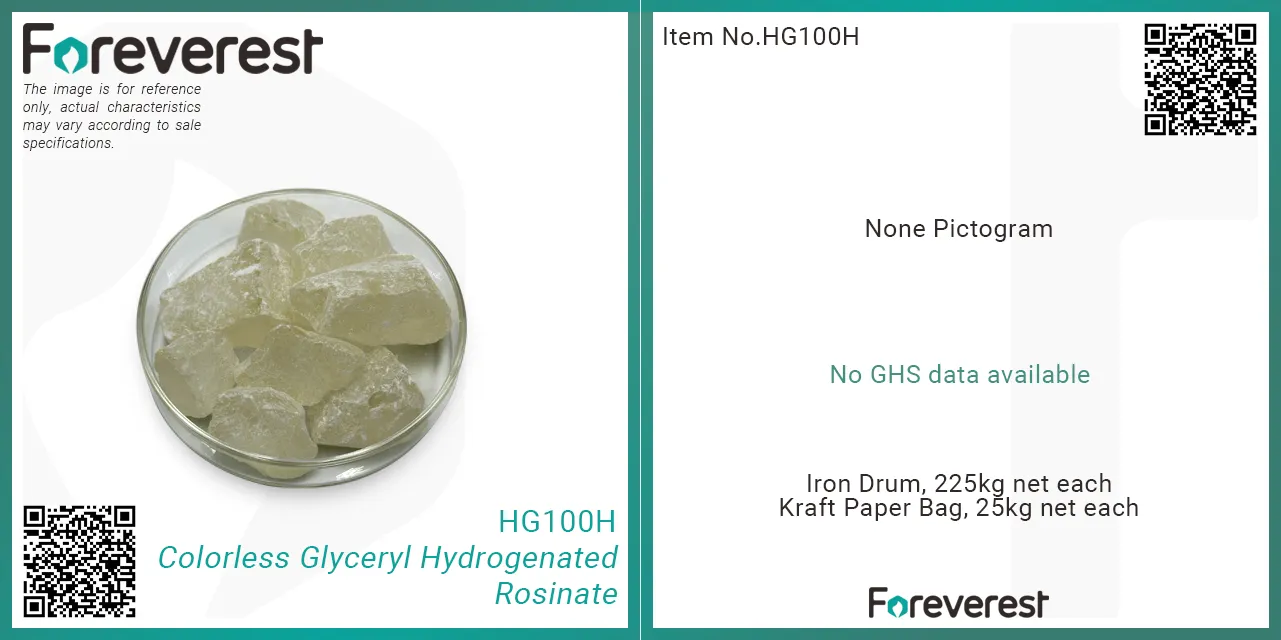
Colorless Glyceryl Hydrogenated Rosinate
Glyceryl Hydrogenated Rosinate HG100D is a kind of super light color tackifying polyols resin, which is esterified from refined hydrogenated rosin and edible glycerol, and through series combined technologies units of catalytic hydrogenation. With benefits of light color, low odor, good heat stability and excellent ageing resistance, Glyceryl Hydrogenated Rosinate is mainly used in screen protection film, medicinal patch, diaper adhesive, PSA and HMA.
Substance Identification
| Synonyms | Colorless Glyceryl Ester of Rosin | CGEHR |
| CAS | 65997-13-9 |
| EINECS | 266-042-9 |
| FEMA | N/A |
| HS.CODE | 3806.90 |
| Molecular Formula | N/A |
| Molecular Weight | N/A |
Application & Uses
- Tackifier for screen protection film
- Tackifier for medicinal patch
- Tackifier for diaper adhesives
- Tackifier for PSA and HMA
Features & Benefits
- Light Color
- Low Odor
- Good Heat Stability
- Excellent Ageing Resistance
Sales Specification
| ITEM | VALUE | TEST METHOD & UNIT |
|---|---|---|
| Solubility | Clear | with toluene 1:1 |
| Color | 200 max | @Hazen Unit |
| Acid Value | 2 to 10 | mg/g |
| Softening Point | 95 to 105 | @R&B, °C |
| Iodine Value | 15 max | gI2/100g |
| ITEM | VALUE | TEST METHOD & UNIT |
|---|---|---|
| Solubility | Clear | with toluene 1:1 |
| Color | 150 max | @Hazen Unit |
| Acid Value | 2 to 10 | mg/g |
| Softening Point | 90 to 100 | @R&B, °C |
| Iodine Value | 15 max | gI2/100g |
Q&A
In screen protection film adhesives, how do a ring‑and‑ball softening point of about 95-105 °C and a Hazen colour around 200 influence performance?
Screen protection films are typically made by coating a pressure‑sensitive adhesive onto optical‑grade PET, drying it, then slitting and rewinding the rolls, so the tackifier’s ring‑and‑ball softening point needs to be well above typical storage and handling temperatures to prevent blocking and adhesive transfer in the roll. A glyceryl hydrogenated rosinate with a 95-105 °C softening point keeps the adhesive layer sufficiently firm at 35-50 °C warehouse and converting conditions, helping the rolls run cleanly through slitting and rewinding without sticking to the release liner or telescoping, while still allowing good wet‑out on the glass or PET screen surface. At the same time, a Hazen colour around 200 keeps the resin close to water‑clear, so the adhesive layer does not introduce a visible yellow cast when the film is viewed over bright display backgrounds or under strong retail lighting, which would be noticeable with higher‑colour rosin esters. This combination of high softening point and low colour in a single glyceryl hydrogenated rosinate grade therefore supports both roll‑handling safety and optical neutrality in screen protection film adhesives.
What does an iodine value of 15 max reveal about the hydrogenation depth of a glyceryl hydrogenated rosinate, and how does this benefit UV-curable adhesive formulations?
Iodine value is a standard measure of residual unsaturation, so a maximum of 15 g of iodine per 100 g shows that the glyceryl hydrogenated rosinate has been hydrogenated to a very low double‑bond content compared with conventional rosin esters. With so few conjugated double bonds, the resin contributes much less absorption in the near‑UV region where most free‑radical photoinitiators work, which helps a UV‑curable acrylic PSA maintain good light transmission through the adhesive layer instead of losing part of the incident UV dose in the tackifier. This makes it easier to achieve reliable through‑cure in thicker films or highly filled systems, because less UV is diverted into side reactions on the tackifier backbone. A low iodine value also correlates with improved oxidative and colour stability, since the remaining saturated structures are less prone to radical‑initiated oxidation and yellowing over time, which supports long‑term clarity requirements in electronics, optical and medical UV‑curable adhesives. For developers, specifying an iodine value around 15 therefore gives a practical proxy for both high hydrogenation depth and better ageing behaviour of the tackifier, without having to run full UV‑vis and accelerated ageing tests on every batch.
How does an acid value of 2 to 10 mg KOH/g in a colorless glyceryl hydrogenated rosinate contribute to the safety profile of tackifiers used in medicinal and transdermal patches?
Resin acids are considered the main allergens in colophony, and any residual free rosin in glyceryl rosinate-type tackifiers is recognised as a potential source of allergic reactions in sensitive individuals (Karlberg et al., 1980, Contact Dermatitis; Hausen et al., 1989, Contact Dermatitis). An acid value of 2-10 mg KOH/g in a colorless glyceryl hydrogenated rosinate indicates a high degree of esterification and therefore a relatively low level of free resin acids compared with conventional rosin esters, which aligns with safety assessments noting that glyceryl hydrogenated rosinate is generally not sensitising in patch tests, apart from effects attributable to residual rosin (CIR, 2004, Final Report on the Safety Assessment of Glyceryl Monoesters). For medicinal and transdermal patches that remain on the skin for many hours or days, starting from a tackifier with low acid value helps reduce the baseline load of potentially irritating or sensitising free acids at the adhesive-skin interface, and supports a wider safety margin when the full formulation is evaluated in human patch tests. Lower free acid levels also tend to improve the hydrolytic and colour stability of the ester during storage, because there are fewer acidic sites that can catalyse ester cleavage and promote oxidative yellowing, which is important where clarity and consistent adhesion are critical. Even so, overall sensitisation risk depends on the complete adhesive system and patient population, so formulators still need to confirm compatibility via appropriate in‑vitro and in‑vivo tests, using the low‑acid tackifier as one contribution to an improved safety profile rather than a guarantee on its own.
When should a hygiene adhesive formulator choose a high-softening-point rosin ester over a conventional grade for disposable diaper adhesives?
Disposable diaper construction and positioning adhesives are typically SIS or SBS-based hot melts that must stay tacky and flexible at body temperature, yet resist blocking when finished products are compressed, palletised and shipped through warm-climate distribution chains. Switching from a conventional rosin ester with a 75-85 °C ring-and-ball softening point to a high-softening-point grade in the 95-105 °C range raises the overall softening behaviour of the adhesive and shifts the onset of blocking to higher temperatures, which can mean the difference between clean release from the release liner and fibre-tearing failures after weeks in a hot warehouse. This becomes especially important when scaling a formulation from temperate-climate trials to global distribution, or when moving from a positioning adhesive that can tolerate some blocking to a full construction adhesive, where blocking can de-laminate the diaper chassis during high-speed conversion. In addition to improved blocking resistance, the higher softening point can broaden the processing window by supporting higher line speeds with reduced risk of stringing or misting at a given application temperature, provided the viscosity profile is adjusted appropriately. The main trade-off for the formulator is the higher melt temperature required for a 95-105 °C resin and the associated risk of thermal stress on the SBC polymer, which typically needs to be managed through stabiliser packages, controlled residence time and careful temperature profiling.
Could a colorless glyceryl hydrogenated rosinate listed in the EU CosIng database as a film-forming agent be used in colour cosmetics such as lipstick and mascara?
Glyceryl Hydrogenated Rosinate (CAS 65997‑13‑9) is listed in the EU CosIng database with functions including film forming and adhesive, and is used as a cosmetic ingredient in various markets, subject to the general safety requirements of EU Regulation 1223/2009 rather than any specific Annex restriction. A low‑colour grade controlled around Hazen 200 helps the resin remain nearly neutral in tone, so it does not shift the target shade of pigmented systems such as lipsticks and mascaras, while an acid value in the range of about 2–10 mg KOH/g indicates low levels of free resin acids, which aligns with safety assessments reporting low irritation and sensitisation potential for glyceryl hydrogenated rosinate apart from reactions due to residual rosin (CIR, 2004, Final Report on the Safety Assessment of Glyceryl Monoesters). Deep hydrogenation, typically reflected in a low iodine value, also improves oxidative and colour stability of the resin, helping the finished cosmetic resist darkening and shade drift over shelf life under light and air exposure. In practice, this means a colourless glyceryl hydrogenated rosinate can be a technically suitable film former and binder in colour cosmetics, provided the finished product meets all applicable cosmetic safety and purity requirements and the specific grade is supported by supplier documentation such as impurity profiles, allergen information and toxicological data.
Similar Specs
GHS Hazard Statements
| Not classified |
Storage
- avoid contact with light
- keep separated from incompatible substances
- store and handle in accordance with all current regulations and standards
- store in a cool, dry place
- store in a tightly closed container
Relation Products
Remark
The above information is believed to be accurate and represents the best explanation currently available to us. However, no liability is assumed for any consequences arising from the use of this content. The technical standards for our products are developed and updated jointly by our customers and ourselves; where any changes occur, the latest specification shall prevail and will be confirmed in the relevant contract.All suggestions and data provided are based on information we consider to be reliable and are offered in good faith, but without any guarantee, as the conditions and methods of use of our products are beyond our control. Foreverest® makes no warranties, whether express or implied, regarding the accuracy, completeness or suitability of this information, and expressly disclaims any implied warranty of fitness for a particular purpose. Prospective users should conduct their own tests and evaluations to determine the suitability of Foreverest® materials and any recommendations for their intended applications before adoption, and, where appropriate, should obtain confirmation or approval from the relevant regulatory authorities.Any references in this page to patents or patented technologies, including descriptive material derived from patents or citations of specific patent numbers, are provided for information only. They must not be interpreted as a recommendation to use our products in a manner that could infringe any third‑party patent, nor as a grant of any licence or permission to use patents owned by Foreverest®.
Start Purchasing
-

Minimum Order Quantity
Quote required -
Lead Time
Quote required -
Available Incoterms
Quote required -
Regional Availability
Quote required