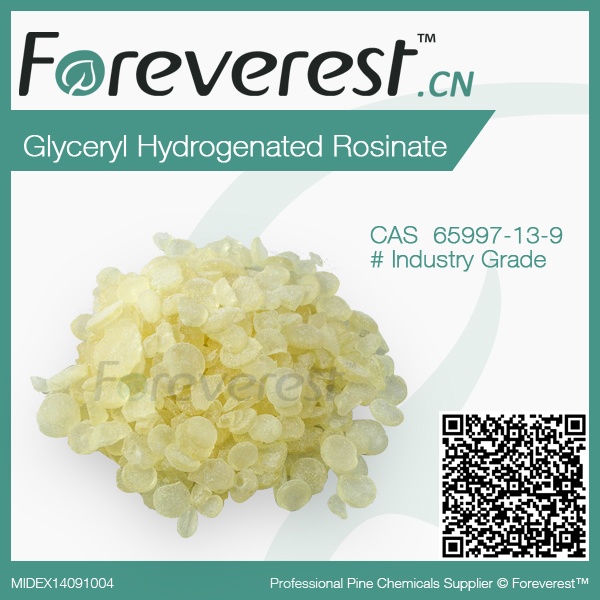
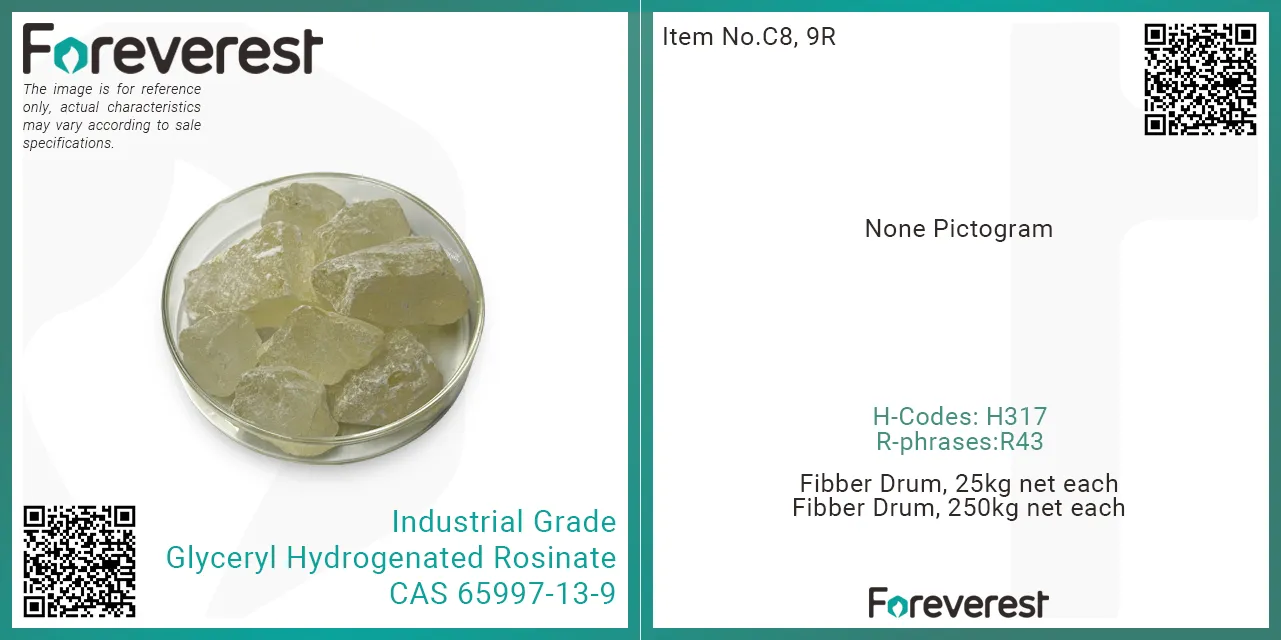
Glyceryl Hydrogenated Rosinate (Industrial)
Glyceryl Hydrogenated Rosinate, also called Glycerol Ester of Hydrogenated Rosin (GEHR) and Ester Of Hydrogenated Rosin, is esterified from refined hydrogenated rosin and edible glycerol.
Substance Identification
| Synonyms | Glycerol Ester of Hydrogenated Rosin | GEHR | Ester Of Hydrogenated Rosin | C8/9R |
| CAS | 65997-13-9 |
| EINECS | 266-042-9 |
| FEMA | N/A |
| HS.CODE | 3806.90 |
| Molecular Formula | C3H8O3·W99 |
| Molecular Weight | 945.41 |
Application & Uses
- Optical resins
- Optically clear coatings
- Personal cares
- Specialty adhesives for applications in the electronics industry, electrical engineering, medical technology and optics
- Disposable diapers
Features & Benefits
- Excellent resistance to oxidation and discoloration
- Exceptional cutaneous tolerance
- Light color
- Low odor
- Medium softening point
- Thermoplastic hydrogenated resin
- Wide solubility and compatibility range
Sales Specification
| ITEM | VALUE | TEST METHOD & UNIT |
|---|---|---|
| Acid Value | 9 max | mgKOH/g |
| Ash Content | 0.1 max | % |
| Colour | 8 max | @Gardner |
| Softening Point | 78 to 88 | @R&B, °C |
| Specific Gravity | 1.060 to 1.070 | @25°C |
| ITEM | VALUE | TEST METHOD & UNIT |
|---|---|---|
| Acid Value | 9 max | mgKOH/g |
| Ash Content | 0.1 max | % |
| Colour | 3 max | @Gardner |
| Softening Point | 78 to 88 | @R&B, °C |
| Specific Gravity | 1.060 to 1.070 | @25°C |
Q&A
Can a hydrogenated glyceryl rosinate with a Gardner 3 colour specification function effectively as a tackifier in UV-curable pressure-sensitive adhesives for optical display lamination?
A Gardner 3 hydrogenated glyceryl rosinate grade such as HG853 is sufficiently light in colour that, at typical tackifier loadings, it does not impart a visible yellow or amber tint to optically clear pressure-sensitive adhesive layers used in display lamination. Because the rosin backbone has been hydrogenated, the resin contains far fewer conjugated double bonds than a conventional ester gum, which reduces its absorbance in the near-UV region and helps minimise competition with photoinitiators for incident UV light during curing. Its medium ring-and-ball softening point in the 78-88 °C range places the resin in a viscosity window that allows good wetting and flow on smooth glass or film substrates without requiring excessively high coating temperatures that could stress sensitive optical components. Hydrogenation also improves resistance to oxidative yellowing and colour drift, so the adhesive is better able to maintain its initial clarity and tack profile over the service life of the display when exposed to heat and ambient light. Taken together, this combination of light colour, reduced UV absorbance, suitable softening point and good ageing stability makes a Gardner 3 hydrogenated glyceryl rosinate a practical tackifier option for UV-curable PSAs where both cure efficiency and long-term optical clarity are critical.
How does the 78-88°C ring-and-ball softening point of an industrial-grade hydrogenated glyceryl rosinate benefit the formulation of optically clear protective coatings for precision optical components?
A ring-and-ball softening point between 78 and 88 °C positions an industrial-grade hydrogenated glyceryl rosinate in a “low‑stress” processing window, so clear coatings can be applied at relatively mild temperatures that are less likely to warp thin lenses, disturb interference coatings, or induce residual stress in polymer optics. At the same time, its thermoplastic character and good solvency in standard organic coating vehicles make it an effective co-resin for building film cohesion and chip resistance in optically clear formulations, without forcing the viscosity so high that flow and levelling suffer or haze begins to appear. Selective hydrogenation of the rosin backbone removes most of the conjugated double bonds found in conventional rosin esters, so the coating matrix contains fewer sites that initiate light-driven oxidation and colour formation, which in turn helps the coated component retain its original transmission and neutral tint under prolonged exposure to light and heat. In practice, this combination of gentle application temperature, film-building capability and resistance to oxidative discolouration makes the resin well suited to protective clear coats where the allowable thermal budget is tight and even slight yellowing would put precision optical parts out of specification.
How does the 78-88 °C softening point and Gardner 3 colour specification of a hydrogenated glyceryl rosinate position it relative to the two common benchmark positions in the market — one near 71–77 °C and one near 95–105 °C — when selecting tackifiers for pressure-sensitive adhesive systems?
A softening point of 78-88 °C places this hydrogenated glyceryl rosinate between the established low-softening (~71-77 °C) and high-softening (~95-105 °C) hydrogenated rosin ester benchmarks, giving formulators a mid-range option that increases cohesive strength and shear resistance compared to the softer grade while avoiding the brittleness and higher coating temperatures associated with the harder grade. In acrylic and SBC-based pressure-sensitive adhesives, this intermediate stiffness helps deliver holding power for electronics tapes and high-shear labels, yet maintains enough flexibility for laminating onto thin or curved films without visible edge lift or crack formation. A Gardner 3 colour specification matches the lightest benchmark resins, so the tackifier can be used in clear PSAs for display lamination and transparent specialty tapes without noticeable yellowing at typical loadings. An acid value limit around 9 mg KOH/g keeps residual acidity in the same low range as current market references, supporting reliable compatibility with acrylic and UV-curable PSA systems where excessive acid can interfere with cure kinetics or storage stability. Together, this medium softening point, very light colour and low acid value allow the grade to fill a formulation gap where neither the softer nor the harder benchmark alone provides the required balance of tack, shear strength, optical clarity and processing temperature window.
Why is a hydrogenated glyceryl rosinate with documented cutaneous tolerance and light colour well suited to specialty adhesive formulations used in medical devices that incorporate optical sensing or imaging components?
Medical devices that combine skin-contact pressure-sensitive adhesives with optical sensing, such as pulse oximeter patches, optical biosensor wearables or in vitro diagnostic windows, need tackifiers that support both skin compatibility and high optical transmission through the adhesive layer. A hydrogenated glyceryl rosinate grade described as having “exceptional cutaneous tolerance” and low residual acid value, based on safety assessments of glyceryl monoesters and hydrogenated rosinate derivatives, provides a tackifier option that helps limit additional skin-irritation load while still delivering the adhesion needed to keep the device in place over the intended wear period (CIR, 2004, Int. J. Toxicol.). Its light initial colour at approximately Gardner 3 ensures that, at typical tackifier loadings, the adhesive does not introduce a noticeable yellow tint that could interfere with optical paths between the skin and sensors or degrade signal-to-noise ratios in optical measurements. A medium softening point in the 78-88 °C range allows the resin to be processed at temperatures compatible with thermally sensitive medical-grade films and electronics, while the improved oxidation resistance of the hydrogenated rosin backbone supports retention of clarity and tack under exposure to body temperature, ambient light and repeated UV disinfection cycles.
GHS Hazard Statements
| Not classified |
Storage
- avoid contact with light
- keep separated from incompatible substances
- store and handle in accordance with all current regulations and standards
- store in a cool, dry place
- store in a tightly closed container
Relation Products
Remark
The above information is believed to be accurate and represents the best explanation currently available to us. However, no liability is assumed for any consequences arising from the use of this content. The technical standards for our products are developed and updated jointly by our customers and ourselves; where any changes occur, the latest specification shall prevail and will be confirmed in the relevant contract.All suggestions and data provided are based on information we consider to be reliable and are offered in good faith, but without any guarantee, as the conditions and methods of use of our products are beyond our control. Foreverest® makes no warranties, whether express or implied, regarding the accuracy, completeness or suitability of this information, and expressly disclaims any implied warranty of fitness for a particular purpose. Prospective users should conduct their own tests and evaluations to determine the suitability of Foreverest® materials and any recommendations for their intended applications before adoption, and, where appropriate, should obtain confirmation or approval from the relevant regulatory authorities.Any references in this page to patents or patented technologies, including descriptive material derived from patents or citations of specific patent numbers, are provided for information only. They must not be interpreted as a recommendation to use our products in a manner that could infringe any third‑party patent, nor as a grant of any licence or permission to use patents owned by Foreverest®.
Start Purchasing
-

Minimum Order Quantity
Quote required -
Lead Time
Quote required -
Available Incoterms
Quote required -
Regional Availability
Quote required