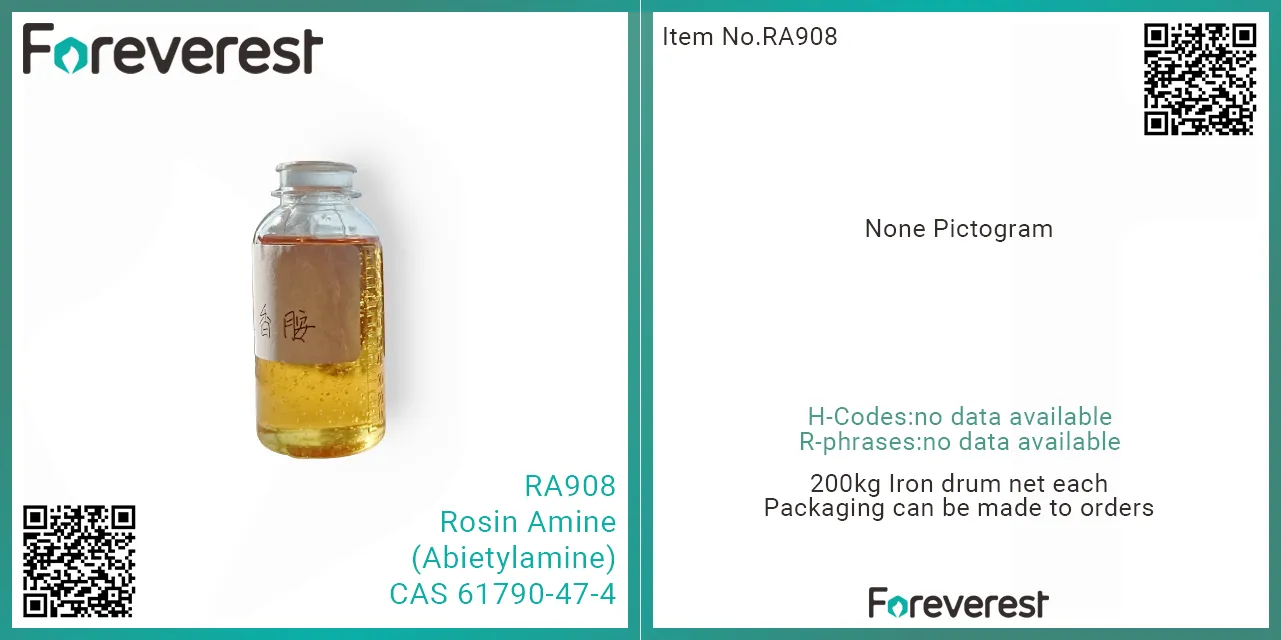
Rosin Amine (Abietylamine)
Rosin amine is an ammonia derivative of rosin. It is a viscous yellow transparent liquid with ammonia and pine flavor. It retains the basic structure of rosin, with additional amine groups attached.
Rosin amine is soluble in conventional solvents, while insoluble in cold water, partly soluble in hot water. Rosin amine is mainly composed of dehydroabietylamine. It has extensive applications in the industry.
Substance Identification
| Synonyms | Amines | Rosin Alkyl | Dehydroabietylamine |
| CAS | 61790-47-4 |
| EINECS | 263-139-8 |
| FEMA | N/A |
| HS.CODE | 38062010 |
| Molecular Formula | C20H33N |
| Molecular Weight | 287.48 |
Application & Uses
- used as additive for electronic solder pastes
- used as detergent for water treatment
- used as water-dispersible derivative for industrial treatment formulations
- used as dispersing agent of optics
- used as flotation
- used as intermediate for inks and medicine
- used as ingredient of lubricants
- used as abietylamine acetate for killing algae, bacteria, mildew, mollusk and others pest.
- usded as preservative of petroleum pipeline
- useed in pigment
Features & Benefits
- Soluble in common organic solvents, such as alcohols, hydrocarbons and chlorinated solvents;
- Insoluble in cold water, but soluble in hot water slightly, about 0.5% at 100°C
- Excellent emulsification, dispersion, solubilization, corrosion inhibition, lubrication, anti-static, anti-corrosion.
Sales Specification
| ITEM | VALUE | TEST METHOD & UNIT |
|---|---|---|
| Appearance | Yellow transparent viscous liquid with a faint ammoniacal ordor | |
| Color | 8 max | @Gardner |
| Content of total amine | 90 min | @Neutralization titration, % |
| Refractive Index | 1.535 to 1.545 | @n20/D |
Q&A
Why is rosin amine used as a corrosion inhibitor additive in electronic solder pastes?
Rosin amine is used in electronic solder pastes mainly as a corrosion-inhibiting additive in the flux system. At low addition levels, it can help protect copper surfaces from oxidation during the soldering cycle while still allowing the flux to remove surface oxides for wetting. Its rosin-derived backbone makes it compatible with rosin-based or resin-containing flux systems, and related rosin amine polyoxyethylene ethers have also been reported as effective corrosion inhibitors in halogen-free formulations. In practice, its value is less about replacing the entire flux chemistry and more about supporting surface protection and residue reliability in no-clean or low-residue solder systems.
How does rosin amine function as a film-forming corrosion inhibitor in petroleum pipeline and industrial water treatment systems?
Rosin amine is used as a film-forming corrosion inhibitor in petroleum pipeline and industrial water treatment systems because its amine functionality can adsorb onto metal surfaces and help build a hydrophobic protective film. In oilfield and pipeline service, that film helps reduce contact between steel, water, oxygen and acidic species, while in aqueous treatment programmes the amine is often used in water-dispersible or salt form to improve handling and dispersion. Public sources also note its use in oil field, petroleum pipeline and industrial water treatment applications, which makes it a practical option where a rosin-derived amine chemistry is acceptable. The exact delivery route and dosage, however, should be selected according to the fluid phase, water cut, temperature and flow regime of the system.
Can rosin amine be converted into a water-treatment additive for industrial water systems, and what form is most practical?
Rosin amine can be converted into a water-dispersible acetate salt, which is the more practical form for aqueous industrial water-treatment programs. In that form, it is mainly used as a corrosion-inhibiting and disinfection-oriented additive rather than as a stand-alone replacement for conventional biocides. The 90% minimum total amine content of RA908 provides a practical active-matter level for downstream acetate preparation while keeping the feedstock in a commercially practical grade. For industrial cooling water or similar systems, the acetate form is generally easier to dose and disperse, while the free amine is more relevant when the chemistry is handled in an organic phase or used as an intermediate.
Similar Specs
GHS Hazard Statements
| H-Code | H302/H315/H317/H318/H400/H410 |
| P-Code | P264/270/280/261/272/273 |
| Response | P301+P312 P330 P302+P352 P332+P313 P333+P313 P362+P364 P305+P351+P338 P310 P391 |
| Storage | P405 |
| Disposal | P501 |
| UN Number | UN 3077 9/PG 3 |
| Signal Word | Danger |
Storage
- avoid contact with light
- keep separated from incompatible substances
- store and handle in accordance with all current regulations and standards
- store in a cool, dry place
- store in a tightly closed container
Relation Products
Relation Articles
- Application of Gum Rosin
- The Species of Pine Oleoresin in China
- Application of Nonionic Surfactants based on Rosin As Corrosion Inhibitor for Tubing Steel During Acidization of Petroleum Oil and Gas Wells
- Real Bio-based Ingredients for Formulator's Toolbox
- Rosin Resins Codes Updated
- Study of Novel Rosin-Based Biomaterials for Pharmaceutical Coating
- Progress on the patents about the modifications of gum rosin and their applications
Remark
The above information is believed to be accurate and represents the best explanation currently available to us. However, no liability is assumed for any consequences arising from the use of this content. The technical standards for our products are developed and updated jointly by our customers and ourselves; where any changes occur, the latest specification shall prevail and will be confirmed in the relevant contract.All suggestions and data provided are based on information we consider to be reliable and are offered in good faith, but without any guarantee, as the conditions and methods of use of our products are beyond our control. Foreverest® makes no warranties, whether express or implied, regarding the accuracy, completeness or suitability of this information, and expressly disclaims any implied warranty of fitness for a particular purpose. Prospective users should conduct their own tests and evaluations to determine the suitability of Foreverest® materials and any recommendations for their intended applications before adoption, and, where appropriate, should obtain confirmation or approval from the relevant regulatory authorities.Any references in this page to patents or patented technologies, including descriptive material derived from patents or citations of specific patent numbers, are provided for information only. They must not be interpreted as a recommendation to use our products in a manner that could infringe any third‑party patent, nor as a grant of any licence or permission to use patents owned by Foreverest®.
Start Purchasing
-

Minimum Order Quantity
Quote required -

Lead Time
Quote required -

Available Incoterms
Quote required -

Regional Availability
Quote required