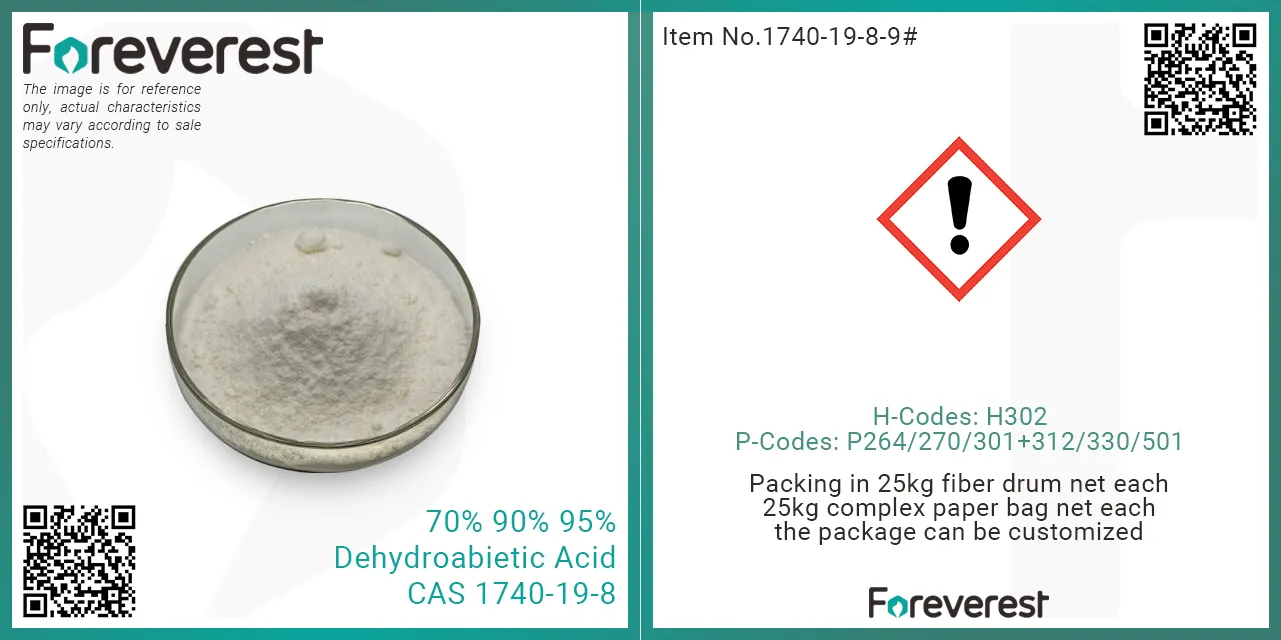
Dehydroabietic Acid
Dehydroabietic acid, a colorless needle-like crystal, is an abietane diterpenoid resin acid derived from pine resin (Pinus). Its defining feature is a distinctive tricyclic diterpene structure.
Substance Identification
| Synonyms | DAA, DHAA, Dehydroabietate |
| CAS | 1740-19-8 |
| EINECS | 217-102-8 |
| FEMA | N/A |
| HS.CODE | N/A |
| Molecular Formula | C20H28O2 |
| Molecular Weight | 300.44 |
Application & Uses
- As rosin-type nucleating agent for polypropylene (PP)
- Used commonly in the synthesis of surfactants, antioxidants and chiral catalysts.
- As intermediates in synthesis of biological compounds example for the skeleton of antipodal steroids.
- Antifungal, resist mildewing of rice caused by Pyricularia oryzae
- Antiulcer extracts, moderate antisecretory
- Dilation of blood vessels
- Activion nerve function, irritate to release the transmitter substance GABA of inhibitory nerve and excitatory substance.
Features & Benefits
- Solubility: Soluble in ethanol, benzene, chloroform, ether, acetone, carbon dioxide and dilute sodium hydroxide solution, insoluble in water.
- High optical rotation.
Sales Specification
| ITEM | VALUE | TEST METHOD & UNIT |
|---|---|---|
| Appearance | Colorless needle crystal | |
| Color | 2 max | @Gardner |
| Acid Value | 180 to 210 | mgKOH/g |
Q&A
What distinguishes the tricyclic diterpene scaffold of dehydroabietic acid from abietic acid, and why does this structural difference matter for downstream chemistry?
Dehydroabietic acid differs from abietic acid in that its C ring is fully aromatized to a benzene ring instead of containing a conjugated diene, which markedly reduces the tendency for autoxidation and degradation under typical thermal and oxidative conditions. This aromatic ring replacement makes the scaffold more robust in the presence of elevated temperatures, acidic media or oxidizing reagents, so it is better suited as a starting material for higher‑intensity structural modification routes. At the same time, the molecule retains the C‑18 carboxylic acid as a main handle for ester and amide formation, the aromatic ring as a site for electrophilic substitution, and the natural abietane framework with asymmetric centers that support the design of chiral derivatives, enabling a wide range of heterocyclic and other functionalized dehydroabietic acid derivatives reported in the literature (Hao et al., 2022, Toxins). Overall, when downstream chemistry must tolerate higher temperatures, acidic catalysts or mild oxidants, dehydroabietic acid is generally preferred over abietic acid as the parent scaffold
How do alkali dehydroabietate salts function as nucleating agents for polypropylene, and what crystallization performance improvements have been documented?
Alkali metal dehydroabietate salts act as heterogeneous nucleating agents in polypropylene by dispersing as insoluble, high‑melting particles that provide numerous surfaces on which PP chains can fold and crystals can start to grow, thus increasing the crystallization temperature and rate. Differential scanning calorimetry has shown that, at suitable loadings, Na‑dehydroabietate can raise the crystallization peak temperature of PP by about 10°C and K‑dehydroabietate by about 6°C relative to neat PP, supporting shorter molding cycles and higher heat distortion performance. Work by Dou and co‑workers reported that a 1:1:1 co‑crystal of DHA/DHAA‑K/DHAA‑Na at around 0.3 wt% reduced PP haze from roughly 36% to about 7%, markedly increased gloss and refined spherulite diameters into the sub‑micrometer range where visible‑light scattering is minimal. In addition, FTIR and WAXD analyses confirmed that DHAA‑Na can be formed in situ during melt blending with sodium stearate at typical PP processing temperatures near 220°C, demonstrating that the nucleator can be generated directly during standard compounding rather than added as a separate salt (Dou & Wang, 2009, J. Appl. Polym. Sci.).
Can dehydroabietic acid function as a plant protection fungicide beyond rice blast, and what crop disease spectrum has been validated?
Available studies indicate that dehydroabietic acid shows fungicidal activity against a broader range of plant pathogens than the single rice blast indication (Pyricularia oryzae) often cited on product information, including several fungi associated with major crop and horticultural diseases (Wei et al., 2010, Chinese Journal of Pesticide Science). In vitro and small‑scale trials have shown concentration‑dependent inhibition of mycelial growth for Botrytis cinerea, Alternaria alternata, Fusarium oxysporum and other phytopathogenic fungi, supporting its classification as a plant‑derived antifungal lead compound (Chen et al., 2025, Plant Disease). A 2022 review by Hao et al. further catalogues the agricultural bioactivity portfolio of DHA and its derivatives, extending from antifungal to insecticidal and herbicidal effects, and highlighting its role as a structural scaffold for optimizing agrochemical candidates (Hao et al., 2022, Toxins). Some DHA‑based derivatives have also been reported to modulate endocrine‑related pathways in insects, suggesting possible interactions with hormonal regulation, although their precise mechanisms and safety profiles still require detailed investigation. Overall, dehydroabietic acid is best viewed as a bio‑rational lead for integrated pest management research rather than a finished product, and any practical use as a crop protection fungicide must comply with toxicological assessment and registration requirements.
Why can dehydroabietic acid‑based PP nucleating agents offer a sustainability advantage over petroleum‑derived sorbitol clarifiers for transparent packaging?
The sustainability advantage of dehydroabietic acid‑based nucleating agents is rooted in renewable feedstock rather than superior optical performance: DMDBS and related sorbitol clarifiers are made by condensing D‑sorbitol with benzaldehyde‑type aromatics from the petrochemical chain, whereas dehydroabietic acid is a resin acid obtained from pine rosin, a forest‑derived biomass resource (Dou et al., 2009, J. Appl. Polym. Sci.; Hernández‑Fernández et al., 2023, Polymers). Dou and co‑workers showed that a 1:1:1 co‑crystal of DHA/K/Na at around 0.3 wt% can reduce PP haze to roughly 7% while significantly increasing gloss and refining spherulites, achieving optical clarity comparable to high‑performance sorbitol‑based clarifiers in transparent PP applications (Dou et al., 2009, J. Appl. Polym. Sci.). From a carbon‑cycle perspective, DHA and other rosin‑derived diterpenes embody biogenic carbon fixed during tree growth, whereas DMDBS‑type sorbitol acetals contain a substantial fossil‑carbon component originating from benzene‑derived feedstocks, creating a structural difference in life‑cycle carbon profiles (Environment and Climate Change Canada, 2021, Draft Screening Assessment – Resins and Rosins Group). For brand owners targeting bio‑based or renewable‑carbon content in packaging, switching to rosin‑derived clarifiers allows the clarifying/nucleating additive fraction to be counted as a documented contribution to renewable carbon, provided that appropriate lifecycle and biobased‑content standards are used for verification.
GHS Hazard Statements
| H-Code | H301/H400/H410 |
| P-Code | P264/P270/P273 |
| Response | P301+P310+P330 P391 |
| Storage | P405 |
| Disposal | P501 |
| Signal | Danger |
| UN Number | UN 2811 |
Storage
- avoid contact with light
- keep separated from incompatible substances
- store and handle in accordance with all current regulations and standards
- store in a cool, dry place
- store in a tightly closed container
Relation Products
Relation Articles
Remark
The above information is believed to be accurate and represents the best explanation currently available to us. However, no liability is assumed for any consequences arising from the use of this content. The technical standards for our products are developed and updated jointly by our customers and ourselves; where any changes occur, the latest specification shall prevail and will be confirmed in the relevant contract.All suggestions and data provided are based on information we consider to be reliable and are offered in good faith, but without any guarantee, as the conditions and methods of use of our products are beyond our control. Foreverest® makes no warranties, whether express or implied, regarding the accuracy, completeness or suitability of this information, and expressly disclaims any implied warranty of fitness for a particular purpose. Prospective users should conduct their own tests and evaluations to determine the suitability of Foreverest® materials and any recommendations for their intended applications before adoption, and, where appropriate, should obtain confirmation or approval from the relevant regulatory authorities.Any references in this page to patents or patented technologies, including descriptive material derived from patents or citations of specific patent numbers, are provided for information only. They must not be interpreted as a recommendation to use our products in a manner that could infringe any third‑party patent, nor as a grant of any licence or permission to use patents owned by Foreverest®.
Start Purchasing
-

Minimum Order Quantity
Quote required -

Lead Time
Quote required -

Available Incoterms
Quote required -

Regional Availability
Quote required