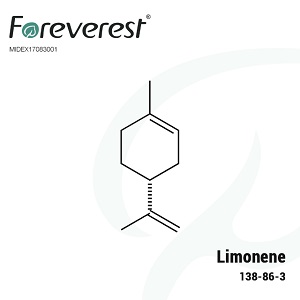
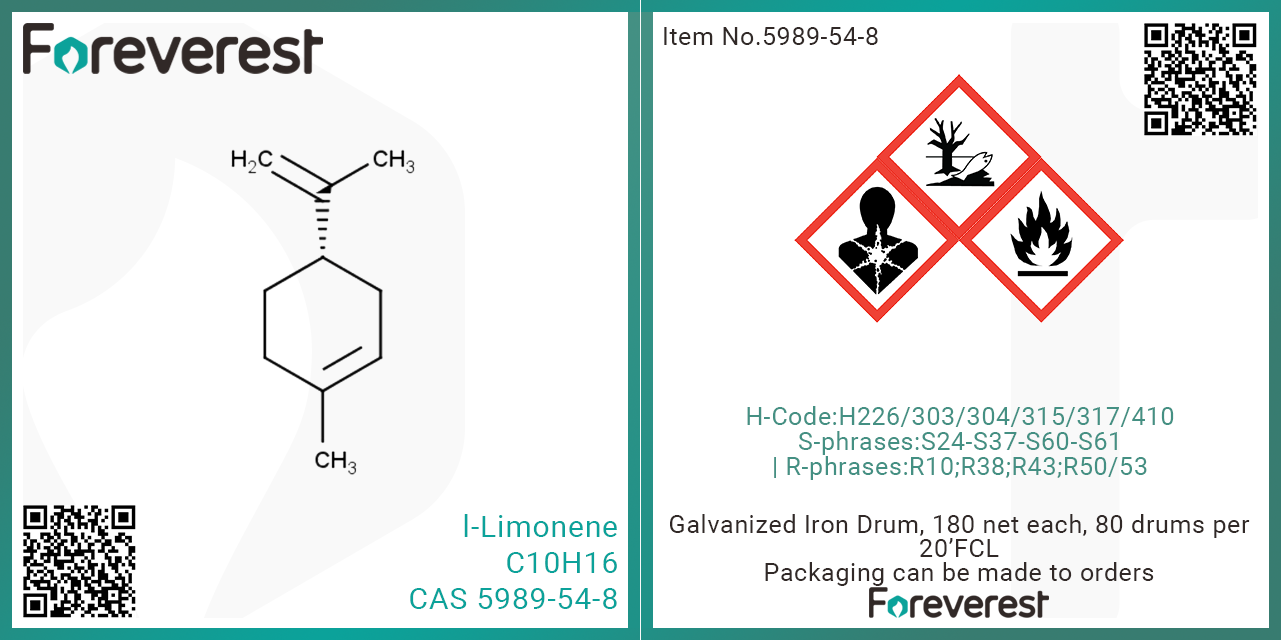
l-Limonene
l-Limonene is the optical isomer of Limonene. It is classified as three types: l-Limonene, d-Limonene optical isomers and one racemic.
It is a colorless to pale yellow liquid with a piney, turpentine-like odor.
d-Limonene is naturally found in essential oils of citrus, such as sweet orange oil and mandarin oil. l-Limonene presents in Pine needle oil, Turpentine, Cajeput oil and other essential oils.
Racemic limonene is derived from turpentine. It mainly used in food flavour and synthetic fragrances.
Substance Identification
| Synonyms | 1,8-ρ-Menthadiene | 1-Methyl-4-isopropenyl-1-cyclohexene | l-p-Mentha-1,8-diene |
| CAS | 5989-54-8 |
| EINECS | 227-815-6 |
| FEMA | N/A |
| HS.CODE | 290219 |
| Molecular Formula | C10H16 |
| Molecular Weight | 136.2364 |
Application & Uses
- used as a food flavor and fragrance formulation
- used as an ingredient of detergent
- used as an effective solvent in 3D printing and beverage production
- used as artificial fragrance components
- used as pharmaceutical material
- used as botanical insecticide
Sales Specification
| ITEM | VALUE | TEST METHOD & UNIT |
|---|---|---|
| Appearance | Colorless transparent liquid | |
| Aroma | Piney, turpentine | |
| Refractive Index | 1.460 to 1.480 | @n20/D |
| Relative Density | 0.836 to 0.875 | @d20/20 |
| Optical Rotation | -90 | @20°C, ° |
| Limonene | 95 min | @G.C, % |
| Flash Point | 48 min | @°C |
Q&A
Can L-limonene replace D-limonene in downstream applications, or are their markets fundamentally different?
D-Limonene, sourced as a citrus processing byproduct, tends to dominate commodity-scale applications in cleaning solvents, food flavouring, and botanical insecticides, whilst l-limonene, typically derived from pine, fir, or mint essential oils, occupies a smaller but higher-value niche in chiral synthesis, specialty fragrances, and as a precursor to specific carvone enantiomers. The two enantiomers are not interchangeable in stereochemically demanding applications, and racemic dipentene cannot substitute for either pure enantiomer in asymmetric synthesis pathways.
Why do L-limonene and D-limonene smell different despite sharing the same molecular formula?
D-Limonene delivers a sweet citrus-orange aroma with an odour detection threshold of approximately 200 micrograms per litre, whilst l-limonene produces a piney, turpentine-like scent with a higher threshold around 500 micrograms per litre, because olfactory receptors are chiral proteins that follow a lock-and-key model. Formulators typically select l-limonene when a pine or herbaceous terpene note is required rather than the citrus character associated with d-limonene.
How can L-limonene be used as a chiral building block in pharmaceutical synthesis?
(S)-(-)-limonene serves as a renewable chiral pool building block for stereoselective transformations, with published research demonstrating its conversion to bicyclic amino alcohols and aminodiols with excellent diastereoselectivities, as well as its use in designing chiral ligands for transition metal complexes in asymmetric catalysis. The C4 stereocentre is typically preserved through these transformations, making the enantiomeric purity of the starting limonene a critical parameter for drug intermediate synthesis.
What does L-limonene's optical rotation actually mean for formulation and downstream use?
L-Limonene's (S)-(-) configuration, with a specific rotation of approximately minus 90 degrees at 20 degrees Celsius, produces the optical mirror image of d-limonene, which rotates plane-polarised light in the opposite direction. Both enantiomers share identical boiling point, density, and molecular weight, but the opposite stereochemistry at the C4 chiral centre means they interact differently with biological systems and chiral catalysts, so the optical purity of the limonene feedstock tends to determine the stereochemical outcome of downstream derivatives.
What storage and handling conditions does L-limonene 95% require to maintain quality?
L-Limonene 95% carries H226 for flammability, H317 for skin sensitisation, and H410 for aquatic toxicity, classified under UN 2052 Class 3 Packing Group III, so it should be stored in tightly closed containers in a cool, dry, well-ventilated place with opened containers carefully resealed and kept upright. Limonene oxidises readily in air to form carveol, carvone, and limonene oxide, which can affect both olfactory quality and skin sensitisation potential, so minimising headspace and nitrogen blanketing are typically recommended for longer-term storage.
Similar Specs
GHS Hazard Statements
| H-Code | H226/303/304/315/317/410 |
| P-Code | P210/233/240/241/242/243/261/264/272/273/280 |
| Response | P301+P310 P303+P361+P353 P312 P331 P333+P313 P370+P378 P391 |
| Storage | P403+P235 P405 |
| Disposal | P501 |
Storage
- containers which are opened must be carefully resealed and kept upright to prevent leakage
- keep container tightly closed in a dry and well-ventilated place
- store in cool place
Relation Products
Relation Articles
- Dipentene and Limonene: Relationship, Bio‑Sourcing and Market Applications
- [Internal Sharing Session Memo] Differences between Terpene Resins Synthesised from Different Pinene Monomers, Their Applications, and a Discussion on Resin Supply Chain Stability
- Terpenes (C5H8)-medicinal molecules and important building blocks in nature
- Dipentene, a low-cost substitute or extender for Citrus D-Limonene
- Industry Report Summary of Limonene Market Size, Price, 2016 - 2023
- Advancing Adhesives: Non-Toxic Solvents
- COULD CITRUS PEEL REPLACE CRUDE OIL IN PLASTICS, PARACETAMOL?
- Catalytic Upgrading of Extractives to Chemicals: Monoterpenes to “EXICALS”
- GUEST ARTICLE: From 'all natural' advertising to PR nightmare... Reflections on Rice v. National Beverage Corp (LaCroix)
- Green in Perfume, How to build a better rose
- Green solvents market is expected to reach EUR11.8 billion, globally by 2020
- Polyterpenes by ring opening metathesis polymerization of caryophyllene and humulene
- Real Bio-based Ingredients for Formulator's Toolbox
- Synthesizing the Future
- Ten questions concerning air fresheners and indoor built environments
- The benefits of Terpenes on health and well-being
- The development trend of food flavor
- Terpenes Go ROMPing Into New Materials
- ANTI-VIRUS FUNCTION of ESSENTIAL OILS and PLANT EXTRACTS
- Dipentene, an effective, safe, biodegradable cleaning and degreasing material
- R&D on Terpinen-4-ol
- TERPENE ESSENTIAL OILS: The research and development direction of anti-virus drugs is concerned
- Terpenes from Forests and Human Health
Remark
The above information is believed to be accurate and represents the best explanation currently available to us. However, no liability is assumed for any consequences arising from the use of this content. The technical standards for our products are developed and updated jointly by our customers and ourselves; where any changes occur, the latest specification shall prevail and will be confirmed in the relevant contract.All suggestions and data provided are based on information we consider to be reliable and are offered in good faith, but without any guarantee, as the conditions and methods of use of our products are beyond our control. Foreverest® makes no warranties, whether express or implied, regarding the accuracy, completeness or suitability of this information, and expressly disclaims any implied warranty of fitness for a particular purpose. Prospective users should conduct their own tests and evaluations to determine the suitability of Foreverest® materials and any recommendations for their intended applications before adoption, and, where appropriate, should obtain confirmation or approval from the relevant regulatory authorities.Any references in this page to patents or patented technologies, including descriptive material derived from patents or citations of specific patent numbers, are provided for information only. They must not be interpreted as a recommendation to use our products in a manner that could infringe any third‑party patent, nor as a grant of any licence or permission to use patents owned by Foreverest®.
Start Purchasing
-

Minimum Order Quantity
Quote required -

Lead Time
Quote required -

Available Incoterms
Quote required -

Regional Availability
Quote required