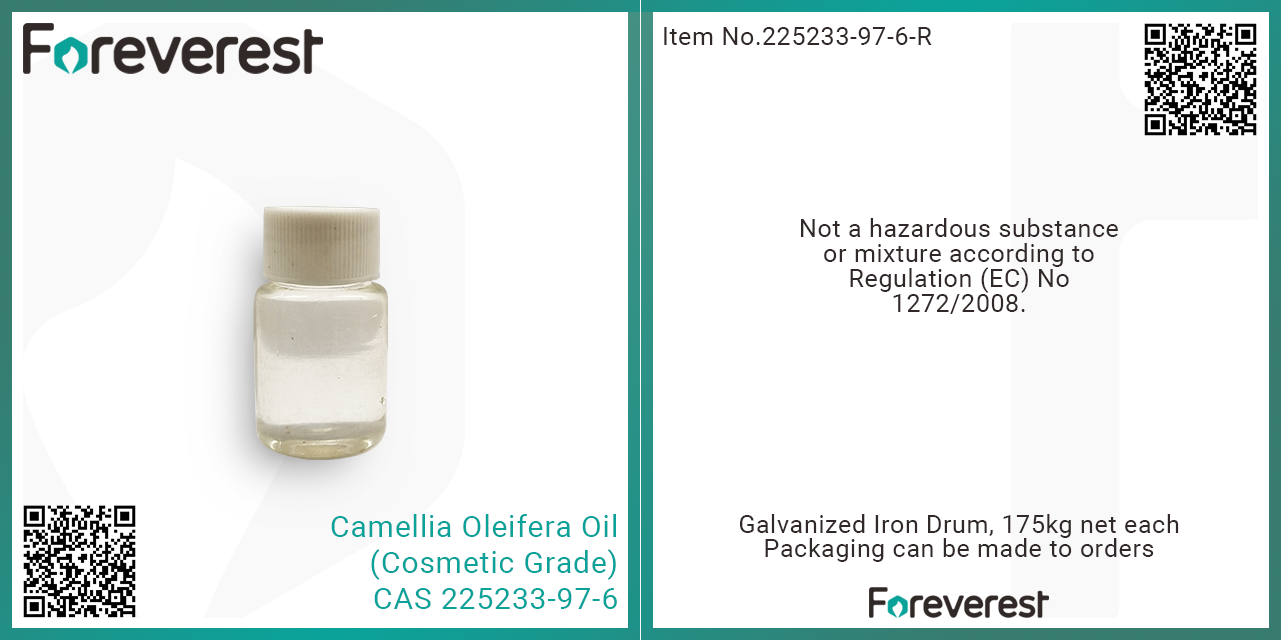
Camellia Oleifera Oil Refined
Camellia Oleifera Oil (also called as White tea oil) is transformed from natural tea oil through long-term storage in a specific environment. The natural oil turns its color from golden yellow to light yellow until colorless and tasteless crystal tea oil. The color of white tea oil is transparent and pure. It is the result of natural transformation of color and luster over the years, rather than rapid purification by artificial refining. Thereby it is also called aged white tea oil.
It is excellent ingredient to be used for cosmetic products. The pure extracted oil, which contains 86% oleic oil, fits the human body perfectly.
! Note: Camellia Oleifera Oil is extracted from seeds of Camellia Oleifera, it is different between Camellia Sinensis Leaf Extract. Learn more about botanical information via FRPS or Medicinal Plant Images Database of HKBU.
Substance Identification
| Synonyms | C.Oleifera | Camellia Oleifera | Oil-seed Camellia | Camellia Oleifera Abel | White tea oil |
| CAS | 225233-97-6 |
| EINECS | 607-092-7 |
| FEMA | N/A |
| HS.CODE | 15159000 |
| Molecular Formula | N/A |
| Molecular Weight | N/A |
Application & Uses
- Body Care, such as BB cream, soaps
- Hair Care, such as hair conditioners
- Lipsticks
- Makeup, such as makeup removers
Features & Benefits
- S1 safe pet care ingredient
- Fits human skip perfectly
- High contains of oleic oil
- Not easy to be deteriorated, oxygenated and evaporated
Sales Specification
| ITEM | VALUE | TEST METHOD & UNIT |
|---|---|---|
| Appearance | Clear and bright liquid | |
| Acid Value | 0.2 max | KOHmg/g |
| Contents of Oleic acid | 74 to 87 | |
| Contents of Linoleic acid | 7 to 14 | @GC, % |
| Moisture Content | 0.1 max | % |
| Impurity | 0.05 max | % |
| Solvent Resides | Negative | |
| Heavy Metals | 5 max | ppm |
| As | 2 max | ppm |
Q&A
How does refined Camellia oleifera seed oil function as a safe ingredient in pet grooming and skin care formulations?
Refined Camellia oleifera seed oil is a non‑volatile fixed oil composed mainly of triglycerides and a modest unsaponifiable fraction, so it does not carry the respiratory or hepatic risks associated with concentrated essential oils and terpenes—risks that are particularly pronounced in cats, which are deficient in key UDP‑glucuronosyltransferase enzymes used to metabolise phenolic and terpenoid compounds (Court, 2013; Tisserand & Young, 2014). With an oleic‑acid content in the 74–87% range, it forms a breathable, lightweight lipid film on skin and coat that helps reduce transepidermal water loss without the heavy, build‑up‑prone residue often seen with castor or coconut oils, making it well suited to leave‑on grooming products for both dogs and cats. Several commercial pet‑care brands already formulate dog‑and‑cat grooming oils, shampoos and conditioners with Camellia oleifera seed oil as a main or co‑main lipid, taking advantage of its pale colour and low inherent odour to minimise sensory interference, while still designing products to limit ingestion through licking and to comply with local pet‑cosmetic regulations and basic dermal tolerance testing.
Why does refined Camellia oleifera oil resist oxidation, deterioration, and evaporation during storage?
Refined Camellia oleifera oil’s oxidative stability is driven primarily by its fatty‑acid profile: oleic acid accounts for about 74–87% of total fatty acids, while polyunsaturated acids such as linoleic and linolenic typically represent only 7–14%, making it significantly less prone to peroxide formation than oils dominated by di‑ and tri‑unsaturated species like grapeseed or rosehip. A very low acid value specification (around 0.2 mg KOH/g max) and moisture content capped at roughly 0.1% indicate minimal free fatty acids and bound water, reducing the substrate and driving force for hydrolytic rancidity and the development of off‑odours during storage. As a triglyceride‑based fixed oil with typical molecular weights in the 800–900 Da range and correspondingly low vapour pressure at ambient temperature, refined Camellia oleifera oil is inherently resistant to evaporation, and a "solvent residues: negative" specification further confirms that no volatile processing solvents remain to off‑gas over time.
Which specification differences should a procurement manager understand when choosing between the refined and cosmetic grades of Camellia oleifera oil?
The refined and cosmetic grades share the same core safety and compositional controls: both specify a maximum acid value of 0.2 mg KOH/g, an oleic acid content of 74–87% with linoleic acid at 7–14%, moisture ≤0.1%, impurity ≤0.05%, negative solvent residues, and heavy‑metal and arsenic limits of ≤5 ppm and ≤2 ppm respectively. The cosmetic‑grade sheet additionally reports peroxide value (≤6 meq/kg), iodine value (83–89 g/100 g) and unsaponifiable matter (≤15 g/kg), which makes it more convenient for formulation and QC teams who need to monitor oxidative status and unsaponifiable content directly as part of their in‑house control strategy. The refined grade, described as "white tea oil" or "aged Camellia oil," emphasises long‑term natural colour and odour reduction, yielding a clearer, lower‑odour oil compared with the golden, characteristically camellia‑scented cosmetic grade, which can be advantageous in applications where base‑oil colour and odour must be minimal, such as transparent facial products or sensitive pet‑care formulations. For procurement, this means the choice is less about basic safety—both grades meet stringent limits—and more about whether downstream users prioritise extended analytical parameters like PV/IV/unsaponifiables, or a visually and olfactively neutral base oil for cross‑category use.
Similar Specs
GHS Hazard Statements
| H-Code | no data available |
| P-Code | no data available |
| Response | no data available |
| Storage | no data available |
| Disposal | no data available |
Storage
- flammable materials should be stored in a separate safety storage cabinet or room
- ground all equipment containing material
- keep away from heat
- keep away from sources of ignition
- keep container tightly closed
- keep in a cool, well-ventilated place
Relation Products
Relation Articles
Remark
The above information is believed to be accurate and represents the best explanation currently available to us. However, no liability is assumed for any consequences arising from the use of this content. The technical standards for our products are developed and updated jointly by our customers and ourselves; where any changes occur, the latest specification shall prevail and will be confirmed in the relevant contract.All suggestions and data provided are based on information we consider to be reliable and are offered in good faith, but without any guarantee, as the conditions and methods of use of our products are beyond our control. Foreverest® makes no warranties, whether express or implied, regarding the accuracy, completeness or suitability of this information, and expressly disclaims any implied warranty of fitness for a particular purpose. Prospective users should conduct their own tests and evaluations to determine the suitability of Foreverest® materials and any recommendations for their intended applications before adoption, and, where appropriate, should obtain confirmation or approval from the relevant regulatory authorities.Any references in this page to patents or patented technologies, including descriptive material derived from patents or citations of specific patent numbers, are provided for information only. They must not be interpreted as a recommendation to use our products in a manner that could infringe any third‑party patent, nor as a grant of any licence or permission to use patents owned by Foreverest®.
Start Purchasing
-

Minimum Order Quantity
Quote required -
Lead Time
Quote required -
Available Incoterms
Quote required -
Regional Availability
Quote required