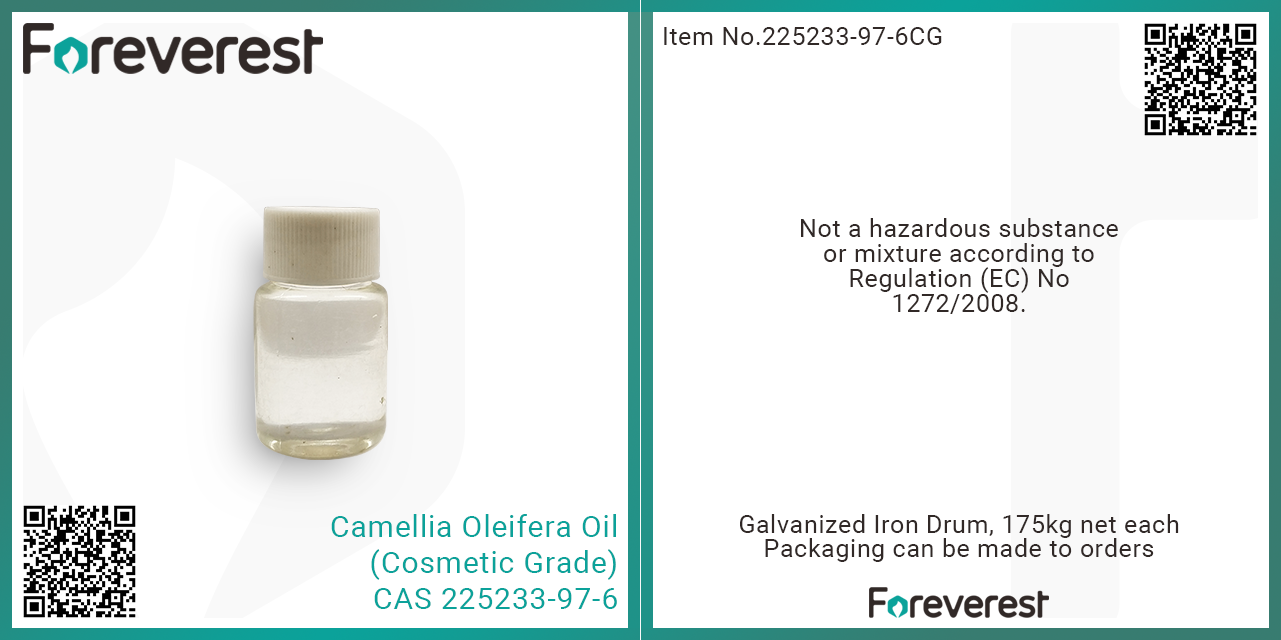
Camellia Oleifera Oil (Cosmetic Grade)
Camellia Oleifera Oil appears as a yellow oily liquid. Its physical properties and fatty acid composition are remarkably similar to those of Olive Oil, yet Camellia Oil contains a significantly higher proportion of unsaturated fatty acids. Our Foreverest™ Camellia Oleifera Oil is naturally extracted and cold-hand pressed using traditional techniques from the high-quality oil-seeds of Camellia Oleifera originating in Fujian, China—this pure natural biological source guarantees exceptional product quality. It is inherently non-toxic and odour-free.

This purely extracted oil is rich in oleic acid, containing approximately 86%. Its composition perfectly fits the human body, exhibiting excellent affinity with human skin. Furthermore, Camellia Oil demonstrates superior resistance to deterioration, oxygenation, and evaporation, ensuring product stability in cosmetic formulations.
! Note: Camellia Oleifera Oil is extracted from seeds of Camellia Oleifera, it is different between Camellia Sinensis Leaf Extract. Learn more about botanical information via FRPS or Medicinal Plant Images Database of HKBU.
Substance Identification
| Synonyms | C.Oleifera | Camellia Oleifera | Oil-seed Camellia | Camellia Oleifera Abel |
| CAS | 225233-97-6 |
| EINECS | 607-092-7 |
| FEMA | N/A |
| HS.CODE | 15159000 |
| Molecular Formula | N/A |
| Molecular Weight | N/A |
Application & Uses
Body Care Products
- Such as BB creams and various soaps, providing moisturisation and a soft skin feel.
Hair Care Products
- Including hair conditioners, aiding in hair nourishment and texture improvement.
Lip Products
- A key ingredient in items like lipsticks, offering moisturising and smoothing benefits.
Make-Up Removal Products
- Used in make-up removers and similar products for gentle and effective cleansing.
Features & Benefits
- S1 safe pet care ingredient
- Natural Skin Affinity, Superior Hydration & Nourishment:
- Derived from the natural oil-seeds of Camellia Oleifera, this pure Camellia Oil is rich in approximately 86% oleic acid, making its composition perfectly compatible with human skin. Non-toxic and odour-free, it provides exceptional moisture function, deeply nourishing skin and hair, improving various skin conditions, and offering a gentle yet highly effective skincare experience.
- Exceptional Stability for Broad Cosmetic Applications:
- Camellia Oil exhibits superior resistance to deterioration, oxygenation, and evaporation, ensuring the long-term stability and efficacy of formulated products. This characteristic, combined with its versatility, makes it an indispensable and ideal ingredient for a wide range of premium personal care and cosmetic formulations, including BB creams, soaps, hair conditioners, lipsticks, and make-up removers.
Sales Specification
| ITEM | VALUE | TEST METHOD & UNIT |
|---|---|---|
| Appearance | Clear and bright liquid | |
| Color, Yellow | 10 max | |
| Color, Red | 1 max | |
| Acid Value | 0.2 max | KOHmg/g |
| Peroxide Value | 6 max | mep/kg |
| Iodine Value | 83 to 89 | g/100g |
| Saponification Value | 193 to 196 | mgKOH/g |
| Unsaponifiable Matter | 15 max | g/kg |
| Contents of Palmitic acid | 6.2 to 10 | @GC, % |
| Contents of Stearic acid | 0.8 to 2 | @GC, % |
| Contents of Oleic acid | 74 to 87 | @GC, % |
| Contents of Linoleic acid | 7 to 14 | @GC, % |
| Moisture Content | 0.1 max | % |
| Impurity | 0.05 max | % |
| Solvent Resides | Negative | |
| Heavy Metals | 5 max | ppm |
| As | 2 max | ppm |
Q&A
Which specification parameters should a formulator prioritise when selecting a Camellia oleifera seed oil for leave‑in hair conditioner applications?
For a leave‑in hair conditioner, acid value and peroxide value are the first quality filters: keeping the acid value in the range of roughly 0.2–0.5 mg KOH/g (free fatty acids <0.25%) indicates a well‑refined oil with low levels of hydrolytic rancidity and reduced risk of scalp irritation, while a peroxide value at or below about 5–6 meq/kg signals minimal primary oxidation, helping avoid heavy, sticky feel or off‑odours. An iodine value between about 83 and 89 g I₂/100 g reflects a predominantly monounsaturated profile that balances spreadability and oxidative stability, which is important for a leave‑on product continuously exposed to air. The fatty‑acid spectrum—oleic acid at roughly 73–85% with linoleic acid around 7–14% plus modest palmitic and stearic fractions—gives Camellia oleifera oil its characteristically lightweight conditioning effect on hair, distinguishing it from heavier, more build‑up‑prone oils such as castor or coconut in fine, leave‑in applications.
Why is the oxidative stability of a botanical oil particularly important when formulating cleansing oils and makeup removers intended for daily use?
Daily‑use cleansing oils and makeup removers are applied directly to the face, often around the eyes, to dissolve long‑wear foundations and waterproof mascaras while preserving the skin barrier, so any oxidative degradation of the botanical oil during shelf life will quickly show up as rancid odour, heavier feel, and potentially increased irritation in a product used every day. Camellia oleifera seed oil, whose fatty‑acid profile is dominated by oleic acid (typically around 73–85%, with some cosmetic‑grade batches approaching 86%), is relatively more resistant to oxidation than polyunsaturated‑rich oils like grapeseed or rosehip, and cosmetic specifications commonly cap its peroxide value at about 6 meq/kg. This stability profile helps the cleansing oil maintain consistent performance from the first pump to the last—effectively dissolving makeup without the base oil drifting towards a rancid or irritant state—and the oleic‑rich, skin‑compatible lipid structure further supports a daily cleansing step that removes films and pigments without leaving the face feeling stripped or tight.
Can Camellia oleifera seed oil serve as the primary lipid phase in waterless solid cosmetic formats such as shampoo bars and solid conditioners?
Camellia oleifera seed oil has a fatty‑acid profile dominated by oleic acid (typically around 73–85%, with total unsaturated fatty acids above 85%) and cosmetic‑grade specifications that hold its peroxide value to roughly ≤5–6 meq/kg, giving it relatively better oxidative stability than more polyunsaturated oils such as grapeseed or rosehip, and than some olive or sweet almond oils, in anhydrous matrices where oxidation products are not diluted by water. Commercial solid shampoo and conditioner bar formulas already incorporate Camellia oleifera seed oil alongside surfactants, fatty alcohols and plant butters, demonstrating its suitability as a main or co‑main lipid phase in waterless formats. Its unsaponifiable fraction, which includes squalene and phytosterols, adds conditioning and antioxidant benefits that can partially offset the need for separate emollient additives, although its moderate iodine value (roughly 82–90) still reflects residual unsaturation, so formulators targeting tropical or high‑temperature supply chains typically reinforce the oil phase with low‑dose mixed tocopherols or other antioxidants (around 0.05–0.1%) to further control heat‑induced oxidation and odour drift.
Similar Specs
GHS Hazard Statements
| H-Code | no data available |
| P-Code | no data available |
| Response | no data available |
| Storage | no data available |
| Disposal | no data available |
Storage
- Environmental & Temperature Control:
- Store in a cool, dry, well-ventilated area, and protect from light.
- Avoid high temperatures to maintain product stability and prevent decomposition or volatilisation.
- Keep in a cool, well-ventilated place.
- Container Management & Prevention:
- Ensure containers are tightly closed to prevent volatilisation and external contamination, and are clearly labelled.
- Ground all equipment containing the material to prevent static build-up.
- Hazard Isolation:
- Keep storage areas away from heat, sparks, open flames, and all sources of ignition.
- This combustible liquid should be stored in a separate safety storage cabinet or room.
- Keep away from incompatible materials to prevent hazardous reactions.
- Safe Handling & Inspection:
- Handle carefully, and stack stably.
- After prolonged storage, always check quality before use.
- Compliance & Emergency Preparedness:
- Strictly comply with all safety regulations, particularly those pertaining to combustible liquid storage.
- Ensure emergency plans are in place for unforeseen circumstances.
Relation Products
Relation Articles
Remark
The above information is believed to be accurate and represents the best explanation currently available to us. However, no liability is assumed for any consequences arising from the use of this content. The technical standards for our products are developed and updated jointly by our customers and ourselves; where any changes occur, the latest specification shall prevail and will be confirmed in the relevant contract.All suggestions and data provided are based on information we consider to be reliable and are offered in good faith, but without any guarantee, as the conditions and methods of use of our products are beyond our control. Foreverest® makes no warranties, whether express or implied, regarding the accuracy, completeness or suitability of this information, and expressly disclaims any implied warranty of fitness for a particular purpose. Prospective users should conduct their own tests and evaluations to determine the suitability of Foreverest® materials and any recommendations for their intended applications before adoption, and, where appropriate, should obtain confirmation or approval from the relevant regulatory authorities.Any references in this page to patents or patented technologies, including descriptive material derived from patents or citations of specific patent numbers, are provided for information only. They must not be interpreted as a recommendation to use our products in a manner that could infringe any third‑party patent, nor as a grant of any licence or permission to use patents owned by Foreverest®.
Start Purchasing
-

Minimum Order Quantity
Quote required -
Lead Time
Quote required -
Available Incoterms
Quote required -
Regional Availability
Quote required