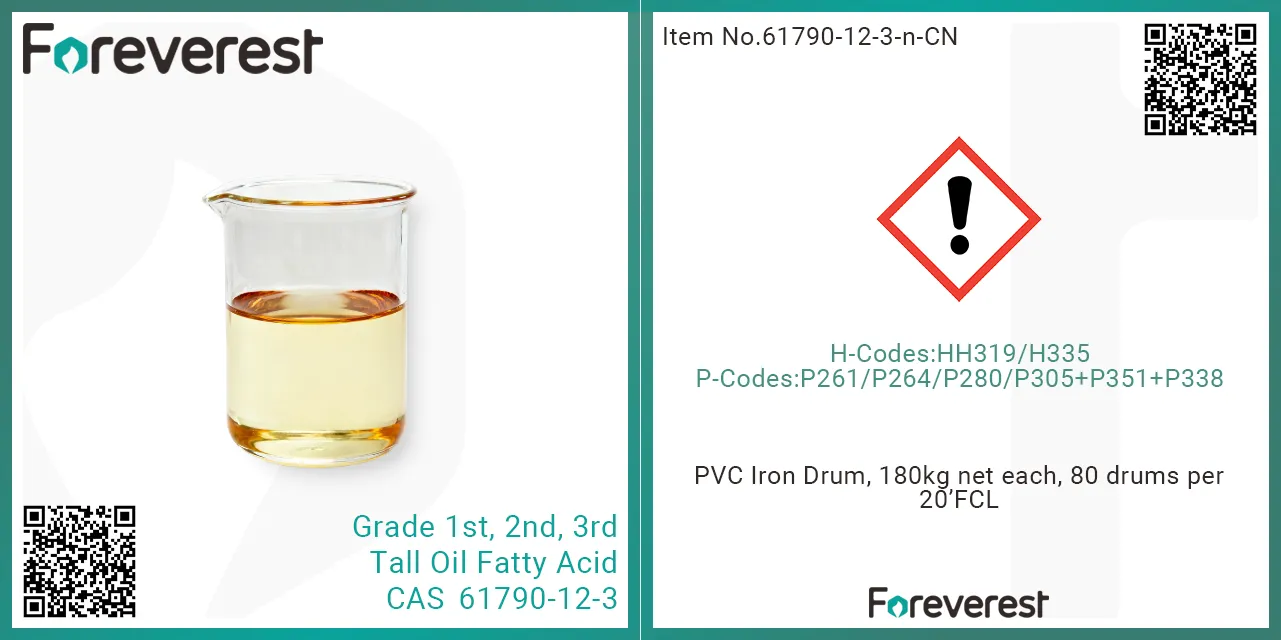
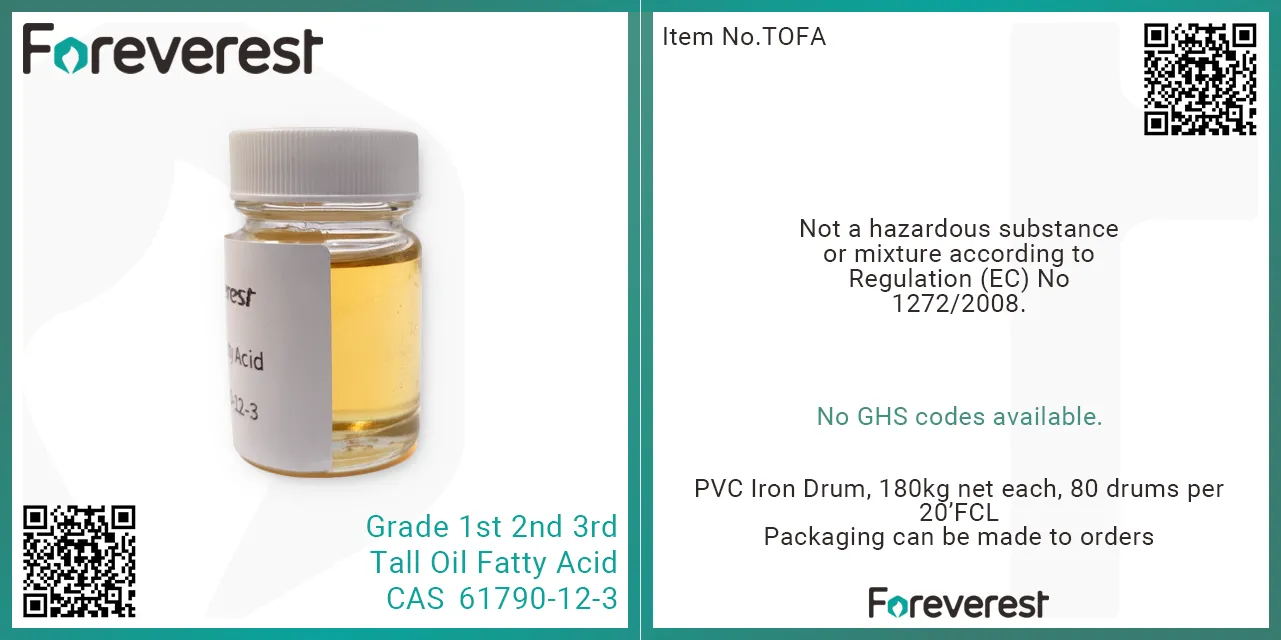
Tall Oil Fatty Acid
Tall oil fatty acid (TOFA) is a low cost unsaturated fatty acid (oleic acid) and is a source of low boiling point fatty acids widly used in synthetic lubricants industry. Which have light in color and low in rosin, is a consistent, cost-effective, source of liquid fatty acid. The utility of tall oil fatty acid can be found in the long carbon chain (C18) acid function of the carboxyl group (-COOH) or unsaturation of the double bonds.
Substance Identification
| Synonyms | TOFA |
| CAS | 61790-12-3 |
| EINECS | 232-304-6 |
| FEMA | N/A |
| HS.CODE | 382313 |
| Molecular Formula | N/A |
| Molecular Weight | N/A |
Application & Uses
- alkyds and other protective coating resins
- chemical intermediates
- corrosion inhibitors
- defoamers
- emulsifiers
- epoxy resin esters
- lubricants
- metalworking fluid
- plasticizers
- printing ink
- rubber paper
- soaps & detergent
- synthetic detergents
Sales Specification
| ITEM | VALUE | TEST METHOD & UNIT |
|---|---|---|
| Abietic Acid | 2 max | % |
| Acid value | 192 min | mgKOH/g |
| Colour | 5 max | @Gardner |
| Fatty Acids | 94 min | % |
| Unsaponifiables | 2 max | % |
| ITEM | VALUE | TEST METHOD & UNIT |
|---|---|---|
| Abietic Acid | 5 max | % |
| Acid value | 190 min | mgKOH/g |
| Colour | 7 max | @Gardner |
| Fatty Acids | 95 min | % |
| Unsaponifiables | 3 max | % |
| ITEM | VALUE | TEST METHOD & UNIT |
|---|---|---|
| Abietic Acid | 9 max | % |
| Acid value | 188 min | mgKOH/g |
| Colour | 10 max | @Gardner |
| Fatty Acids | 90 min | % |
| Unsaponifiables | 10 max | % |
Q&A
How does the fatty acid profile of tall oil fatty acid influence alkyd resin performance in protective coatings?
Tall oil fatty acid (TOFA) consists mainly of oleic and linoleic acids, in proportions that depend on the wood species and geographic origin of the crude tall oil feedstock, and this oleic–linoleic balance has a direct impact on the air‑drying speed, film hardness development, and water resistance of the resulting alkyd resins. Linoleic‑rich TOFA grades, typically associated with Nordic softwood kraft mills where linoleic acid can approach the low‑ to mid‑40% range of the fatty acid fraction, tend to produce faster‑drying, harder alkyd films because the higher degree of unsaturation supports more rapid oxidative crosslinking. By contrast, oleic‑rich TOFA grades, more characteristic of some North American and Chinese crude tall oil sources where oleic acid often reaches the mid‑40% range or higher, generally yield alkyds that dry slightly more slowly but offer improved flexibility, good gloss retention, and durable weather and water resistance in protective coating applications.
How do tall oil production routes differ between China and the major producing regions, and what does this mean for the composition of the resulting TOFA?
In major tall oil‑producing regions such as the Nordic countries and North America, crude tall oil is typically recovered from softwood kraft pulping by acidulating tall oil soap with sulphuric acid and then using decanting and centrifugation to separate the organic phase, yielding CTO with acid numbers often in the 160–165 range when based on predominantly pine feedstocks and with rosin (resin) acid contents that can reach several tens of percent, depending on the wood mix. After fractional distillation in integrated tall‑oil refining operations, this type of CTO produces TOFA grades with well‑characterised oleic–linoleic ratios and tightly controlled levels of residual rosin acids, which are widely used as consistent feedstocks for alkyd resins and other oleochemical derivatives. In China, by contrast, the more limited domestic softwood kraft capacity—concentrated in a small number of mills processing mixed softwood and hardwood feedstocks—and variations in soap skimming and acidulation practices tend to yield CTO with lower average acid numbers and reduced rosin acid content compared with pure softwood CTO, which in turn influences the oleic–linoleic balance and the amount of rosin acid that remains in the distilled TOFA fractions, leading to compositional and performance differences that downstream users need to consider when formulating coatings, adhesives, and other tall‑oil‑based products.
How is tall oil fatty acid positioned in the transition toward water‑based and low‑VOC alkyd resin formulations?
Tall oil fatty acid (TOFA)–based alkyd resins are increasingly being used in water‑borne alkyd dispersions and alkyd–acrylic hybrid systems as part of the shift toward low‑VOC coatings, driven by stricter VOC emission limits in the EU and North America and by regulatory frameworks that favour water‑based or high‑solids binder technologies over traditional solvent‑borne systems. Because TOFA is a 100% bio‑based feedstock derived from kraft pulping by‑products, it makes use of an existing industrial side stream rather than competing with food crops or requiring dedicated agricultural land, and its bio‑based content can be quantified according to standards such as EN 16785‑1 or schemes like the USDA BioPreferred program, positioning it as a renewable fatty acid source for more sustainable alkyds. In this way, TOFA enables the development of low‑VOC alkyd products that retain the familiar adhesion, flexibility, and durability associated with alkyd binders, while helping coatings manufacturers meet carbon‑ and bio‑based content targets in modern protective and decorative coating formulations.
GHS Hazard Statements
There is currently no available data for this product, click to view GHS Classification and Labelling by UNECE.Storage
- do not store in direct sunlight
- keep away from heat, sparks and open flame
- keep containers closed when not in use
- store at ambient temperature and atmospheric pressure
- use care in handling/storage
Relation Products
Remark
The above information is believed to be accurate and represents the best explanation currently available to us. However, no liability is assumed for any consequences arising from the use of this content. The technical standards for our products are developed and updated jointly by our customers and ourselves; where any changes occur, the latest specification shall prevail and will be confirmed in the relevant contract.All suggestions and data provided are based on information we consider to be reliable and are offered in good faith, but without any guarantee, as the conditions and methods of use of our products are beyond our control. Foreverest® makes no warranties, whether express or implied, regarding the accuracy, completeness or suitability of this information, and expressly disclaims any implied warranty of fitness for a particular purpose. Prospective users should conduct their own tests and evaluations to determine the suitability of Foreverest® materials and any recommendations for their intended applications before adoption, and, where appropriate, should obtain confirmation or approval from the relevant regulatory authorities.Any references in this page to patents or patented technologies, including descriptive material derived from patents or citations of specific patent numbers, are provided for information only. They must not be interpreted as a recommendation to use our products in a manner that could infringe any third‑party patent, nor as a grant of any licence or permission to use patents owned by Foreverest®.
Start Purchasing
-

Minimum Order Quantity
Quote required -

Lead Time
Quote required -

Available Incoterms
Quote required -

Regional Availability
Quote required