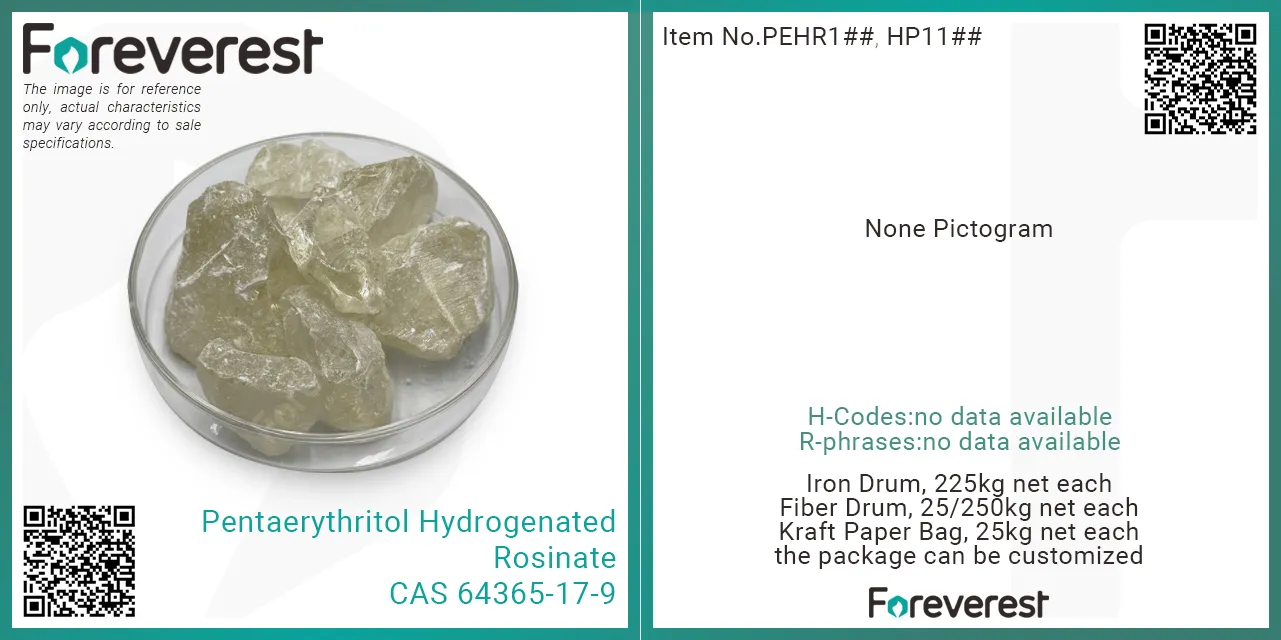
Pentaerythritol Hydrogenated Rosinate
Pentaerythritol Ester of Hydrogenated Rosin is made from hydrogenated rosin through esterification with pentaerythritol. HP1104 is Refined Hydrogenated Rosin through esterification with pentaerythritol, this product serves as a substitute product.
Substance Identification
| Synonyms | Pentaerythritol Ester of Hydrogenated Rosin |
| CAS | 64365-17-9 |
| EINECS | 264-848-5 |
| FEMA | N/A |
| HS.CODE | 38069000 |
| Molecular Formula | N/A |
| Molecular Weight | N/A |
Application & Uses
- hot melt adhesives and coatings
- pressure sensitive adhesives
Sales Specification
| ITEM | VALUE | TEST METHOD & UNIT |
|---|---|---|
| Acid Value | 20 max | mgKOH/g |
| Colour | 4 to 6 | @Gradner |
| Softening Point | 105 to 115 | @R&B, °C |
| Solubility | Clear | with toluene1:1 |
| Specific Gravity | 1.060 to 1.090 | @25/25°C |
| ITEM | VALUE | TEST METHOD & UNIT |
|---|---|---|
| Acid Value | 20 max | mgKOH/g |
| Colour | 8 to 10 | @Gradner |
| Softening Point | 105 to 115 | @R&B, °C |
| Solubility | Clear | with toluene1:1 |
| Specific Gravity | 1.060 to 1.090 | @25/25°C |
Q&A
How does HP1104’s specification profile relate to typical pentaerythritol hydrogenated rosinate grades, and what practical points should a purchasing team review when qualifying it as a substitute?
HP1104 is a pentaerythritol ester of hydrogenated rosin with a ring‑and‑ball softening point of 105–115 °C, a Gardner colour of 4–6 and an acid value not exceeding 20 mg KOH/g, placing it among the higher-softening, pale pentaerythritol hydrogenated rosinates described for hot-melt and pressure-sensitive adhesive use. Many commercially available grades in this family sit in the 92–105 °C softening point range, with similar colour windows and acid value limits up to 20 mg KOH/g, so HP1104 mainly differentiates itself by its slightly higher softening point while keeping acidity and colour within the familiar specification band. In hot-melt adhesive formulations, a softening point above about 105 °C can provide a modest increase in resistance to heat softening and blocking during storage or transport in warm climates, which may help reduce adhesive bleed or sticking in stacked packages compared with a mid‑90s softening point resin. A Gardner 4–6 colour is consistent with applications where a pale amber adhesive is acceptable—such as carton sealing, woodworking and general-purpose PSA tapes—rather than highly colour‑critical optical or decorative uses that demand water‑white tackifiers. Like other hydrogenated rosin esters, HP1104 shows broad compatibility with EVA, SIS, SBS, natural rubber, acrylics and related polymers, and is soluble in aromatic and aliphatic hydrocarbons, esters and ketones at typical formulating ratios, so no unusual solvent or polymer changes are expected when introducing it into an existing base. When qualifying HP1104 as a substitute for an existing pentaerythritol hydrogenated rosinate, purchasing and technical teams would normally compare loop tack, peel adhesion and shear adhesion failure temperature at equal loading in the target polymer, to confirm that the slightly higher softening point does not undesirably shorten open time, increase application viscosity or shift the tack–cohesion balance beyond the accepted process window.
What practical benefit does the 105–115 °C softening point of HP1104 offer a hot-melt adhesive formulator compared with pentaerythritol hydrogenated rosinate grades that soften in the 94–102 °C range?
A ring-and-ball softening point of 105–115 °C means HP1104 stays solid and mechanically supportive at higher temperatures than pentaerythritol hydrogenated rosinates that soften in the mid‑90s to low‑100s °C, which directly improves the heat resistance of hot-melt bonds. In practical terms, an adhesive tackified with HP1104 is less prone to heat softening, blocking or bond opening during hot-fill operations or storage and transport in warm climates, and in pressure-sensitive HMAs the higher softening point can translate into a higher shear adhesion failure temperature (SAFT) under static load. An acid value limit of 20 mg KOH/g is typical for esterified rosin tackifiers and is compatible with the thermal stability requirements of EVA- and SIS-based systems, so the main formulation effect of switching from a 94–102 °C grade to HP1104 is a modest increase in melt viscosity at a given application temperature, which formulators should check against their target coating or extrusion viscosity and open-time window on existing equipment.
Why does a hydrogenated pentaerythritol rosinate tackifier outperform non-hydrogenated rosin esters in pressure-sensitive adhesives exposed to heat, UV light, or outdoor conditions?
Hydrogenation saturates the double bonds in the rosin acid backbone, removing the conjugated unsaturation that makes non-hydrogenated rosin esters prone to oxidation, yellowing and embrittlement when exposed to heat, UV light and oxygen. Technical data for hydrogenated pentaerythritol rosinates in the same CAS 64365‑17‑9 family highlight that this structural change gives better resistance to oxidation, greater heat stability, improved colour retention and more stable tack than ordinary rosin esters when used as PSA tackifiers. In practice, a PSA based on a hydrogenated tackifier such as HP1104 can maintain peel adhesion and loop tack for longer during thermal ageing at around 70–80 °C and shows less yellow‑brown discolouration under heat and UV than a formulation using a non‑hydrogenated rosin ester. The higher softening point of HP1104 (105–115 °C) also adds thermal margin for high‑temperature PSA uses—such as masking tapes that must withstand paint‑bake cycles or tapes and labels exposed to warm air streams—where both oxidative stability and resistance to thermal softening are required. When comparing a hydrogenated pentaerythritol rosinate with a non‑hydrogenated ester, formulators typically run accelerated ageing at the target temperature for several hundred hours, tracking colour change, peel adhesion retention and shear adhesion failure temperature to quantify the gain in durability under the specific heat and weathering profile of the application.
Can pentaerythritol hydrogenated rosinate serve as a bio-based alternative to petroleum-derived tackifiers in packaging adhesives, and what makes its chemistry suitable for this application?
Pentaerythritol hydrogenated rosinate is based on rosin from pine, so it carries a high share of bio-based carbon; biomass ranking data for hydrogenated rosin derivatives place them in the highest category, corresponding to roughly 95–100% renewable raw material usage according to ISO 16620 methodology. As brands and regulators push packaging value chains toward lower fossil content and clearer reporting of renewable carbon, rosin-derived tackifiers offer a way to increase bio-based content without changing adhesive architecture from EVA-, SIS- or acrylic-based systems. The hydrogenated rosin backbone provides oxidative and colour stability comparable to highly stabilised hydrocarbon tackifiers, and HP1104’s 105–115 °C softening point supports heat resistance suitable for hot-fill processes and warm-climate distribution in case and carton sealing or palletising adhesives. Chemically, it behaves like other pentaerythritol rosin esters—showing good compatibility with EVA, SIS and many acrylic polymers and solubility in standard adhesive solvents—so formulators can often evaluate it within existing formulations rather than redesigning the base polymer. For customers who track renewable content, aligning on a test method such as ISO 16620-based bio-based carbon analysis during early validation helps substantiate claims about the bio-based fraction of the finished packaging adhesive.
GHS Hazard Statements
| Not classified |
Storage
- avoid contact with light
- keep separated from incompatible substances
- store and handle in accordance with all current regulations and standards
- store in a cool, dry place
- store in a tightly closed container
Relation Products
Remark
The above information is believed to be accurate and represents the best explanation currently available to us. However, no liability is assumed for any consequences arising from the use of this content. The technical standards for our products are developed and updated jointly by our customers and ourselves; where any changes occur, the latest specification shall prevail and will be confirmed in the relevant contract.All suggestions and data provided are based on information we consider to be reliable and are offered in good faith, but without any guarantee, as the conditions and methods of use of our products are beyond our control. Foreverest® makes no warranties, whether express or implied, regarding the accuracy, completeness or suitability of this information, and expressly disclaims any implied warranty of fitness for a particular purpose. Prospective users should conduct their own tests and evaluations to determine the suitability of Foreverest® materials and any recommendations for their intended applications before adoption, and, where appropriate, should obtain confirmation or approval from the relevant regulatory authorities.Any references in this page to patents or patented technologies, including descriptive material derived from patents or citations of specific patent numbers, are provided for information only. They must not be interpreted as a recommendation to use our products in a manner that could infringe any third‑party patent, nor as a grant of any licence or permission to use patents owned by Foreverest®.
Start Purchasing
-

Minimum Order Quantity
Quote required -

Lead Time
Quote required -

Available Incoterms
Quote required -

Regional Availability
Quote required