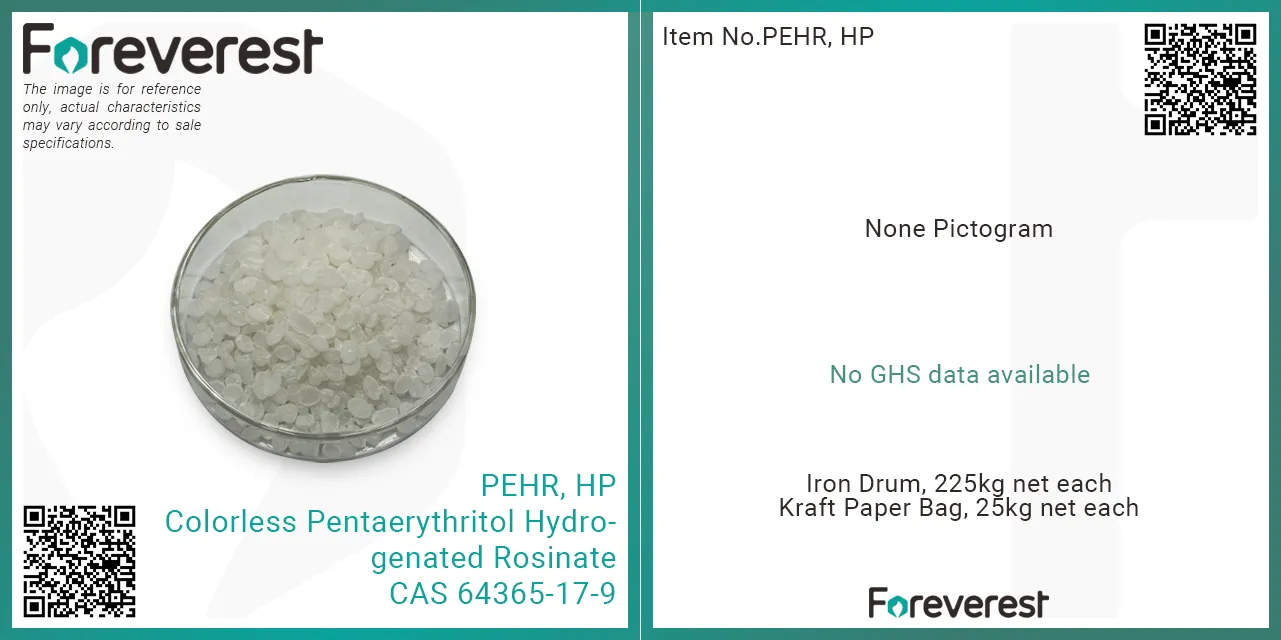
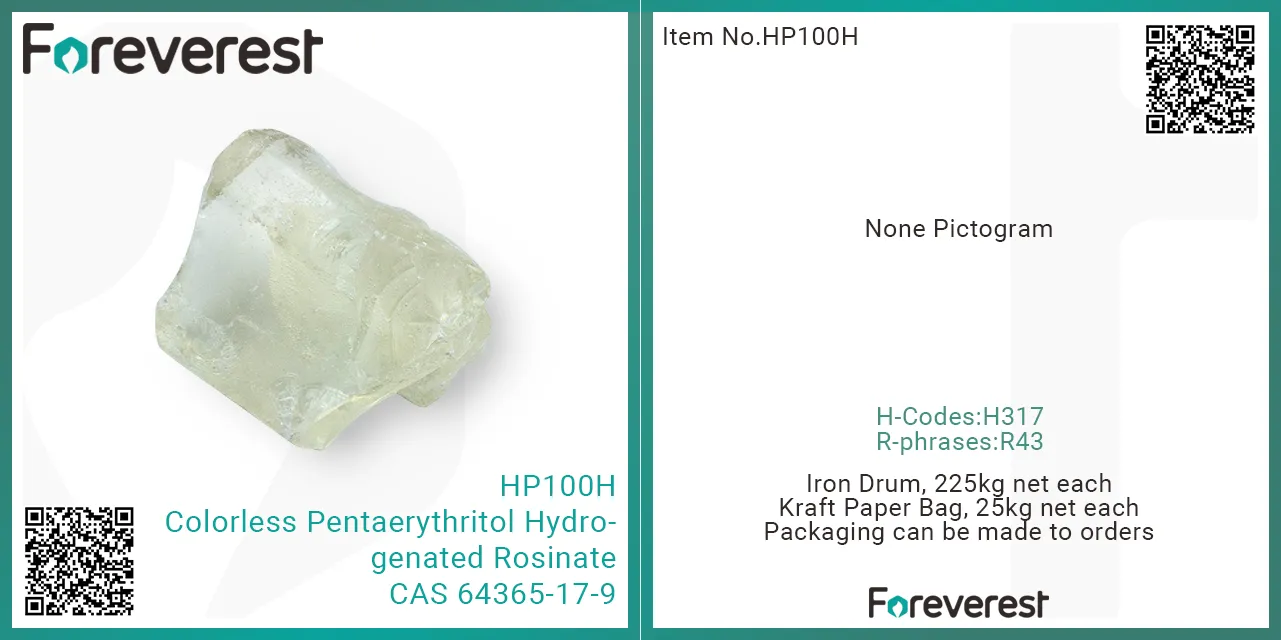
Colorless Pentaerythritol Hydrogenated Rosinate
PEHR100D is a kind of super light color tackifying polyols resin, which is esterified from refined gum rosin by pentaerythritol, and through series combined technologies units of catalytic hydrogenation. With benefit of light color, low odor, good heat stability and excellent ageing resistance, CPEHR is mainly used in screen protection film, medicinal patch, diaper adhesive, PSA and HMA.
Substance Identification
| Synonyms | Colorless Pentaerythritol Ester of Hydrogenated Rosin | CPEHR |
| CAS | 64365-17-9 |
| EINECS | 264-848-5 |
| FEMA | N/A |
| HS.CODE | 3806.30 |
| Molecular Formula | N/A |
| Molecular Weight | N/A |
Application & Uses
- used as tackifier for screen protection film
- used as tackifier for medicinal patch
- used as tackifier for diaper adhesives
- used as tackifier for PSA and HMA
- used as moisture-curable hot melt adhesive(US Patent 8324299)
Features & Benefits
- Light Color
- Low Odor
- Good Heat Stability
- Excellent Ageing Resistance
Sales Specification
| ITEM | VALUE | TEST METHOD & UNIT |
|---|---|---|
| Solubility | Clear | with toluene 1:1 |
| Color | 150 max | @Hazen Unit |
| Acid Value | 10 to 30 | mg/g |
| Softening Point | 95 to 105 | @R&B, °C |
| Iodine Value | 15 max | gI2/100g |
| ITEM | VALUE | TEST METHOD & UNIT |
|---|---|---|
| Note | Merged with PEHR100E |
Q&A
Which performance advantage does the tetra-functional structure of pentaerythritol impart when this hydrogenated rosin ester is used in diaper hot-melt adhesives subjected to body-temperature service?
Pentaerythritol has four hydroxyl groups, so when rosin is first esterified with pentaerythritol and the resulting rosin pentaerythritol ester is then catalytically hydrogenated, the product has a highly functional ester network with a ring‑and‑ball softening point around 95-105 °C, typically 10-15 °C higher than comparable hydrogenated glycerol esters based on the same rosin backbone. In diaper hot-melt adhesives based on SIS or SBS, this higher softening point and harder resin character help increase the adhesive’s resistance to creep and cold flow at body temperature, so bonds in elastic attachment or construction lines are less prone to gradual deformation while the article is worn. By contrast, systems built on softer hydrogenated glycerol esters with softening points nearer 80-85 °C tend to reach their “rubbery” region closer to use temperature, which can make it harder to meet demanding creep or shear targets without adding an additional hard resin. The hydrogenated pentaerythritol rosin ester’s good heat and ageing stability also helps maintain these mechanical properties during storage and distribution, reducing the risk that adhesive performance drifts as diapers sit in warehouses or transit through warm climates.
Why does a pentaerythritol ester of hydrogenated rosin typically resist thermal degradation better than its glycerol ester counterpart during hot-melt processing above 160 degrees?
Pentaerythritol is a tetra-functional polyol, so when rosin is first esterified with pentaerythritol and the resulting rosin pentaerythritol ester is then hydrogenated, the product has a more highly substituted, compact ester structure than a corresponding hydrogenated glycerol ester, and this is consistently associated with higher softening points and better thermal stability in comparative studies. In rosin systems, pentaerythritol esters show a higher onset temperature for mass loss and a smaller drop in molecular weight under heating than glycerol esters, which is often rationalised by the absence of easily accessible β‑hydrogen positions next to the quaternary carbon in pentaerythritol esters, making β‑elimination and back‑formation of free resin acids less favourable at typical hot-melt processing temperatures above about 160 °C. This structural advantage helps explain why pentaerythritol esters of hydrogenated rosin tend to maintain lighter colour and more stable tack over repeated heating cycles, whereas glycerol rosin esters more readily darken and generate additional acid functionality under similar conditions. When this is combined with a low iodine value (for example, around 15), indicating that most oxidatively sensitive double bonds in the rosin backbone have been saturated by hydrogenation, the resulting ester offers a robust combination of heat and ageing stability that is well suited to hot-melt processing windows above 160 °C.
In medicinal and transdermal patch adhesives, how should formulators interpret an acid value of 10-20 mg KOH/g for a pentaerythritol ester of hydrogenated rosin when assessing its suitability for long-term skin contact?
An acid value of 10-20 mg KOH/g in a pentaerythritol ester of hydrogenated rosin indicates a low-to-moderate level of residual acid functionality, mainly from partially or unesterified resin acids remaining after esterification. Rosin-related contact allergy is primarily linked to resin acids and, in particular, their oxidized abietadiene-type derivatives, so keeping the acid value toward the lower end of this range helps limit the pool of free or loosely bound resin acids that can reach the skin surface during long-term patch wear (Karlberg et al., 1988; Hausen et al., 1989). For medicinal and transdermal patch adhesives, this is one part of managing sensitisation risk in patients with known or potential colophony allergy, but it cannot eliminate the possibility of reactions on its own, which is why safety reviews note that pentaerythritol or glyceryl rosinate-type materials may still cause allergic contact dermatitis in sensitive individuals. In practice, formulators and procurement teams qualifying tackifiers for prolonged skin contact often prefer grades that sit at the lower end of the specified acid value window, combined with light colour and low odour, and then confirm overall safety via human patch testing on the finished adhesive system rather than relying solely on acid value as a surrogate.
In screen protection film adhesives, under which service conditions does the higher 95-105 °C ring-and-ball softening point of a pentaerythritol ester of hydrogenated rosin offer a clear advantage over an 85 °C-range glycerol ester in avoiding edge lift?
With a ring-and-ball softening point in the 95-105 °C range, a pentaerythritol ester of hydrogenated rosin remains far above the 35-45 °C surface temperatures typically seen on consumer electronics displays, so the pressure-sensitive adhesive layer stays in a glassy-rubbery balance that resists cold flow during normal heating and cooling cycles. This higher softening point increases the thermal safety margin when device temperatures rise under fast charging or prolonged gaming, helping the adhesive maintain dimensional stability at the edges and reducing the tendency for edge lift caused by gradual creep or differential contraction between the film and the display substrate. Glycerol esters of hydrogenated rosin with softening points nearer 80-85 °C can deliver adequate adhesion, but they operate with less headroom above use temperature, which can make edge stability more sensitive to installation conditions and thermal spikes in edge-to-edge glass protectors. In high-end screen protection films where any lifting is immediately visible and unacceptable, the higher softening point of the pentaerythritol ester therefore offers a clear advantage, especially when combined with a Hazen colour ceiling around 150 that supports the high optical clarity these applications demand.
What key properties make a pentaerythritol hydrogenated rosin ester a promising bio-based tackifier candidate for PLA in compostable packaging?
pentaerythritol hydrogenated rosin ester is a promising bio-based tackifier for PLA because its high softening point in the 95-105 °C range is compatible with PLA melt-processing temperatures and helps adjust melt rheology without requiring excessively high processing temperatures that would accelerate backbone scission. The tetra-functional structure of pentaerythritol gives a more highly substituted rosin ester than a glycerol counterpart, and this denser ester network is associated with higher softening points and improved cohesive strength and thermal stability in rosin-based tackifiers, which is beneficial for PLA films exposed to elevated temperatures during hot filling or short heat cycles. Hydrogenation of the rosin backbone removes conjugated double bonds that would otherwise promote radical-driven oxidation and yellowing, so the tackifier maintains a light colour and helps preserve the optical clarity expected from transparent compostable packaging films. Because both rosin acids and pentaerythritol can be sourced from renewable feedstocks, the rosin ester tackifier contributes a high bio-based content to the PLA formulation, supporting renewable-content targets that many compostable certification schemes expect, even though full compliance still depends on the entire film structure and test conditions. Experimental work on PLA–gum rosin ester blends shows that both pentaerythritol and glycerol esters act as bio-based processing aids that increase melt flow index and slightly enhance thermal stability, with the pentaerythritol ester consistently showing a modest advantage in onset of thermal degradation compared with the glycerol ester (de la Rosa-Ramírez et al., 2023, J. Polym. Environ.).
Similar Specs
GHS Hazard Statements
| Not classified |
Storage
- avoid contact with light
- keep separated from incompatible substances
- store and handle in accordance with all current regulations and standards
- store in a cool, dry place
- store in a tightly closed container
Relation Products
Remark
The above information is believed to be accurate and represents the best explanation currently available to us. However, no liability is assumed for any consequences arising from the use of this content. The technical standards for our products are developed and updated jointly by our customers and ourselves; where any changes occur, the latest specification shall prevail and will be confirmed in the relevant contract.All suggestions and data provided are based on information we consider to be reliable and are offered in good faith, but without any guarantee, as the conditions and methods of use of our products are beyond our control. Foreverest® makes no warranties, whether express or implied, regarding the accuracy, completeness or suitability of this information, and expressly disclaims any implied warranty of fitness for a particular purpose. Prospective users should conduct their own tests and evaluations to determine the suitability of Foreverest® materials and any recommendations for their intended applications before adoption, and, where appropriate, should obtain confirmation or approval from the relevant regulatory authorities.Any references in this page to patents or patented technologies, including descriptive material derived from patents or citations of specific patent numbers, are provided for information only. They must not be interpreted as a recommendation to use our products in a manner that could infringe any third‑party patent, nor as a grant of any licence or permission to use patents owned by Foreverest®.
Start Purchasing
-

Minimum Order Quantity
Quote required -

Lead Time
Quote required -

Available Incoterms
Quote required -

Regional Availability
Quote required