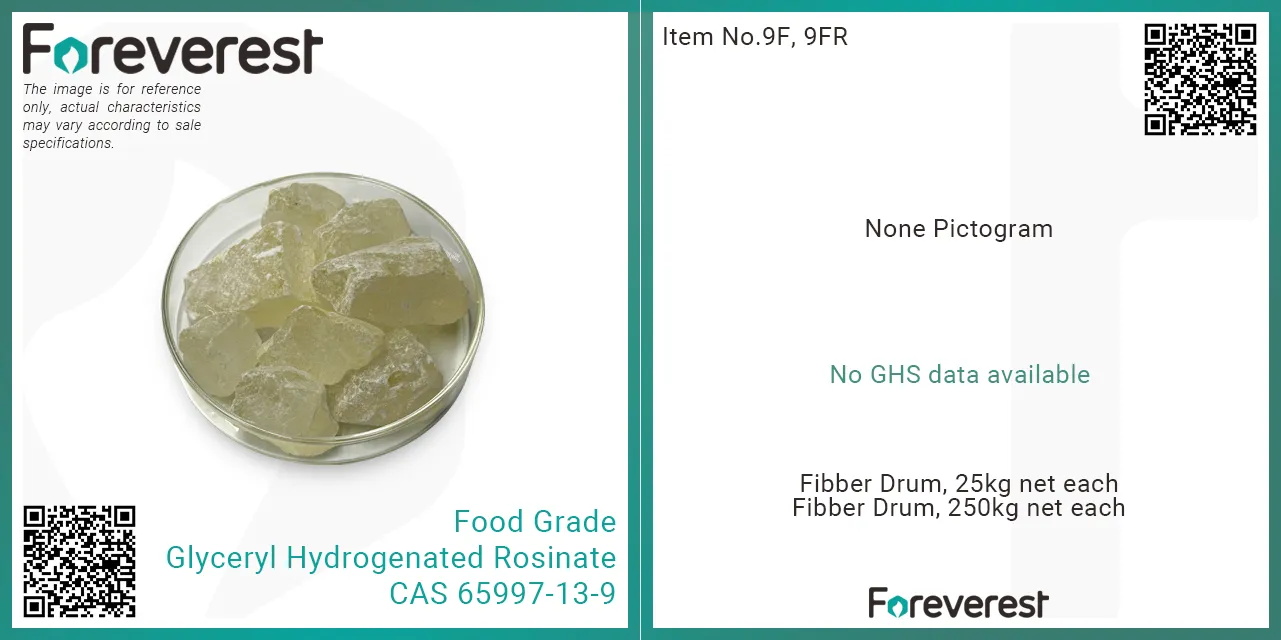
Glyceryl Hydrogenated Rosinate (Food)

Glyceryl Hydrogenated Rosinate, also called Glycerol Ester of Hydrogenated Rosin (GEHR) and Ester Of Hydrogenated Rosin, is esterified from refined hydrogenated rosin and edible glycerol. The modification improves its stability and reduces its unsaturation. It has good biocompatibility and can be safely used in cosmetics and personal care products.

Substance Identification

Synonyms Glycerol Ester of Hydrogenated Rosin | GEHR | Ester Of Hydrogenated Rosin | 9F/9FR
CAS 65997-13-9
EINECS 266-042-9
FEMA N/A
HS.CODE 380630
Molecular Formula N/A
Molecular Weight N/A

Application & Uses

  • chewing ingredient for chewing gum (Approved by FDA 172.615)
  • emulsification stabilizer for drinks

Sales Specification

ITEM VALUE TEST METHOD & UNIT
Acid Value 3 to 8 mgKOH/g
Arsenic Content 0.0002 max @As, %
Ash Content 0.1 max %
Colour 8 @Gardner
Heavy Metal 0.002 max @PBS
Softening Point 78 to 88 @R&B, °C
Specific Gravity 1.060 to 1.070 @25°C
ITEM VALUE TEST METHOD & UNIT
Acid Value 3 to 8 mgKOH/g
Arsenic Content 0.0002 max @As, %
Ash Content 0.1 max %
Colour 3 to 4 @Gardner
Heavy Metal 0.002 max @PBS
Softening Point 78 to 88 @R&B, °C
Specific Gravity 1.060 to 1.070 @25°C

Q&A

Why does a hydrogenated glyceryl rosinate serve as a preferred gum base modifier in functional chewing gum formulations carrying vitamins, caffeine, or cannabidiol?

Conventional ester gum based on unhydrogenated rosin retains conjugated double bonds in the resin acid backbone, and these unsaturated sites are more prone to autoxidation, which can lead to colour darkening of the gum base and contribute additional oxidative stress in formulations that already contain oxygen-sensitive vitamins or botanical extracts over long shelf lives. Hydrogenating the rosin prior to esterification, or using a hydrogenated glyceryl rosinate grade, saturates most of these double bonds and yields a low-odour, low-acid tackifier that resists oxidation and discolouration, providing a more stable and less reactive microenvironment around sensitive actives in functional chewing gum. A reduced acid value in the range of about 3-8 mg KOH/g indicates fewer free resin acids, which helps minimise acid-base interactions with alkaloid-type actives such as caffeine or nicotine and supports more predictable solubility and release behaviour during chewing. At the same time, glyceryl hydrogenated rosinate maintains the tack, chew texture and plasticising effect on gum base elastomers like polyvinyl acetate or SBR that are characteristic of ester gum, making it an attractive option when brand claims depend on consistent active content and sensory profile at the end of an 18-24 month shelf life.

What practical advantage does the Gardner 3-4 colour of a lighter hydrogenated ester gum grade offer when replacing brominated vegetable oil in premium citrus-flavoured beverages?

A Gardner 3-4 colour specification, as in lighter hydrogenated ester gum grades such as HG854F, keeps the resin’s own colour contribution low enough that even at the loading levels needed for effective weighting of citrus flavour oils, it does not impart a noticeable yellow or amber cast to clear beverage emulsions, unlike darker Gardner 7-8 ester gums that can make the cloud appear dull or muddy. When the hydrogenated ester gum is properly dissolved into the flavour oil phase and used to bring the oil density close to that of the aqueous phase, the resulting cloud remains bright and visually appealing, which is important for premium juice drinks and craft sodas that rely on a clean, natural-looking haze. Hydrogenation of the rosin backbone also removes many oxidisable double bonds, improving the resin’s resistance to oxidation and further darkening during storage, so the clouding emulsion shows better colour stability throughout the distribution cycle and helps reduce the risk of visible ring formation or colour drift in shelf-stable products. For beverage developers reformulating away from brominated vegetable oil under recent regulatory bans, choosing a lighter hydrogenated ester gum grade from the outset minimises the need for downstream colour correction or masking and supports both the visual and labelling expectations of modern “clean-label” citrus beverages.

When developing protective surface coatings for fresh citrus fruit, under which storage and distribution conditions does switching from a non-hydrogenated ester gum to a hydrogenated glyceryl rosinate provide a clear performance benefit?

Fresh citrus coatings use film-forming resins as part of a semi-permeable barrier system that slows moisture loss and gas exchange, and the coating needs to remain intact, transparent and well-adhered throughout cold-chain distribution that can last several weeks. Non-hydrogenated ester gums retain conjugated double bonds in the rosin acid backbone, making them more susceptible to autoxidation under the fluctuating temperature and light conditions of produce supply chains; as oxidation progresses, the film can yellow and develop surface haze or bloom, and in some cases this can contribute to reduced adhesion to the fruit peel. Switching to a hydrogenated glyceryl rosinate removes most of these vulnerable unsaturated sites and provides a lighter, more oxidation-resistant resin, so the coating film is better able to maintain its clarity and barrier performance over the full storage and distribution period—an advantage that becomes most apparent in longer cold chains or export programmes where fruit may spend several weeks in transit. The lower initial colour of a Gardner 3-4 hydrogenated grade such as HG854F also means the coating does not muddy or mask the natural peel colour, which is important for premium citrus varieties where visual grade directly influences wholesale price. When the formulation is further optimised by combining the hydrogenated ester gum with waxes such as carnauba or shellac, its good compatibility and oxidative stability help the concentrate remain uniform without phase separation during storage, supporting consistent coating performance at packhouse scale.

How does the cleaner taste profile of a hydrogenated glyceryl rosinate translate into a practical formulation advantage when the resin is used as a glaze or coating component in premium confectionery?

Unmodified rosin glycerides can contribute a characteristic bitter or harsh note because of residual resin acids and their oxidized derivatives, and this off-note can transfer into the surface of chocolate panned products or sugar dragees when ester gum is used as a glossing or film-forming agent. Hydrogenating the rosin backbone reduces the level of easily oxidisable abietadiene-type resin acids that are associated with these flavour defects, and food-grade glyceryl hydrogenated rosinate grades are specifically processed to give a low-odour, low-taste profile, so the finished coating has a cleaner taste that is important in premium confectionery where even slight bitterness is quickly noticed. A softening point in the 78–88 °C range places the hydrogenated resin in a practical window for confectionery glaze applications: it can be applied as a hot melt or from a warm solution and then sets to a glossy, non-tacky film at typical ambient storage temperatures without requiring specialised cooling equipment. When formulators blend the hydrogenated ester with food-grade waxes or shellac to tune gloss, slip and bite, its broad compatibility and good colour stability allow a wide range of ratios to be explored without excessive haze or phase separation, giving development teams flexibility to dial in the exact surface texture and mouthfeel their brand targets. Taken together, the cleaner taste, manageable melt viscosity and improved oxidation and colour stability during processing are key reasons why hydrogenated glyceryl rosinate can be favoured over conventional ester gum in high-end confectionery coatings.

Package

  • Fibber Drum, 25kg net each
  • Fibber Drum, 250kg net each

Preview all the spec of packaging

GHS Hazard Statements

No GHS data available

Storage

  • avoid contact with light
  • keep separated from incompatible substances
  • store and handle in accordance with all current regulations and standards
  • store in a cool, dry place
  • store in a tightly closed container

Remark

— Disclaimer —
The above information is believed to be accurate and represents the best explanation currently available to us. However, no liability is assumed for any consequences arising from the use of this content. The technical standards for our products are developed and updated jointly by our customers and ourselves; where any changes occur, the latest specification shall prevail and will be confirmed in the relevant contract.All suggestions and data provided are based on information we consider to be reliable and are offered in good faith, but without any guarantee, as the conditions and methods of use of our products are beyond our control. Foreverest® makes no warranties, whether express or implied, regarding the accuracy, completeness or suitability of this information, and expressly disclaims any implied warranty of fitness for a particular purpose. Prospective users should conduct their own tests and evaluations to determine the suitability of Foreverest® materials and any recommendations for their intended applications before adoption, and, where appropriate, should obtain confirmation or approval from the relevant regulatory authorities.Any references in this page to patents or patented technologies, including descriptive material derived from patents or citations of specific patent numbers, are provided for information only. They must not be interpreted as a recommendation to use our products in a manner that could infringe any third‑party patent, nor as a grant of any licence or permission to use patents owned by Foreverest®.

Start Purchasing

  • Minimum Order Quantity

    Quote required
  • Lead Time

    Quote required
  • Available Incoterms

    Quote required
  • Regional Availability

    Quote required