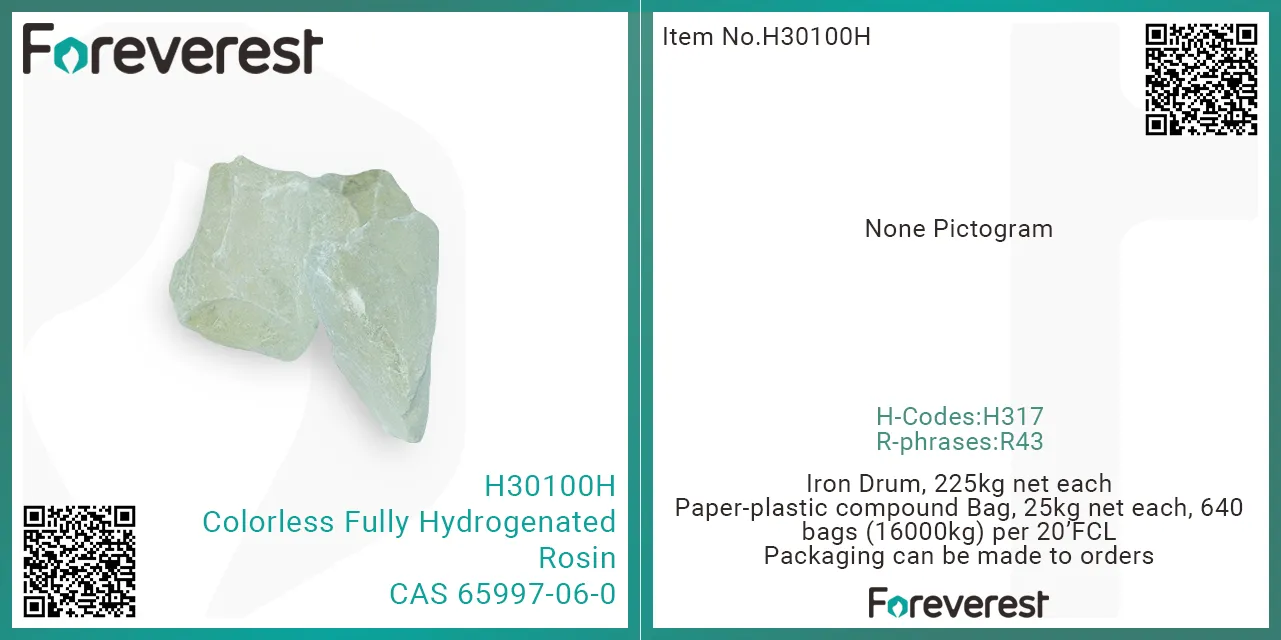
Colorless Fully Hydrogenated Rosin
Foreverest™ Colorless Fully Hydrogenated Rosin H30100H is a highly refined, water‑white rosin derivative produced by deep hydrogenation and removal of coloured impurities. It is designed for applications that require the electrical performance of rosin together with exceptionally low colour and high thermal stability, particularly in modern lead‑free solder fluxes, light‑coloured rosin resins and hot‑melt adhesive systems.
This is an alternative.
Substance Identification
| Synonyms | High Hydrogenated Rosin |
| CAS | 65997-06-0 |
| EINECS | 266-041-3 |
| FEMA | N/A |
| HS.CODE | 38069000 |
| Molecular Formula | N/A |
| Molecular Weight | N/A |
Application & Uses
- Solid and liquid soldering fluxes for tin‑lead and lead‑free electronics, where clear post‑solder residues and high insulation resistance are required.
- Raw material for light‑coloured rosin esters and rosin resins used in hot‑melt and pressure‑sensitive adhesives, including UV‑curable PSAs and double‑sided tapes for electronics and automotive applications.
- Tackifier component in hot‑melt adhesives for packaging, woodworking, footwear and leather goods, where low colour and good heat resistance are needed.
- Modifier in acrylate and specialty printing inks, dyes and pigment vehicles, improving adhesion and film strength while maintaining a clean optical appearance.
Features & Benefits
Extra Light Colour
- Water‑white appearance with Hazen colour typically ≤100, helping keep solder flux residues, adhesives and coatings visually clear and compatible with optical inspection and high‑appearance standards.
High Acid Value
- Acid value in the 164–168 mg KOH/g range supports good wetting and adhesion to metals and polar substrates, while contributing to surface cleaning in solder flux and adhesive applications.
Stabilised Rosin Chemistry
- Fully hydrogenated resin acids with abietic acid content ≤0.5% and controlled dehydroabietic acid levels improve resistance to oxidative darkening and thermal degradation compared with conventional gum rosin, supporting long‑term colour stability.
Good Solvent Solubility
- Soluble in most common organic solvents used in fluxes, inks and adhesives, enabling easy incorporation into existing formulations without major process changes.
Sales Specification
| ITEM | VALUE | TEST METHOD & UNIT |
|---|---|---|
| Appearance | White transparent solid | |
| Color | 100 max | @Hazen, # |
| Softening Point | 74 to 78 | @R&B, °C |
| Tetrahydro resin acid | 30 min | % |
| Dehydroabietic acid | 10 max | % |
| Acid Value | 164 to 168 | mgKOH/g |
| Abietic Acid | 0.5 max | % |
Q&A
Can a colorless fully hydrogenated rosin improve post‑soldering visual inspection in lead‑free flux formulations compared with conventional rosin?
Unlike standard gum rosin, which tends to darken and char at the higher reflow temperatures required for lead‑free solder alloys, a fully hydrogenated rosin with abietic acid controlled below about 0.5% maintains a much lighter colour and better thermal stability throughout the soldering profile (A Complete Guide to Rosin and Hydrogenated Rosin, 2023). The residue left on the board after soldering stays translucent instead of turning amber‑brown, allowing operators and AOI systems to see solder joints and component alignment more clearly without removing the flux first. A high acid value in the 164–168 mg KOH/g range supports oxide removal and surface cleaning during preheat, which promotes solder wetting on oxidised pads, while the hydrogenated backbone resists oxidative darkening under lead‑free reflow conditions (Techspray, 2024; Hakko, 2024). Because the resin itself is water‑white at around Hazen 100, it does not mask visual indicators of incomplete joints, bridging or staining, although formulators still need to balance the activator and halide package to match their specific alloy, thermal profile and electrical‑reliability requirements.
What makes a colorless fully hydrogenated rosin suitable as a tackifier in UV‑curable pressure‑sensitive adhesives?
The key advantage is the very low ultraviolet absorbance of fully hydrogenated rosin across the 280–380 nm range where most free‑radical photoinitiators operate, so it competes far less with the photoinitiator for UV light than conventional rosin esters containing residual abietic and dehydroabietic acids (Li et al., 2018, Industrial Crops and Products; Do et al., 2008, International Journal of Adhesion and Adhesives). In UV‑curable PSAs, traditional rosin esters can absorb strongly in this band and cause incomplete surface cure, leading to a tacky, under‑crosslinked top layer and higher risk of dirt pickup or migration. By contrast, a colorless fully hydrogenated rosin with Hazen colour around 100 shows greatly reduced UV extinction and allows more of the incident UV to reach the photoinitiator and reactive groups, so formulators can often reduce photoinitiator loading by roughly 15–20% while still achieving good depth of cure in clear films (Comer, 2023, PSTC; SpecialChem, 2022, UV‑cure PSA Guide). The water‑white colour and low chromophore content also suit optically transparent PSA constructions, helping maintain clarity in applications such as optical tapes, overlaminates and clear labels where both appearance and through‑cure are critical.
Why is a colorless fully hydrogenated rosin a viable tackifier choice for UV‑curable acrylic pressure‑sensitive adhesives used in electronic and automotive applications?
In UV‑curable systems, a tackifier must not significantly absorb in the same UV range as the photoinitiator; if it does, it competes for photons, reduces through‑cure and leaves the adhesive under‑crosslinked and tacky in depth (Do et al., 2008, International Journal of Adhesion and Adhesives). A colorless fully hydrogenated rosin, in which the conjugated double bonds of abietic‑type acids are largely saturated and the residual abietic acid content is held below about 0.5%, shows much lower UV absorbance than conventional rosin esters and therefore allows curing radiation to penetrate the full adhesive thickness. Its good compatibility with acrylic backbones means it can be blended into UV‑curable acrylic PSAs without inducing haze, which is critical for optically demanding constructions such as double‑sided bonding tapes in electronics and clear laminating films in automotive interiors (Comer, 2023, PSTC; Czech, 2010, International Journal of Adhesion and Adhesives). The improved oxidation resistance that comes with full hydrogenation also helps the adhesive resist yellowing and discolouration over its service life under heat and sunlight, supporting long‑term appearance requirements for electronic displays and automotive trim, although developers should still verify cure speed, adhesion build and ageing performance within their specific monomer and photoinitiator package.
Which specification parameters should procurement teams focus on when evaluating this colorless fully hydrogenated rosin as a drop‑in alternative to existing extra‑light hydrogenated rosin grades?
Three key specification items are most useful for assessing functional equivalence. First, softening point: this grade’s ring‑and‑ball softening point of about 72–78 °C falls within the same general window as many extra‑light hydrogenated rosins specified around 70–80 °C, indicating a similar thermal processing range for esterification, hot‑melt processing and flux compounding. Second, acid value: a value in the 165–175 mg KOH/g range sits at the higher end of typical hydrogenated rosin specifications (often 160–170 mg KOH/g), which can translate into slightly higher esterification reactivity and stronger interaction with polar substrates in adhesives and fluxes. Third, residual abietic‑type acids: this grade is specified at a maximum of about 0.5% abietic acid, whereas some benchmark extra‑light hydrogenated rosins quote lower maxima; for colour‑critical or long‑term stability applications, procurement should therefore request lot‑specific GC data to confirm actual abietic levels before approving it as a direct replacement. Looking at these three parameters together—softening point, acid value and residual abietic content—gives a practical basis for deciding whether this product can serve as a drop‑in alternative in existing formulations, or whether minor formulation adjustments may be needed.
What characteristics of a colorless fully hydrogenated rosin suggest it could be explored as a tackifier candidate in optically clear adhesives for foldable display lamination?
Optical bonding adhesives for foldable OLED panels require components that add virtually no haze or colour and resist yellowing over years of repeated folding and exposure to heat and light—requirements that have already led to the use of highly refined rosin esters such as glyceryl hydrogenated rosinate in some optically clear adhesive (OCA) systems. The acid form of a colorless fully hydrogenated rosin offers a low Hazen colour baseline (around 100) and tightly controlled abietic acid content below about 0.5%, which together support good photostability and low UV absorption, both important for maintaining transparency in UV‑curable or light‑exposed OCA formulations. An acid value in the 164–168 mg KOH/g range can also promote wetting on polariser films, glass and hard‑coat layers, improving interfacial contact in multi‑layer laminations. However, its softening point of roughly 74–78 °C is lower than what many current OCA tackifier or base‑polymer systems use to achieve the cohesive strength and resistance to cavitation needed under repeated folding stress, so any practical evaluation would likely require blending with higher‑softening resins or crosslinkable acrylic networks, and would need thorough mechanical and reliability testing before being considered viable for production use.
Package
- Iron Drum, 225kg net each
- Paper-plastic compound Bag, 25kg net each, 640 bags (16000kg) per 20'FCL
GHS Hazard Statements
| Not classified |
Storage
- avoid contact with light
- keep separated from incompatible substances
- store and handle in accordance with all current regulations and standards
- store in a cool, dry place
- store in a tightly closed container
Relation Products
Relation Articles
- Methyl Hydrogenated Rosinate for Personal Care and Cosmetics
- Application of Gum Rosin
- Frequently asked questions about new transparent tackifiers Hydrogenated terpene/polyterpene resins
- How to choose tackifier resins for Non-woven adhesives
- Choosing the Correct Soldering Flux Types and Their Advantages/Disadvantages
Remark
The above information is believed to be accurate and represents the best explanation currently available to us. However, no liability is assumed for any consequences arising from the use of this content. The technical standards for our products are developed and updated jointly by our customers and ourselves; where any changes occur, the latest specification shall prevail and will be confirmed in the relevant contract.All suggestions and data provided are based on information we consider to be reliable and are offered in good faith, but without any guarantee, as the conditions and methods of use of our products are beyond our control. Foreverest® makes no warranties, whether express or implied, regarding the accuracy, completeness or suitability of this information, and expressly disclaims any implied warranty of fitness for a particular purpose. Prospective users should conduct their own tests and evaluations to determine the suitability of Foreverest® materials and any recommendations for their intended applications before adoption, and, where appropriate, should obtain confirmation or approval from the relevant regulatory authorities.Any references in this page to patents or patented technologies, including descriptive material derived from patents or citations of specific patent numbers, are provided for information only. They must not be interpreted as a recommendation to use our products in a manner that could infringe any third‑party patent, nor as a grant of any licence or permission to use patents owned by Foreverest®.
Start Purchasing
-

Minimum Order Quantity
Quote required -

Lead Time
Quote required -

Available Incoterms
Quote required -

Regional Availability
Quote required