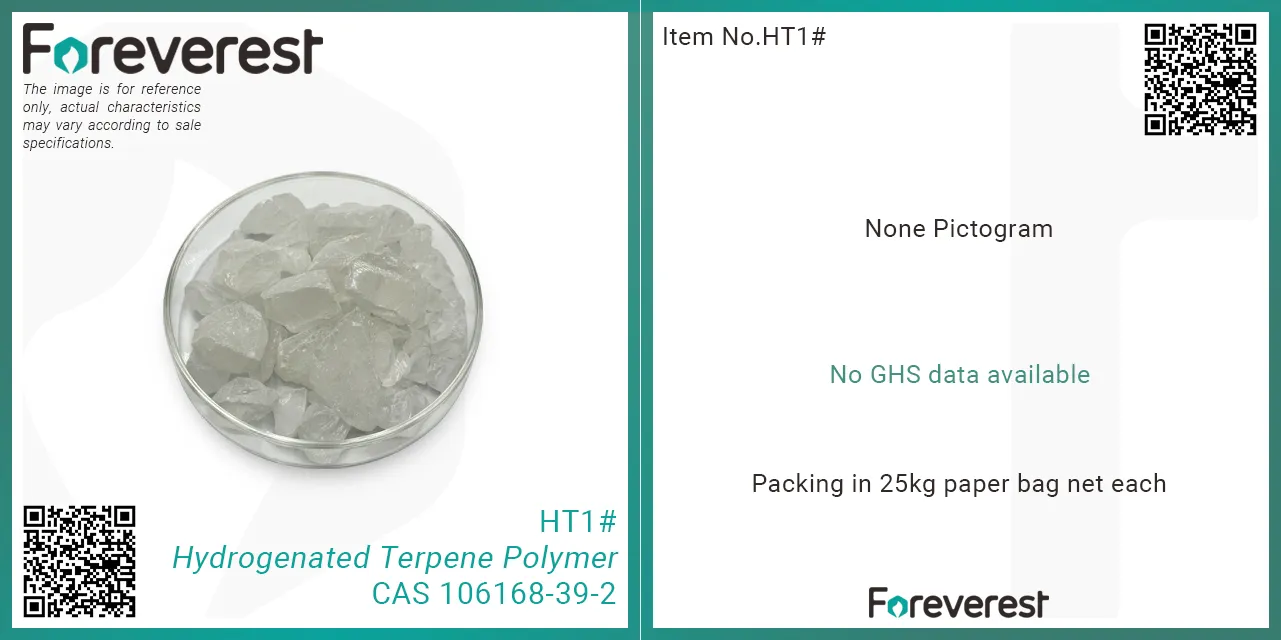
Hydrogenated Terpene Polymer
Foreverest® HTR105 is a kind of colorless or water white resin that has thermal stability and weather resistance.
It is a newly developed hydrogenated terpene resin. Hydrogenated Terpene Polymer is an excellent raw material for natural adhesives and also be used as additives to modify various plastics.
Substance Identification
| Synonyms | HTR 105 |
| CAS | 106168-39-2 |
| EINECS | N/A |
| FEMA | N/A |
| HS.CODE | N/A |
| Molecular Formula | N/A |
| Molecular Weight | N/A |
Application & Uses
Adhesives & PSAs
- Optically clear adhesives (OCA): good compatibility of hydrogenated terpene resins with styrenic block copolymers (SIS/SEBS) enables low-haze, high-transparency formulations for display lamination and premium protective films. Their low refractive-index fluctuation further enhances optical performance.
- Hot-melt adhesives (SEBS/EVA/APAO): hydrogenated terpene resins markedly improve initial tack and bond retention under high-temperature reflow conditions. Their non-polar nature ensures perfect compatibility with PP/PE substrates, eliminating the phase-separation and recycling-contamination risks associated with polar tackifiers.
- Hygiene and nonwoven applications: hydrogenated terpene resins optimise the viscoelastic profile of APAO/SEBS systems, balancing cold tack and heat-holding performance. In web bonding for nappies, sanitary pads and mask ear-loops, their low odour and low fogging residues enhance end-user experience.
- Flexible electronics and wearable devices: hydrogenated terpene resins facilitate low-modulus, long-term-stable PSAs that offer skin conformability while their low migration tendency minimises potential interference with sensitive electronic components.
- UV/EB-curable bonding: hydrogenated terpene resins synergise with acrylic PSA or radiation-curable systems to deliver rapid tack build-up and suppress photo-yellowing, meeting the demands of high-speed coating processes.
EV Vehicles
- Green tyre formulations: deeply hydrogenated terpene resins significantly reduce light oil and aromatic content in new-energy-vehicle tyre and interior NVH (noise, vibration and harshness) sealant compounds, mitigating odour release and fogging during service. They also serve as processing aids that replace conventional aromatic resins, lowering volatile emissions and improving interlayer adhesion during mixing.
- Battery-pack auxiliary materials: the thermal and ageing resistance of hydrogenated terpene resins enables them to withstand the complex thermal cycling environment within battery compartments, ensuring long-term reliability.
Electronics & Flexible Circuits
- Flexible circuit boards (e.g. PI/PU systems): low dielectric constant, low moisture absorption and favourable interfacial wetting properties make hydrogenated terpene resins suitable as adhesive buffer layers.
- Electronic encapsulation: outstanding thermo-oxidative and photostability effectively inhibit yellowing, enhancing long-term device reliability.
Features & Benefits
- excellent properties in color (water white)
- good thermal stability, and weather resistance
Sales Specification
| ITEM | VALUE | TEST METHOD & UNIT |
|---|---|---|
| Appearance | Colorless or water white resin | |
| Color | 50 max | @Hasen |
| Softening Point | 95 to 105 °C | @R&B |
| Melt Viscosity | 2400 max | @(150 °C), cP |
Q&A
In SEBS-based hot-melt adhesives for transparent packaging, how does HTR105 perform relative to established hydrogenated terpene resin grades?
A softening point of 95–105 °C and a Hazen colour limit of 50 place HTR105 in the “medium-softening, water-white” range of hydrogenated terpene resins, which is well suited to SEBS-based hot-melt adhesives that must keep the bond line inconspicuous on clear packaging films. Compared with higher-softening hydrogenated terpene grades (for example 115–135 °C) or hydrogenated hydrocarbon resins with similar softening points, this 95–105 °C level offers a compromise between cohesive strength and process temperature: it provides enough stiffness to support hot-fill or stacked load conditions, while still allowing application at melt temperatures typical of SEBS HMAs without excessive viscosity build. The terpene-derived, low-acid backbone gives HTR105 broad compatibility with SEBS, SIS, EVA and APAO, and its low intrinsic colour makes it a practical choice where the adhesive line should remain visually neutral, in contrast to some hydrogenated C5/C9 resins that can show slightly higher background haze at comparable softening points. A melt viscosity below about 2400 cP at 150 °C means that, in most SEBS formulations, coating and bead application windows can be maintained on standard hot-melt equipment without significant changes to line temperature or pressure settings. When replacing another hydrogenated terpene tackifier with similar nominal specifications, formulators should still run comparative loop-tack, peel and shear tests in the target SEBS system, because differences in molecular weight distribution and hydrogenation depth between suppliers can shift the balance between initial tack, cohesive strength and creep behaviour even within the same general resin class.
What performance gains can a polyolefin film developer expect when using a hydrogenated terpene polymer as a modifying additive in PP or PE packaging films?
Hydrogenated terpene polymers are known to be compatible with polyolefins, and Yasuhara Chemical reports that blending such resins into PP and PE can improve transparency, gloss, heat-seal behaviour and flow properties; HTR105, with its Hazen 50 max colour and hydrogenated terpene backbone, is designed for this type of clarity-sensitive modification. At typical addition levels, a hydrogenated terpene resin can slightly lower the melt viscosity of PP or PE compounds and narrow the processing window, which helps fill thin-wall mould cavities or achieve more uniform gauge in cast or blown films without significantly increasing extrusion temperature. Compared with hydrogenated hydrocarbon resins of similar softening point, a terpene-derived modifier like HTR105 offers a fully alicyclic, bio-based hydrophobic segment that tends to give good optical cleanliness and contributes a measurable renewable carbon fraction, while maintaining compatibility with common packaging film architectures. In practice, a film developer evaluating HTR105 would map haze, gloss and heat-seal initiation temperature as a function of resin loading—often starting in the 5–20 phr range—and confirm that barrier properties and interlayer seal strength remain within the target specification for the chosen PP or PE structure.
Under what operating and durability conditions might a hydrogenated terpene polymer be favoured over a conventional hydrogenated hydrocarbon resin for adhesive or encapsulant layers inside an EV battery pack?
In EV battery packs, internal adhesives and encapsulant layers often see repeated thermal cycling between sub-zero ambient temperatures and operating hotspots that can approach 60–80 °C near high-discharge cells, as well as long-term exposure to elevated temperatures in parked vehicles. A hydrogenated terpene polymer like HTR105 is designed with a saturated backbone and low colour, so it offers better resistance to oxidation, yellowing and embrittlement under these thermal conditions than non-hydrogenated terpene or rosin-based tackifiers, while still behaving like a conventional tackifier in terms of tack and peel. Patent literature on lithium battery hot-melt adhesives describes the use of terpene or bio-based tackifiers alongside polyolefin or elastomer backbones to provide initial tack, creep resistance and durability in electrolyte-rich environments, indicating that terpene-type resins can be formulated into battery-related adhesive systems when properly stabilised. The softening point of 95–105 °C for HTR105 gives a thermal margin above typical in-pack temperatures, so the resin remains solid and dimensionally stable in service rather than softening and allowing adhesive creep, while still being processable at hot-melt application temperatures. In practice, a development team comparing a hydrogenated terpene polymer with a conventional hydrogenated hydrocarbon resin would run lap-shear and creep tests before and after 500–1000 thermal shock cycles (for example −40 °C to +85 °C) on the relevant substrates, and would also screen for any differences in weight loss, colour change or mechanical modulus to judge whether the terpene-based option offers a meaningful durability advantage in the specific pack design.
Under what conditions might a hydrogenated terpene polymer be used instead of an aromatic processing resin in new-energy-vehicle tyre tread and NVH sealant compounds?
Hydrogenated terpene polymers contain essentially no aromatic structures, so when they are used in place of aromatic hydrocarbon processing resins in tyre tread or interior NVH sealant compounds, they can help reduce solvent‑like odour and lower the contribution to volatile and fogging emissions inside the vehicle. HTR105, with a Hazen colour of 50 max and a hydrogenated terpene backbone, is formulated as a low‑colour, thermally stable resin that can act as a processing aid in rubber or sealant mixing by reducing compound viscosity, improving filler dispersion and helping the compound flow into complex cavity geometries, while contributing less to in‑cabin fogging than aromatic resins. Technical information from terpene resin suppliers highlights the use of hydrogenated terpene and terpene–phenolic resins as modifiers in tyre tread compounds and sealants, where they are selected for their low VOC profile and good transparency rather than for additional aromatic content. The main trade‑off for a formulator is that aromatic processing resins often have a relatively high glass transition temperature and can give a small but useful boost to wet‑grip performance; switching to a terpene‑based resin with a lower Tg may slightly reduce wet traction unless the compound is rebalanced, for example by increasing the fraction of higher‑Tg elastomer or combining the terpene resin with a complementary higher‑Tg resin to keep wet braking within the target range. Because tyre tread和NVH sealant compounds are safety‑ and performance‑critical, any substitution of an aromatic processing resin with a hydrogenated terpene polymer still needs full validation of key properties such as rolling resistance, wet grip, tanδ curves, compression set and fogging behaviour under the specific operating conditions of the new‑energy vehicle platform.
Similar Specs
GHS Hazard Statements
| Not classified |
Storage
- Store in Ventilated, dry warehouse
Relation Products
Relation Articles
- [Internal Sharing Session Memo] Differences between Terpene Resins Synthesised from Different Pinene Monomers, Their Applications, and a Discussion on Resin Supply Chain Stability
- The Characteristics of Hydrogenated Terpene Resin
- Application of Water-White/Colorless Hydrogenated Terpene Resin in Electronic Component Packaging
- What is Terpene Resins?
- How to choose tackifier resins for Non-woven adhesives
- Terpenes Go ROMPing Into New Materials
- Coating Resins Supplier Guide
- Food Industry Application of Terpene Resin
- Orange is the new black gold: how peel could replace crude oil in plastics
- Polyterpenes by ring opening metathesis polymerization of caryophyllene and humulene
- Recent advances in bio-based epoxy resins and bio-based epoxy curing agents
- Reshaping Adhesive and Sealant Formulation Strategies
- Choosing the Correct Soldering Flux Types and Their Advantages/Disadvantages
- Rosin-Modified Resins, Terpene Resins, and Petroleum Resins in Different Ink Systems
Remark
The above information is believed to be accurate and represents the best explanation currently available to us. However, no liability is assumed for any consequences arising from the use of this content. The technical standards for our products are developed and updated jointly by our customers and ourselves; where any changes occur, the latest specification shall prevail and will be confirmed in the relevant contract.All suggestions and data provided are based on information we consider to be reliable and are offered in good faith, but without any guarantee, as the conditions and methods of use of our products are beyond our control. Foreverest® makes no warranties, whether express or implied, regarding the accuracy, completeness or suitability of this information, and expressly disclaims any implied warranty of fitness for a particular purpose. Prospective users should conduct their own tests and evaluations to determine the suitability of Foreverest® materials and any recommendations for their intended applications before adoption, and, where appropriate, should obtain confirmation or approval from the relevant regulatory authorities.Any references in this page to patents or patented technologies, including descriptive material derived from patents or citations of specific patent numbers, are provided for information only. They must not be interpreted as a recommendation to use our products in a manner that could infringe any third‑party patent, nor as a grant of any licence or permission to use patents owned by Foreverest®.
Start Purchasing
-

Minimum Order Quantity
Quote required -
Lead Time
Quote required -
Available Incoterms
Quote required -
Regional Availability
Quote required