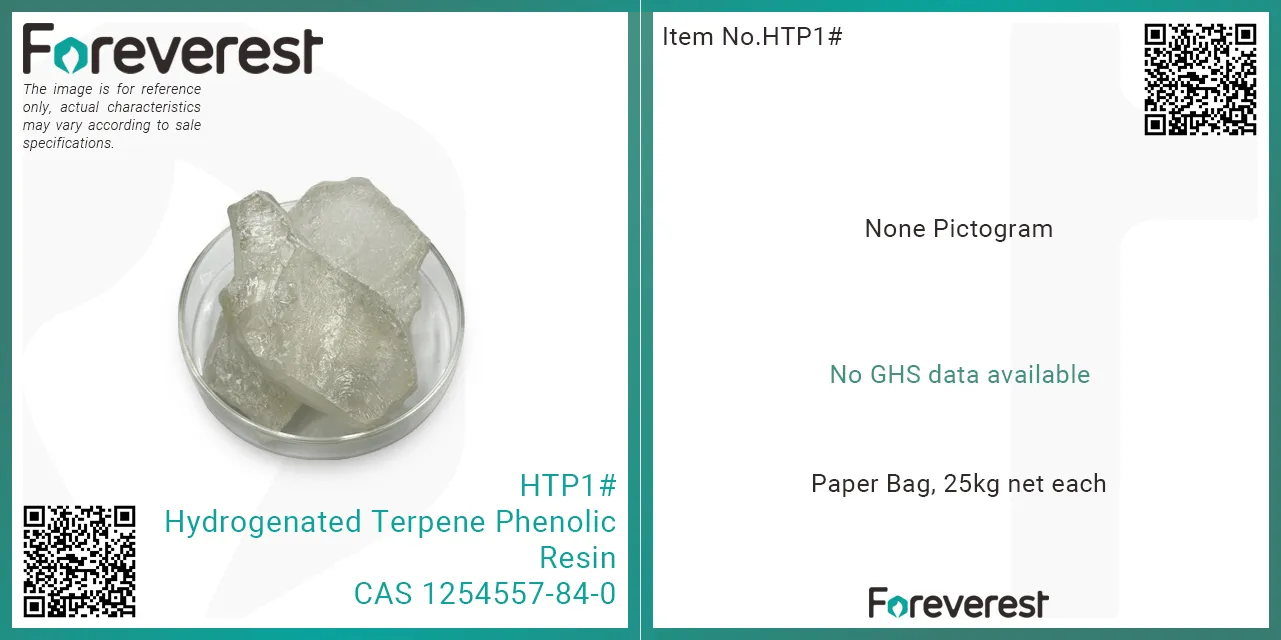
Hydrogenated Terpene Phenolic Resin
Foreverest Hydrogenated Terpene Phenolic Resin is a hydrogenated grade of terpene phenolic resin, it copolymerized by combining the renewable terpene resin and phenol with the enhanced properties of excellent thermal stability and UV stability in addition to the original properties of terpene phenolic resin.
This resin meets the demands for products that require superior transparency and stability.
Substance Identification
| Synonyms | Hydrogenated Terpene Resin |
| CAS | 1254557-84-0 |
| EINECS | N/A |
| FEMA | N/A |
| HS.CODE | N/A |
| Molecular Formula | N/A |
| Molecular Weight | N/A |
Application & Uses
Tyre & Rubber Compounding
- Tyre tread compounds: hydrogenated terpene-phenolic resins not only improve tread wear resistance and wet-skid resistance, but also reduce rolling resistance by optimising interactions between rubber molecular chains, thereby enhancing fuel efficiency.
- Compatibility & reinforcement: excellent compatibility with natural rubber and synthetic rubbers (e.g. SBR, BR) ensures uniform dispersion during mixing and the formation of a stable network structure, improving tensile strength and tear strength of the composite.
Hot-Melt & Pressure-Sensitive Adhesives
- Water-white HMAs and PSAs: the water-white colour of hydrogenated terpene-phenolic resins enables their use in light-coloured or transparent adhesive formulations whilst retaining the high cohesive strength and heat resistance characteristic of phenolic resins.
- EVA-based HMAs: markedly adjusts the viscosity–temperature profile, improves substrate wetting, and increases the shear strength of bonded joints.
Electronic Encapsulation
- High-frequency device encapsulation: the reduced double-bond content of hydrogenated terpene-phenolic resins limits side reactions during high-temperature curing, lowering dielectric loss and making them well suited for encapsulation of high-frequency, high-speed electronic devices.
- Epoxy system synergy: potential as a curing agent or toughening agent, offering synergistic effects with epoxy systems.
- Advanced composite encapsulants: owing to their regular molecular structure and high purity, hydrogenated terpene-phenolic resins show promise as a superior matrix or interfacial modifier for advanced electronic encapsulation composites with high thermal conductivity and low dielectric constant. When combined with nano-fillers such as boron nitride or graphene, they have been demonstrated to significantly enhance the thermal conductivity and electromagnetic-wave absorption performance of the resulting composites.
Features & Benefits
- Improved UV and improved heat resistance
- Colorless, transparent, and odorless
Sales Specification
| ITEM | VALUE | TEST METHOD & UNIT |
|---|---|---|
| Appearance | White, transparent, solid like ice | |
| Color, | 100 max | @Hazen, # |
| Softening Point | 110 to 120 | @DEG, ℃ |
| Bromine Value | 5 to 10 | Br g/100g |
| Acid Value | 0.5 max | mg KOH/g |
Q&A
Why is hydrogenating a terpene phenolic resin worth the extra processing step?
Hydrogenation saturates the olefinic double bonds in both the terpene backbone and the phenolic units, removing the unsaturation that normally drives oxidation and yellowing in standard terpene phenolic resins. This produces a water‑white resin with improved thermal and colour stability while retaining the polar phenolic hydroxyl groups that give broad compatibility and strong tack with many polar and non‑polar polymers. For formulators, that means the resin can be used in optical pressure‑sensitive adhesives, clear coatings and light‑coloured hot‑melt formulations without significant colour drift over the product lifetime, while keeping the adhesion and cohesive strength typical of unmodified terpene phenolic resins. A low bromine value, typically around 5-10 Br g/100 g, simply confirms that most reactive unsaturation has been removed, distinguishing hydrogenated grades from conventional terpene phenolic resins where higher unsaturation correlates with poorer colour stability.
When does a hydrogenated terpene phenolic resin make more sense than a hydrogenated C5 or C9 petroleum resin as a tackifier in adhesive and coating formulations?
A hydrogenated terpene phenolic resin is usually preferred when a formulator needs both high bio-renewable content and strong adhesion to more polar or difficult-to-bond substrates, because it combines a turpentine-derived terpene backbone with phenolic hydroxyl groups instead of being a fully hydrocarbon resin. The phenolic polarity extends compatibility into systems such as chloroprene rubber, epoxy, polyamide and acrylic adhesives, where even fully hydrogenated C5 hydrocarbon resins may not provide sufficient solubility or cohesive strength without additional polar tackifiers. At the same time, hydrogenated terpene phenolic grades can be produced with relatively high softening points and glass transition temperatures, supporting hot-melt and high-temperature service where low-softening C5 resins might creep or lose modulus, while their water-white colour and good colour stability help keep light-coloured or transparent formulations within tight appearance limits over time. The trade-off is cost: hydrogenated petroleum resins typically offer a lower price per kilogram and are still the rational choice for bulk, cost-sensitive applications where bio-content and enhanced polar compatibility are not critical.
How can a hydrogenated terpene phenolic resin contribute to low‑loss, high‑frequency electronic encapsulation in epoxy systems?
In high‑frequency electronic encapsulation, a hydrogenated terpene phenolic resin can help maintain low dielectric loss by minimizing residual double bonds that might otherwise participate in side reactions or form polar oxidation products during high‑temperature curing and service. Its relatively regular structure and high purity make it suitable as a modifier in epoxy composites loaded with thermally conductive, electrically insulating fillers such as boron nitride or selected graphene‑based materials, supporting high thermal conductivity while keeping the dielectric constant in a low and stable range. The phenolic hydroxyl groups provide chemical affinity to epoxy networks, so the resin can act as a reactive toughening or interfacial agent rather than a purely inert filler, helping to improve crack resistance and filler–matrix adhesion under thermal cycling. Formulators should still verify compatibility and cure behaviour with their specific epoxy and hardener system, because the UVCB nature of terpene‑based resins means that differences in composition between grades or suppliers can influence viscosity build, gel time and the final dielectric profile.
Similar Specs
GHS Hazard Statements
| No GHS data available |
Storage
- flammable materials should be stored in a separate safety storage cabinet or room
- ground all equipment containing material
- keep away from heat
- keep away from sources of ignition
- keep container tightly closed
- keep in a cool, well-ventilated place
Relation Products
Relation Articles
- [Internal Sharing Session Memo] Differences between Terpene Resins Synthesised from Different Pinene Monomers, Their Applications, and a Discussion on Resin Supply Chain Stability
- The Characteristics of Hydrogenated Terpene Phenolic Resin.
- Food Industry Application of Terpene Resin
- How to choose tackifier resins for Non-woven adhesives
- Recent advances in bio-based epoxy resins and bio-based epoxy curing agents
- Reshaping Adhesive and Sealant Formulation Strategies
- TACKIFIERS: MARKET EVOLVES WITH DEMAND FOR ADHESIVES SEALANTS AND LABELS
- Choosing the Correct Soldering Flux Types and Their Advantages/Disadvantages
- Rosin-Modified Resins, Terpene Resins, and Petroleum Resins in Different Ink Systems
Remark
The above information is believed to be accurate and represents the best explanation currently available to us. However, no liability is assumed for any consequences arising from the use of this content. The technical standards for our products are developed and updated jointly by our customers and ourselves; where any changes occur, the latest specification shall prevail and will be confirmed in the relevant contract.All suggestions and data provided are based on information we consider to be reliable and are offered in good faith, but without any guarantee, as the conditions and methods of use of our products are beyond our control. Foreverest® makes no warranties, whether express or implied, regarding the accuracy, completeness or suitability of this information, and expressly disclaims any implied warranty of fitness for a particular purpose. Prospective users should conduct their own tests and evaluations to determine the suitability of Foreverest® materials and any recommendations for their intended applications before adoption, and, where appropriate, should obtain confirmation or approval from the relevant regulatory authorities.Any references in this page to patents or patented technologies, including descriptive material derived from patents or citations of specific patent numbers, are provided for information only. They must not be interpreted as a recommendation to use our products in a manner that could infringe any third‑party patent, nor as a grant of any licence or permission to use patents owned by Foreverest®.
Start Purchasing
-

Minimum Order Quantity
Quote required -
Lead Time
Quote required -
Available Incoterms
Quote required -
Regional Availability
Quote required