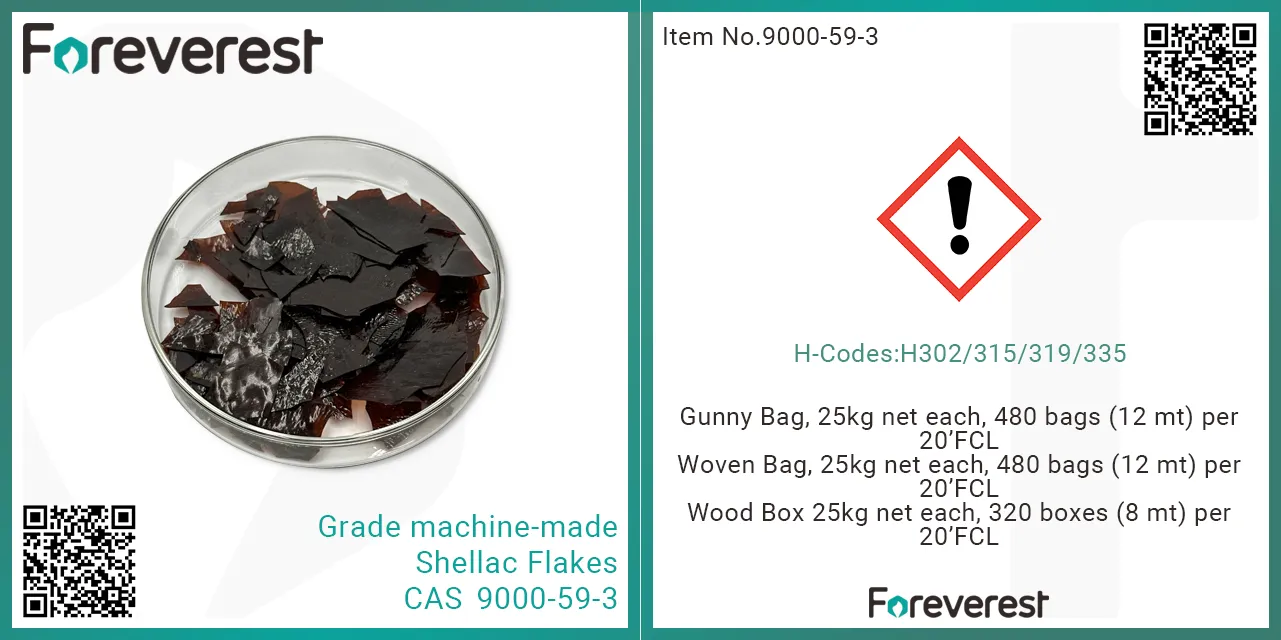
Shellac Flakes
The shellac flake is a natural mixture composed of hydroxycarboxylic acid, sesquiterpene acid and low molecular fatty acid. It is prepared from natural shellac or seedlac by hot melting or dissolving impurities in solvents. Shellac flake contains shellac resin, shellac pigment, shellac wax, sugar and protein.
As a biological product, it has the properties of non-toxic and non-irritating odor. It can effectively inhibit formaldehyde pollution and be used as environmental protection coating in the field of home decoration. Owing to the characteristics of moisture-proof, anticorrosion, rust-proof, electrical insulation and thermoplastics, it is widely used in food, medicine, military industry, electrical, aerospace and other high-end fine industries.
Substance Identification
| Synonyms | Machine made |
| CAS | 9000-59-3 |
| EINECS | 232-549-9 |
| FEMA | N/A |
| HS.CODE | 130110 |
| Molecular Formula | N/A |
| Molecular Weight | N/A |
Application & Uses
- used as adhesive, such as gasket cement, sealing wax, pyrotechnic optical cement
- used in cosmetic, such as in hair lacquer
- used in pharmaceuticals , such as coating for enteric pills
- used in electrical, such as in micanite, insulating varnish
- used in engineering, such as grinding wheels, rivet fastener
- used in paper varnish and playing cards
- used in photography for dry mounting tissue paper, protective varnish
- used in printing for flexographic ink, waterproof ink, photo engraving
- used in rubber of stiffening agent and surface finish
- used in surface coating, such as under coat, primer, sealer, polish, leather dressing, fruit coating etc
- used in textiles for stiffening of hats
Sales Specification
| ITEM | VALUE | TEST METHOD & UNIT |
|---|---|---|
| Acid Value | 73 max | mgKOH/g |
| Colour | 8 max | |
| Heat-hardening | 3.0 min | @Time (170°C+-0.5°C) |
| Insoluble matter | 0.4 max | % |
| Insolubility | 1.0 max | @in alcohol, % |
| Iodine Value | 20 max | @g/100g |
| Monoester | 2.0 max | % |
| Waxiness | 5.5 max | % |
Q&A
Why should an ink manufacturer sourcing handmade shellac consider Chinese machine-made shellac as an alternative?
Machine-made shellac produced by steam heat and hydraulic press filtration delivers insoluble matter at 0.4% max, which is well below the 1.0–2.0% typical of handmade grades. In flexographic and gravure ink production, insoluble particles cause filter blockages, anilox roll scoring, and batch-to-batch viscosity drift, all of which increase press downtime and solvent waste. A more consistent impurity level translates directly to fewer formulation adjustments between batches and, for manufacturers running high-speed multi-colour presses, a measurable reduction in rejected print runs. The waxiness of 5.5% max, retained rather than stripped in the heat-only process, also provides natural slip and rub resistance in the dried ink film, potentially reducing dependence on separately added wax dispersions.
How does the heat-hardening test at 170°C inform a formulator about processing differences between machine-made and handmade shellac?
The heat-hardening test, standardised under Chinese GB/T 8143, measures the time shellac takes to undergo dehydration polymerisation at 170°C. This temperature is well above what the resin encounters in typical solution preparation but is representative of thermal stress during hot-melt processing or high-speed coating drying. A minimum of 3.0 minutes, as specified for this grade, indicates the resin does not crosslink so rapidly that it limits the working window during melt filtration or roller stretching. Handmade shellac, produced over charcoal fire where heating is localised and uneven, can exhibit wider variation in thermal behaviour because the temperature gradient across the melt is less controlled than in steam-based processing. For a formulator preparing alcohol-based insulating varnishes or solvent-based inks, this specification provides a reproducible benchmark: if the heat-hardening time drifts significantly lower between shipments, it may signal a degree of pre-polymerisation that can compromise solubility and film levelling.
What does the monoester specification reveal about film performance in pharmaceutical enteric coating?
Shellac is a complex polyester of hydroxy acids, primarily aleuritic acid and shellolic acid, and the monoester content, specified at 2.0% max for this grade, reflects the proportion of simple monomeric esters remaining in the resin rather than polymerised polyester chains. A low monoester value generally correlates with a higher degree of polymerisation, which in turn affects film integrity: more extensively esterified resin tends to form denser, less permeable films. For enteric coating applications where the film must resist gastric fluid at pH ~1–3 and then dissolve in the intestinal environment at pH >6.8, film density and uniformity directly influence the reliability of pH-triggered release. While monoester is not a standard specification in many Indian machine-made shellac grades, its inclusion here offers a quality indicator that a formulator can track alongside acid value to anticipate batch-consistent film performance.
Can the waxiness specification guide a buyer selecting between machine-made shellac grades for applications where natural wax is beneficial?
Waxiness of 5.5% max represents the natural shellac wax retained in the resin after heat-only processing, placing it near the upper end of what non-dewaxed shellac typically contains and substantially higher than dewaxed grades carrying as little as 0.2% wax. In printing inks, this natural wax functions as an internal lubricant, improving rub resistance and reducing the need for post-added polyethylene or carnauba wax dispersions. In wood polish and leather dressing formulations, the wax contributes to depth of gloss and tactile smoothness in the dried film. A buyer who recognises that their downstream application benefits from wax, rather than requiring the clarity of a dewaxed resin, can treat waxiness not as a defect to minimise but as a functional specification to work with. The machine-made heat process preserves this wax specifically because it avoids the solvent-extraction step that strips it from dewaxed grades.
Which emerging application beyond traditional uses is shellac currently being researched for?
Research published in 2025 has examined shellac as a barrier coating on bagasse paperboard for sustainable food packaging, a domain where PFAS-based greaseproof agents and polyethylene laminates face tightening regulatory restrictions in the EU and North America. Khule et al. (2025, Progress in Organic Coatings) reported that a two-layer 40% shellac coating reduced oxygen transmission by 99.5% and extended potato chip shelf life by approximately 50 days relative to uncoated board. A follow-up study incorporating alginate and bentonite into a ternary shellac composite improved burst strength by over 100% (Nature Scientific Reports, 2025). While no commercial shellac-coated paperboard products have been identified, and the work remains at laboratory prototype stage.
Package
- Gunny Bag, 25kg net each, 480 bags (12 mt) per 20’FCL
- Woven Bag, 25kg net each, 480 bags (12 mt) per 20’FCL
- Wood Box 25kg net each, 320 boxes (8 mt) per 20’FCL
GHS Hazard Statements
There is currently no available data for this product, click to view GHS Classification and Labelling by UNECE.Storage
- avoid contact with light
- keep separated from incompatible substances
- store and handle in accordance with all current regulations and standards
- store in a cool, dry place
- store in a tightly closed container
Relation Products
Relation Articles
Remark
The above information is believed to be accurate and represents the best explanation currently available to us. However, no liability is assumed for any consequences arising from the use of this content. The technical standards for our products are developed and updated jointly by our customers and ourselves; where any changes occur, the latest specification shall prevail and will be confirmed in the relevant contract.All suggestions and data provided are based on information we consider to be reliable and are offered in good faith, but without any guarantee, as the conditions and methods of use of our products are beyond our control. Foreverest® makes no warranties, whether express or implied, regarding the accuracy, completeness or suitability of this information, and expressly disclaims any implied warranty of fitness for a particular purpose. Prospective users should conduct their own tests and evaluations to determine the suitability of Foreverest® materials and any recommendations for their intended applications before adoption, and, where appropriate, should obtain confirmation or approval from the relevant regulatory authorities.Any references in this page to patents or patented technologies, including descriptive material derived from patents or citations of specific patent numbers, are provided for information only. They must not be interpreted as a recommendation to use our products in a manner that could infringe any third‑party patent, nor as a grant of any licence or permission to use patents owned by Foreverest®.
Start Purchasing
-

Minimum Order Quantity
Quote required -

Lead Time
Quote required -

Available Incoterms
Quote required -

Regional Availability
Quote required