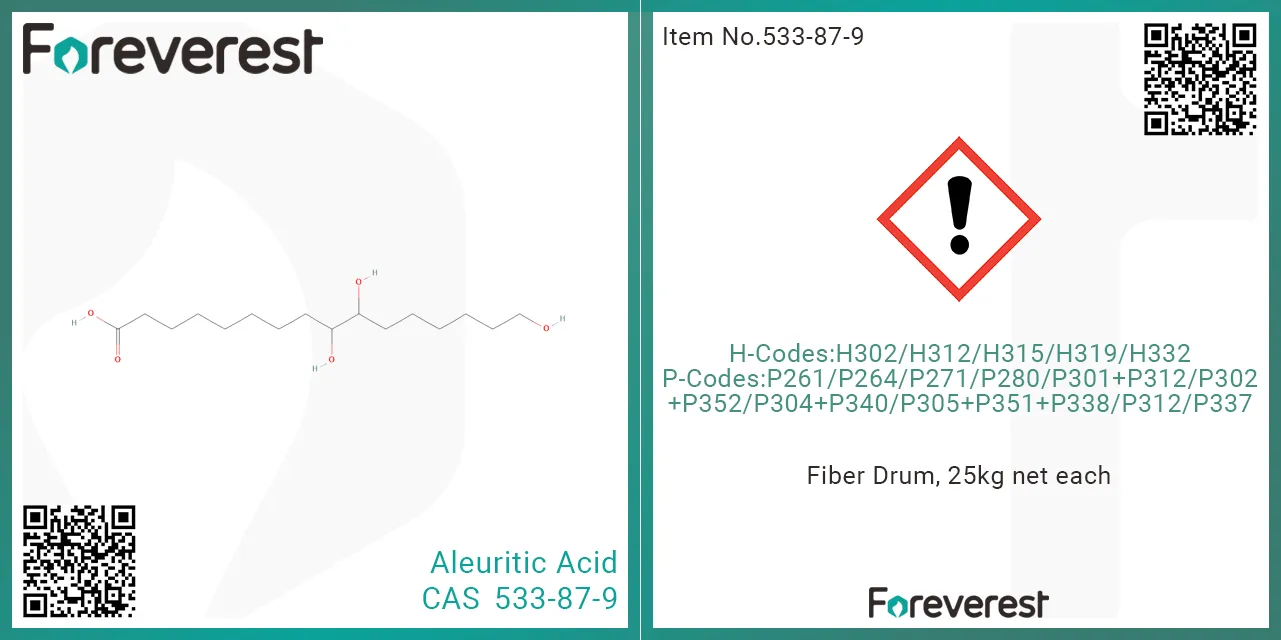
Aleuritic Acid
Aleuritic Acid is the straight-chain fatty acid part of lac resin, which generally accounts for 20% – 30%. It is obtained by saponification of shellac and soluble in low alcohols such as methyl, ethyl or isopropyl alcohol. It can be used to synthesize dihydroxyacetone and glucose laurate monoester. And it has good bonding ability to plastics.
Substance Identification
| Synonyms | (±)-Erythro-Aleuritic Acid |
| CAS | 6949-98-0, 533-87-9 |
| EINECS | 208-578-8 |
| FEMA | N/A |
| HS.CODE | 291719 |
| Molecular Formula | C16H32O5 |
| Molecular Weight | 304.42 |
Application & Uses
- mainly used in the perfumery industry as a starting material for the preparation of macrocyclic "musk" aroma compounds
- used as medicinal and bioactive compounds.
- used in synthesis of dihydroxyacetone, ambrettolide, civeton and Glucose Laurate, etc
- used as raw materials of prostaglandin
- used as aerospace Materials
- used as plastics with good adhesive properties
- proposed as substitute for alpha-hydroxy acid, which are widely used in skin care formulations, such as sun protection lotions/creams, anti-aging preparations, anti-wrinkle preparations.
Features & Benefits
- Soluble in hot water, methanol, ethanol and isopropyl alcohol,
- Insoluble in cold water, ether, petroleum ether carbon disulfide.
Sales Specification
| ITEM | VALUE | TEST METHOD & UNIT |
|---|---|---|
| Content | 95 min | % |
| Solubility | Soluble in alcohol | |
| Ignition Residue (as sulphate) | 0.1 max | % |
Q&A
Why do fragrance manufacturers often choose aleuritic acid as the starting material for macrocyclic musk synthesis instead of a petrochemical route?
Aleuritic acid is widely used because it is a shellac-derived, bio-based intermediate that already contains the functional groups needed to build macrocyclic musk structures such as ambrettolide and isoambrettolide. In practice, that makes it a convenient starting point for fragrance synthesis: manufacturers can convert one renewable raw material into a family of high-value musks without starting from a purely petrochemical backbone. Compared with many petrochemical routes, the aleuritic-acid pathway is attractive because it is already used at commercial scale and has a proven supply chain, including plants dedicated to ambrettolide production. The main decision factors for procurement are therefore feedstock availability, route economics, and the target musk specification, rather than the idea that one route is universally “better” in every case.
How does aleuritic acid differ from conventional alpha-hydroxy acids in structure and likely skincare positioning?
Aleuritic acid is not a direct substitute for conventional alpha-hydroxy acids in skincare because its structure is fundamentally different: it is a shellac-derived C16 triol fatty acid, whereas glycolic, lactic, and mandelic acids are compact alpha-hydroxy acids designed to deliver controlled exfoliation. The long C16 chain and three hydroxyl groups give aleuritic acid a different balance of lipophilicity and hydrogen-bonding potential, so it is better viewed as a bio-based specialty ingredient with formulation interest rather than as a standard exfoliating acid. Conventional AHAs have a well-established role in skin renewal but are also known to cause stinging, erythema, and pH-dependent irritation, while public clinical data for aleuritic acid in skincare remain limited. For that reason, any skincare claim for aleuritic acid should be framed cautiously and validated by formulation and safety testing rather than by analogy to common AHAs.
Why is aleuritic acid a useful starting material for prostaglandin synthesis?
Aleuritic acid is useful in prostaglandin synthesis because it is a shellac-derived C16 compound that already contains the functional-group pattern needed for prostanoid construction. Its vicinal diol can be selectively cleaved and elaborated into intermediates that are then converted into the cyclopentane-containing prostaglandin framework by established synthetic steps. That is why Reuter and Salomon described it in their 1978 Journal of Organic Chemistry paper as an “abundant source of prostanoid synthons.” In practical terms, the value of aleuritic acid is not that it is a finished prostaglandin precursor, but that it gives chemists a renewable, stereochemically useful starting point for building prostanoid intermediates.
GHS Hazard Statements
| H-Code | H302/H315/H319/H335 |
| P-Code | P261/P264/P270/P271/P280 |
| Response | P301+P312/P302+P352/P305+P351+P338/P337+P313 |
| Storage | P403+P233/P405 |
| Disposal | P501 |
| Signal Word | Warning |
Storage
- avoid contact with incompatible materials
- do not cut, drill, grind or weld such containers
- empty containers may contain residual dust which has the potential to accumulate following settling. such dusts may explode in the presence of an appropriate ignition source
- in addition ensure such activity is not performed near full, partially empty or empty containers without appropriate workplace safety authorisation or permit
- limit all unnecessary personal contact
- use in a well-ventilated area
- wear protective clothing when risk of exposure occurs
Relation Products
Relation Articles
Remark
The above information is believed to be accurate and represents the best explanation currently available to us. However, no liability is assumed for any consequences arising from the use of this content. The technical standards for our products are developed and updated jointly by our customers and ourselves; where any changes occur, the latest specification shall prevail and will be confirmed in the relevant contract.All suggestions and data provided are based on information we consider to be reliable and are offered in good faith, but without any guarantee, as the conditions and methods of use of our products are beyond our control. Foreverest® makes no warranties, whether express or implied, regarding the accuracy, completeness or suitability of this information, and expressly disclaims any implied warranty of fitness for a particular purpose. Prospective users should conduct their own tests and evaluations to determine the suitability of Foreverest® materials and any recommendations for their intended applications before adoption, and, where appropriate, should obtain confirmation or approval from the relevant regulatory authorities.Any references in this page to patents or patented technologies, including descriptive material derived from patents or citations of specific patent numbers, are provided for information only. They must not be interpreted as a recommendation to use our products in a manner that could infringe any third‑party patent, nor as a grant of any licence or permission to use patents owned by Foreverest®.
Start Purchasing
-

Minimum Order Quantity
Quote required -

Lead Time
Quote required -

Available Incoterms
Quote required -

Regional Availability
Quote required