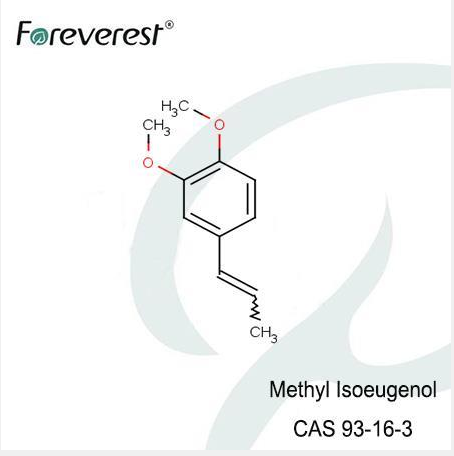
Methyl Isoeugenol
Methyl isoeugenol (isomethyleugenol) is a phenylpropanoid, specifically the methyl ether of isoeugenol. It is a significant component found in the essential oils extracted from various natural sources, including Acorus calamus, the bark of Croton malambo, and the rhizomes of Zingiber zerumbet, Hedychium coronarium, and Etlingera cevuga. It typically appears as a slightly thick, viscous liquid. Methyl isoeugenol is widely utilised in the formulation of flavours and fragrances.
Substance Identification
| Synonyms | Isoeugenyl Methyl Ether | Methylisoeugenol | Isomethyleugenol |
| CAS | 93-16-3 |
| EINECS | 202-224-6 |
| FEMA | 2476 |
| HS.CODE | 2909.30 |
| Molecular Formula | C11H14O2 |
| Molecular Weight | 178.23 |
Toxicological Information
| LD50 oral, rat | 2500mg/kg |
| LD50 dermal, rabbit | 5gm/kg min |
Application & Uses
- Flavour Compositions: Primarily used in the creation of vanilla, berry, and mixed spice flavour compositions.
- Fragrance Formulations: Incorporated into the formulation of carnation, rose, lilac, and Ylang-Ylang (often Yilan) fragrances.
- Isoeugenol Regulation: Serves as a regulating agent for isoeugenol.
- Clove Aroma Management: Applied as an extracting and adjusting agent for clove aroma.
- Pungency Modifier: Functions as a pungency modifier.
- Chocolate Production: Utilised in chocolate production.
Features & Benefits
- Solubility: Soluble in fixed oils and paraffin oil.
- Water Solubility: It has an estimated solubility in water of 169.1 mg/L at 25 °C.
Sales Specification
| ITEM | VALUE | TEST METHOD & UNIT |
|---|---|---|
| Appearance | Slight thick sticky liquid | |
| Odor | Eugenol aroma | |
| Refractive Index | 1.56600 to 1.56900 | @20.00 °C |
| Specific Gravity | 1.04800 to 1.05600 | @20.00 °C |
| Purity | 98 min | % |
Q&A
How should methyl isoeugenol be distinguished from methyl eugenol, isoeugenol, and eugenol, and why does double-bond position affect odour, toxicology data, and regulatory-document management?
Methyl isoeugenol (CAS 93-16-3; isoeugenyl methyl ether) is the methyl ether of isoeugenol and has the structure 1,2-dimethoxy-4-(prop-1-enyl)benzene, whereas methyl eugenol (CAS 93-15-2) is 4-allyl-1,2-dimethoxybenzene with a terminal allyl double bond; the two are positional isomers that differ in double-bond location. Eugenol (CAS 97-53-0) and isoeugenol (CAS 97-54-1) both retain a free phenolic hydroxyl group, with allyl and propenyl side chains respectively; methylation and double-bond position alter odour, oxidation behaviour, and metabolic pathways, so methyl isoeugenol commonly gives softer clove, carnation, and floral facets, while methyl eugenol is generally more spicy and aromatic. Methyl eugenol can undergo benzylic hydroxylation and sulfation to form reactive metabolites associated with DNA-adduct risk and is classified by IARC as Group 2A, whereas isoeugenol is Group 2B; methyl isoeugenol was not separately evaluated in IARC Volume 134, which should not be interpreted as evidence of absence of hazard or as automatic substitutability (Zhang et al., 2022, Archives of Toxicology; IARC Working Group, 2024, IARC Monographs Volume 134). Methyl isoeugenol has its own FEMA 2476 and U.S. 21 CFR 172.515 identity, but food, fragrance, cosmetic, and other applications still require market-specific review; purchasing documents must state the exact name, CAS number, GC assay, and SDS to prevent substitution among 93-16-3, 93-15-2, 97-53-0, and 97-54-1.
What does the page mean by describing methyl isoeugenol as an "isoeugenol regulating agent," and how is it used in fragrance formulation with practical compliance and stability considerations?
Methyl isoeugenol can serve as a heart-to-base material in spicy and floral fragrances, contributing softer, sweeter, persistent clove, carnation, floral, and slightly smoky facets in carnation, rose, tuberose, ylang-ylang, and oriental compositions while extending dry-down. In practice, "isoeugenol regulating agent" should mean that it can be blended with isoeugenol to adjust clove-spice intensity, roundness, and substantivity and, where appropriate, reduce the level of isoeugenol required; it is not a regulatory exemption and does not remove the need for finished-formula safety and labelling assessment. Isoeugenol is restricted under entry 73 of Annex III to the EU Cosmetics Regulation: it is limited to 0.02% in finished non-oral products and requires individual labelling above 0.001% in leave-on products or 0.01% in rinse-off products, while methyl isoeugenol is not listed as a synonym or substitute under that Annex III entry (European Commission, 2009, Regulation (EC) No 1223/2009, Annex III). Under the current 51st Amendment, methyl isoeugenol has no separate IFRA category restriction identified, but the current supplier IFRA Certificate of Conformity, SDS, and finished-product safety assessment remain necessary; because it may turn red under light and in alkaline bases, it should not be used directly in high-pH shampoos, shower gels, or soap systems without accelerated-stability verification.
What is the regulatory status of methyl isoeugenol as a food flavouring, and how does it differ from methyl eugenol?
Methyl isoeugenol (isoeugenyl methyl ether, CAS 93-16-3) is currently listed in Appendix B.3 of GB 2760-2024 as a permitted synthetic food flavouring substance under code S0081 with FEMA number 2476; its technical requirement is not less than 95% assay, and actual use must follow the applicable principles for food flavourings and compounded food flavours. Internationally, it has JECFA number 1266, EU FLAVIS number 04.013, and a U.S. 21 CFR 172.515 identity; JECFA concluded in 2003 that it presents "no safety concern at current levels of intake" when used as a flavouring, rather than establishing a fixed ADI of 5 mg/kg body weight per day (JECFA, 2003, Safety Evaluation of Certain Food Additives and Contaminants). Methyl isoeugenol and methyl eugenol (CAS 93-15-2) are positional isomers, but they require separate toxicological and regulatory assessment: methyl eugenol is classified by IARC as Group 2A and cannot be used as a directly added food flavouring in the EU or United States, whereas methyl isoeugenol was not separately evaluated in IARC Volume 134 and retains its own food-flavouring identity (IARC Working Group, 2024, IARC Monographs Volume 134). Customers should therefore manage methyl isoeugenol using its exact CAS number, chemical name, GC assay, and target-market regulatory documentation and should not transfer the carcinogenicity classification, prohibition status, or compliance documents of methyl eugenol directly to methyl isoeugenol.
Similar Specs
GHS Hazard Statements
| H-Code | H302/H315/H319/H335 |
| P-Code | P261/P264/P270/P271/P280 |
| Response | P301+P312 P305+P351+P338 |
| Storage | P403+P233 P405 |
| Disposal | P501 |
| Signal Word | Warning |
| Pictograms | GHS07 |
Storage
- Flammable materials should be stored in a dedicated safety storage cabinet or room.
- Ensure all equipment containing the material is earthed.
- Keep away from heat and sources of ignition.
- Keep containers tightly closed.
- Store in a cool, well-ventilated place.
Relation Articles
Remark
The above information is believed to be accurate and represents the best explanation currently available to us. However, no liability is assumed for any consequences arising from the use of this content. The technical standards for our products are developed and updated jointly by our customers and ourselves; where any changes occur, the latest specification shall prevail and will be confirmed in the relevant contract.All suggestions and data provided are based on information we consider to be reliable and are offered in good faith, but without any guarantee, as the conditions and methods of use of our products are beyond our control. Foreverest® makes no warranties, whether express or implied, regarding the accuracy, completeness or suitability of this information, and expressly disclaims any implied warranty of fitness for a particular purpose. Prospective users should conduct their own tests and evaluations to determine the suitability of Foreverest® materials and any recommendations for their intended applications before adoption, and, where appropriate, should obtain confirmation or approval from the relevant regulatory authorities.Any references in this page to patents or patented technologies, including descriptive material derived from patents or citations of specific patent numbers, are provided for information only. They must not be interpreted as a recommendation to use our products in a manner that could infringe any third‑party patent, nor as a grant of any licence or permission to use patents owned by Foreverest®.
Start Purchasing
-

Minimum Order Quantity
Quote required -
Lead Time
Quote required -
Available Incoterms
Quote required -
Regional Availability
Quote required