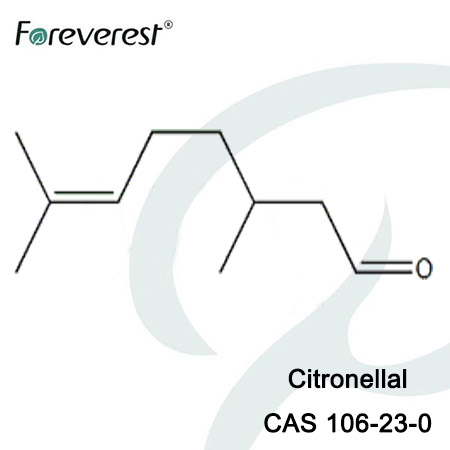
Citronellal
Citronellal is a colorless to yellow liquid with aromas of lemon, citronella and rose. It has 3 kinds of optical rotators, D -, l-, and dl-. D-Citronella is abundant in essential oils and is the main component of citronella oil and eucalyptus oil. In industry, it can be extracted from natural plants by single separation method. It is mainly obtained from pinene in the production of pinane, 3, 7-dimethyl-octadiene, 1,6- and citronellal or be prepared by catalytic dehydrogenation of citronellol in the presence of lead chromium catalyst.
Substance Identification
| Synonyms | Citronel | RHODINAL |
| CAS | 106-23-0 |
| EINECS | 203-376-6 |
| FEMA | 2307 |
| HS.CODE | 29124100 |
| Molecular Formula | C10H18O |
| Molecular Weight | 154.25 |
Toxicological Information
| LD50 oral, rat | 2420mg/kg |
| LD50 skin, rabbit | 2500mg/kg min |
Application & Uses
- used as flavoring to prepare citrus and cherry essences
- used as raw material for the synthesis of citronelol, hydroxycitronelal, menthol, etc.
- used as fixative agent, modifier and regulating agent in cosmetics
- used as aroma enhancer for food and beverage
Sales Specification
| ITEM | VALUE | TEST METHOD & UNIT |
|---|---|---|
| Appearance | Colorless to slightly yellow transparent liquid | |
| Odor | A pleasantly herbaceous, peppery, woody odor | |
| Purity | 85 min | % |
Q&A
How do D-, L-, and DL-citronellal differ in identity, physical properties, and stereochemical significance?
Citronellal (C₁₀H₁₈O; MW 154.25) has one stereogenic centre at C-3 and therefore two enantiomers: D-(+)-citronellal, or (3R)-(+)-citronellal (CAS 2385-77-5), and L-(−)-citronellal, or (3S)-(−)-citronellal (CAS 5949-05-3); DL-(±)-citronellal normally denotes their racemic mixture and is commonly associated with CAS 106-23-0. The pure enantiomers have opposite optical rotations, while a racemic mixture has optical rotation close to zero; however, their intrinsic boiling point, density, and refractive index are the same under achiral measurement conditions, so these properties cannot replace optical rotation or chiral GC for confirming enantiomeric composition. Stereochemistry is decisive in downstream menthol chemistry: industrial routes cyclise (R)-(+)-citronellal predominantly to (−)-isopulegol and then hydrogenate it to (−)-menthol, whereas the opposite enantiomer produces the mirror-image isomer series rather than the same chiral product (Timmerman et al., 2007, Tetrahedron). For chiral fragrance materials, menthol intermediates, or enantioselective reactions, customers should specify the required (R)/(S) configuration or enantiomeric excess and release material by chiral GC together with optical rotation; for general fragrance use, odour, GC assay, and batch consistency remain the primary selection criteria.
In which botanical sources does each optical isomer of citronellal naturally occur, and what does this mean for natural-source procurement?
(R)-(+)-Citronellal, or D-(+)-citronellal (CAS 2385-77-5), is the most commercially relevant enantiomer in Cymbopogon oils; chiral GC detected citronellal as 100% (+) in root, stem, and leaf samples of Cymbopogon winterianus, while citronellal isolated from commercial citronella oil showed approximately 88% enantiomeric excess of the (R)-(+)-form (Cahyono et al., 2013, Malaysian Journal of Fundamental and Applied Sciences). Corymbia citriodora (lemon eucalyptus) oil is commonly citronellal-rich, but its citronellal enantiomeric composition cannot be predicted from the botanical name alone; studied samples can be close to racemic rather than consistently enriched in the D-(+) form. (S)-(−)-Citronellal (CAS 5949-05-3) can co-occur as the natural counterpart in essential oils, while DL-(±)-citronellal (commonly associated with CAS 106-23-0) may result from chemical synthesis, from a natural source with an approximately 1:1 enantiomer ratio, or from an unresolved botanical fraction, so racemic composition alone does not establish synthetic origin. Where natural origin and defined chirality are both required, we recommend specifying the botanical source, physical extraction or separation process, complete GC profile, chiral-GC enantiomer ratio, and optical rotation; the names “citronella oil” and “lemon eucalyptus oil” alone do not guarantee an (R)/(S) configuration or an enantiomeric-excess value.
How does D-(+)-citronellal serve as a key chiral building block in industrial (−)-menthol synthesis, and why does its stereochemistry matter?
D-(+)-Citronellal, or (R)-(+)-citronellal (CAS 2385-77-5), is an important chiral intermediate for high-optical-purity (−)-menthol because its C-3 stereocentre influences the diastereoselectivity of acid-catalysed cyclisation to isopulegol and is carried through subsequent hydrogenation to the menthol product. In the Takasago route, myrcene is converted to N,N-diethylgeranylamine, then asymmetrically isomerised with a chiral Rh-BINAP catalyst to high-ee (+)-citronellal, which is hydrolysed, cyclised predominantly to (−)-isopulegol, and hydrogenated to (−)-menthol (Dylong et al., 2022, Flavour and Fragrance Journal). Related BASF routes use terpene feedstocks such as citral, geraniol, or nerol to generate optically active (+)-citronellal through asymmetric catalytic steps before cyclisation and hydrogenation; the exact catalyst system and process conditions should be confirmed from the relevant supplier or patent documentation (Dylong et al., 2022, Flavour and Fragrance Journal). We therefore recommend specifying (R)/(S) configuration, enantiomeric excess, optical rotation, and chiral-GC result as key release parameters for chiral-synthesis-grade citronellal; racemic or S-citronellal can serve other synthetic routes, but they do not directly provide the same chiral product required for target (−)-menthol production.
When sourcing citronellal for stereospecific applications, how should customers specify the required isomer and verify enantiomeric identity?
The generic name “citronellal” and CAS 106-23-0 can represent material with unspecified enantiomeric composition and are therefore insufficient for menthol, isopulegol, or other synthesis routes that require a single configuration. Customers should specify either (R)-(+)-citronellal/D-(+) (CAS 2385-77-5) or (S)-(−)-citronellal/L-(−) (CAS 5949-05-3), together with the target ee, GC assay, related-substances limit, water limit, and the conditions and acceptance criterion for optical rotation. Enantiomeric composition should be determined by a validated chiral-GC method; modified β-cyclodextrin phases such as β-DEX 225 can resolve citronellal enantiomers, but each laboratory should use certified R/S standards or a validated racemic reference to establish retention times, resolution, linearity, quantitation limit, and method precision (Cahyono et al., 2013, Malaysian Journal of Fundamental and Applied Sciences). Optical rotation is useful as a rapid supporting check for batch consistency, but it is affected by concentration, solvent, temperature, and other chiral impurities and cannot replace chiral GC; for multistep chiral synthesis, both results should form part of the COA and incoming-release requirements.
GHS Hazard Statements
| H-Code | H227/H315/H317/H319 |
| P-Code | P210/P261/P264/P272/P280 |
| Response | P302+P352 P305+P351+P338 P333+P313 P337+P313 P370+P378 |
| Storage | P403+P235 |
| Disposal | P501 |
| Signal Word | Warning |
| Pictograms | GHS07 |
Storage
- flammable materials should be stored in a separate safety storage cabinet or room
- ground all equipment containing material
- keep away from heat
- keep away from sources of ignition
- keep container tightly closed
- keep in a cool, well-ventilated place
Relation Products
Relation Articles
Remark
The above information is believed to be accurate and represents the best explanation currently available to us. However, no liability is assumed for any consequences arising from the use of this content. The technical standards for our products are developed and updated jointly by our customers and ourselves; where any changes occur, the latest specification shall prevail and will be confirmed in the relevant contract.All suggestions and data provided are based on information we consider to be reliable and are offered in good faith, but without any guarantee, as the conditions and methods of use of our products are beyond our control. Foreverest® makes no warranties, whether express or implied, regarding the accuracy, completeness or suitability of this information, and expressly disclaims any implied warranty of fitness for a particular purpose. Prospective users should conduct their own tests and evaluations to determine the suitability of Foreverest® materials and any recommendations for their intended applications before adoption, and, where appropriate, should obtain confirmation or approval from the relevant regulatory authorities.Any references in this page to patents or patented technologies, including descriptive material derived from patents or citations of specific patent numbers, are provided for information only. They must not be interpreted as a recommendation to use our products in a manner that could infringe any third‑party patent, nor as a grant of any licence or permission to use patents owned by Foreverest®.
Start Purchasing
-

Minimum Order Quantity
Quote required -

Lead Time
Quote required -

Available Incoterms
Quote required -

Regional Availability
Quote required