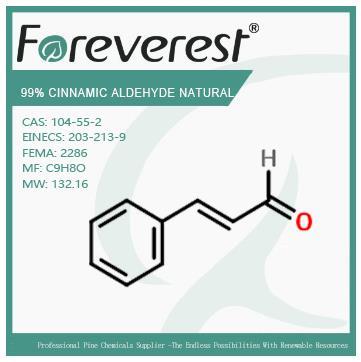
Cinnamic Aldehyde Natural
Cinnamic Aldehyde is naturally found in cinnamon oil, cassia oil, and patchouli oil. It appears pale yellow viscous liquid with cinnamon and a spicy odor. Cinnamic aldehyde has Cis-isomer and trans-isomer. Cinnamic Aldehyde is industrially prepared by condensation of benzaldehyde and acetaldehyde in dilute alkali solution. It is widely used in flavor and fragrance formulation of daily chemical products and agriculture.
Substance Identification
| Synonyms | Cinnamal |
| CAS | 104-55-2 |
| EINECS | 203-213-9 |
| FEMA | 2286 |
| HS.CODE | 2912.29 |
| Molecular Formula | C9H8O |
| Molecular Weight | 132.162 |
Toxicological Information
| LD50 oral, rat | 2220mg/kg |
Application & Uses
- used as a fresh-keeping agent for fruits
- used in flavor formulation, mainly used for making cinnamon, cinnamon and cola flavors, and also for alcohol and tobacco
- used as a flavoring in chewing gum, ice cream, candy, and beverages.
- used as fragrance intensifier of soaps
- used in some perfumes of natural, sweet, or fruity scents
- used as a solvent in industry
- used as pharmaceutical intermediates
- used as an effective insecticide and fungicide
- works as a potent fumigant and practical repellant for adult mosquitos
- used as a corrosion inhibitor for steel
- used in agriculture to produce fungicide etc.
Features & Benefits
- Solubility: Hardly soluble in water, glycerin, soluble in alcohol, ether and petroleum ether. Can volatilize with water vapor
- Stability: unstable in strong acid or strong alkaline medium, easy to cause discoloration, easy to oxidize in air
Sales Specification
| ITEM | VALUE | TEST METHOD & UNIT |
|---|---|---|
| Appearance | Pale yellow to yellow liquid | |
| Odor | Strong cinnamon aroma | |
| Refractive Index | 1.619 to 1.625 | @20 ºC |
| Acid Value | 10.0 max | @A.V. |
| Purity | 99 min | @GC, % |
Q&A
How does cinnamic aldehyde work as a natural preservation strategy in fruit coatings and food packaging?
The α,β‑unsaturated carbonyl structure of cinnamic aldehyde exerts antimicrobial effects by interacting with microbial cell membrane proteins and lipids, altering membrane fatty‑acid biosynthesis pathways and disrupting membrane integrity, which compromises the permeability barrier that bacteria and fungi depend on. In practice, incorporating cinnamic aldehyde into edible coatings or packaging films allows its gradual release and vapor‑phase activity to suppress mold and bacterial growth on stored fruit within the package headspace, extending shelf life without requiring an immediate full release of the active compound. Formulation teams must balance antimicrobial loading against organoleptic thresholds, because the characteristic cinnamon aroma and flavor can migrate into the food matrix at higher doses; this trade‑off is generally easier in whole‑citrus applications, where the peel provides a natural barrier, than in cut‑fruit or berry formats where the edible surface is directly exposed.
Why is cinnamic aldehyde unsuitable for pet care products, particularly those intended for cats?
Cats have documented deficiencies in certain hepatic UDP‑glucuronosyltransferase enzymes, which are key for glucuronidation and clearance of many aromatic and essential‑oil components, including compounds structurally related to cinnamic aldehyde; this means that such substances are metabolized and eliminated more slowly in cats, increasing the risk of accumulation and hepatotoxicity at exposure levels that dogs or humans might tolerate more safely (Court, 2013, J. Vet. Pharmacol. Ther.; Shelton, 2019, J. Essent. Oil Res.). The highest risk arises with concentrated formats—essential‑oil diffusers, leave‑on grooming sprays, and coat conditioners—where inhalation, dermal absorption and ingestion via grooming all contribute to systemic exposure, and even residual cinnamic aldehyde in litter deodorizers or bedding fragrances can be ingested as cats clean their fur. For dogs, ground cinnamon powder is classified by the ASPCA as non‑toxic in small amounts, but concentrated cinnamon essential oil and cinnamaldehyde remain capable of causing irritation and digestive upset, and cinnamaldehyde itself is recognized as a moderate to strong skin sensitiser (classified under H317) in humans and test animals, implying analogous sensitisation risks in leave‑on pet products (NICNAS, 2016, Tier II Assessment of Cinnamaldehyde). Consequently, formulators developing broad‑spectrum pet care ranges generally avoid cinnamic aldehyde and related cinnamon oils altogether.
Similar Specs
GHS Hazard Statements
| H-Code | H315/H317/H319 |
| P-Code | P261/P264/P272/P280 |
| Response | P302+P352 P305+P351+P338 P333+P313 P337+P313 P362+P364 |
| Storage | P403+P233 |
| Disposal | P501 |
| Signal | Warning |
Storage
- flammable materials should be stored in a separate safety storage cabinet or room
- ground all equipment containing material
- keep away from heat
- keep away from sources of ignition
- keep container tightly closed
- keep in a cool, well-ventilated place
Relation Products
Relation Articles
- Cinnamon Oil Compound Might Block Bacteria Like P. aeruginosa from Forming Biofilms, Researchers Say
- Synthesizing the Future
- Study and Application of Cinnamic aldehyde
- An Aroma Chemical Profile - Benzaldehyde
- Analysis of Essential Oil on Antimicrobial Resistance
- Biological function and mechanism of plant extracts (1)
- Biological function and mechanism of plant extracts(2)
- Biological functions and mechanism of plant extracts (1)
- Effects of Cinnamon in Chronic Diseases
- Essential oils in preventing and controlling crop diseases
- Plant Extract for Pet Medical Use
- Application Research of Cinnamic aldehyde in Fragrance & Flavor, Daily Chemicals and Food Additives
Remark
The above information is believed to be accurate and represents the best explanation currently available to us. However, no liability is assumed for any consequences arising from the use of this content. The technical standards for our products are developed and updated jointly by our customers and ourselves; where any changes occur, the latest specification shall prevail and will be confirmed in the relevant contract.All suggestions and data provided are based on information we consider to be reliable and are offered in good faith, but without any guarantee, as the conditions and methods of use of our products are beyond our control. Foreverest® makes no warranties, whether express or implied, regarding the accuracy, completeness or suitability of this information, and expressly disclaims any implied warranty of fitness for a particular purpose. Prospective users should conduct their own tests and evaluations to determine the suitability of Foreverest® materials and any recommendations for their intended applications before adoption, and, where appropriate, should obtain confirmation or approval from the relevant regulatory authorities.Any references in this page to patents or patented technologies, including descriptive material derived from patents or citations of specific patent numbers, are provided for information only. They must not be interpreted as a recommendation to use our products in a manner that could infringe any third‑party patent, nor as a grant of any licence or permission to use patents owned by Foreverest®.
Start Purchasing
-

Minimum Order Quantity
Quote required -

Lead Time
Quote required -

Available Incoterms
Quote required -

Regional Availability
Quote required