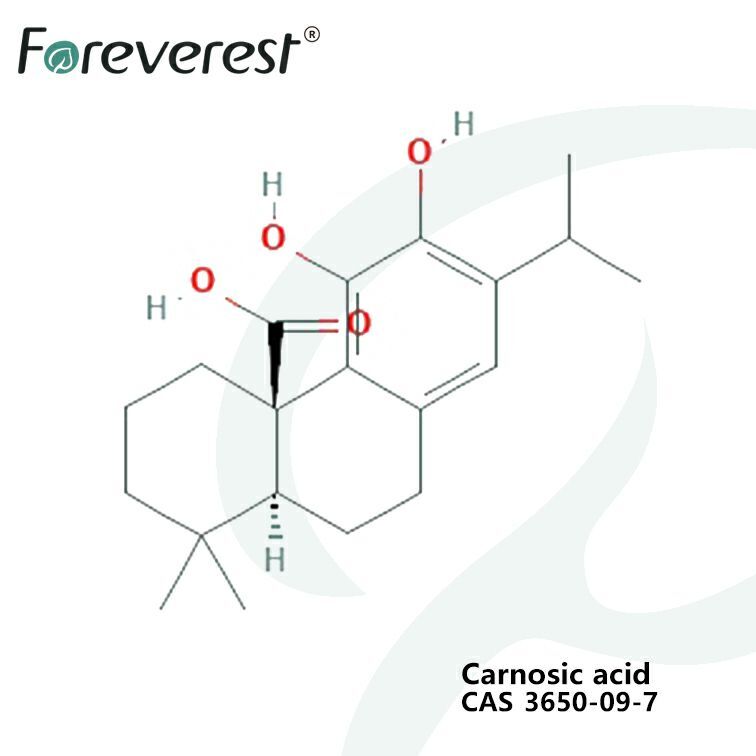
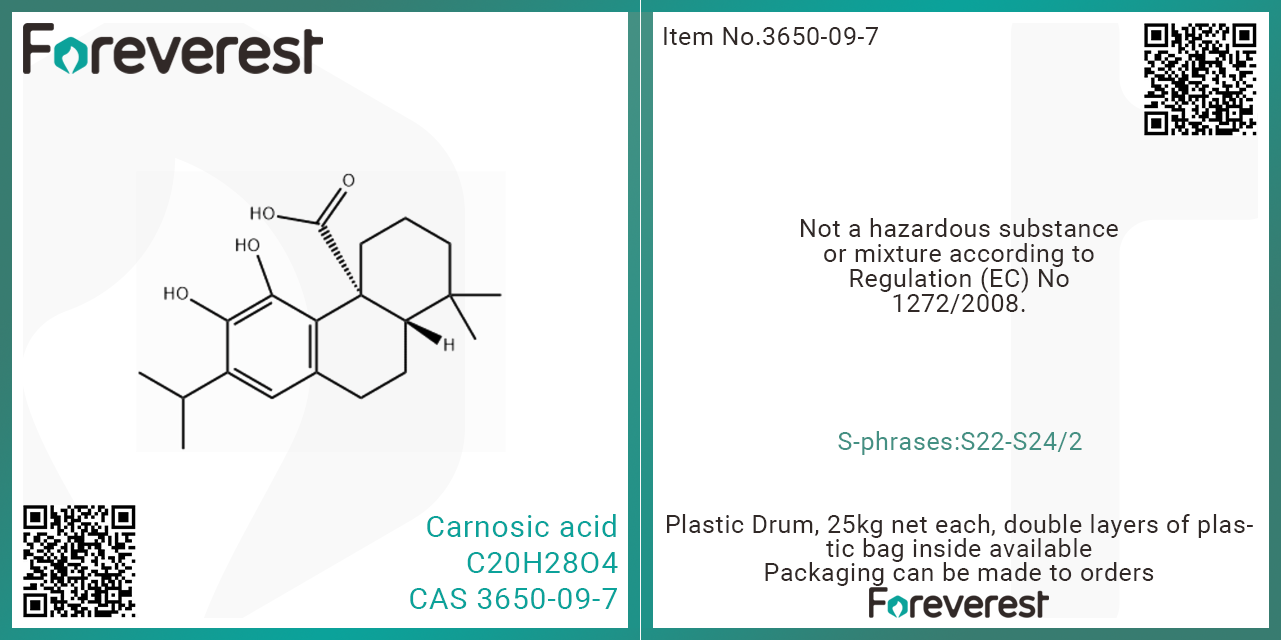
Carnosic acid
Carnosic acid is natural benzenediol abietane diterpene. It is extracted from rosemary and common sage. Carnosic acid appears dark brown-yellow to light white powder. It is widely used in the food, cosmetic and chemical industries.
Substance Identification
| Synonyms | Salvin | (4aR,10aS)-5,6-Dihydroxy-7-isopropyl-1 | 1-dimethyl-1,3,4,9,10,10a-hexahydro-2H-phenanthrene-4a-carboxylic acid |
| CAS | 3650-09-7 |
| EINECS | N/A |
| FEMA | N/A |
| HS.CODE | N/A |
| Molecular Formula | C20H28O4 |
| Molecular Weight | 332.43 |
Application & Uses
- increasingly used in food and nutrition health industries as main active antioxidants of food additives
- used as an ingredient of some hair care and personal care products, such as tooth grinding and gargle agent, toothpaste, mouthwash and chewing gum, etc.
- used as additives in pet feed
- used in the pharmaceutical industry for the treatment of diabetes and gastric disease. It is proven to be efficient in the treatment of hyperglycemia as well
- used in some chemical and medical research
Features & Benefits
- S1 safe pet care ingredient
- a natural, efficient and stable (high temperature durable), security, non-toxic and none-side-effects, oil-soluble antioxidants and a green food additive
Sales Specification
| ITEM | VALUE | TEST METHOD & UNIT |
|---|---|---|
| Appearance | Yellow green or light yellow powder | |
| Purity | 10 to 90 | @HPLC, % |
Q&A
How does carnosic acid function as an antioxidant, and how does its mechanism differ in practice from synthetic antioxidants such as BHA, BHT, and TBHQ?
Carnosic acid is a lipophilic phenolic diterpene antioxidant in rosemary extract, and its ortho-diphenol structure can donate hydrogen atoms to lipid peroxyl radicals, interrupting the autoxidation chain of unsaturated lipids; its principal direct mechanism is therefore described as hydrogen-atom transfer (HAT) (Wei et al., 2021, Antioxidants). In oils, meat products, and baked foods, carnosic acid and its oxidation product carnosol can delay oxidation, but their relative performance versus BHA, BHT, TBHQ, or tocopherols depends on the food matrix, temperature, metal ions, dose, and test endpoint; for example, carnosic acid outperformed TBHQ in a thermal oleic-acid model, whereas TBHQ can remain stronger in other test systems. In cell and animal studies, carnosic acid can oxidise to electrophilic quinone-like products that modify critical Keap1 cysteine residues and promote Nrf2-regulated antioxidant genes, including HO-1, NQO1, and glutathione-synthesis-related enzymes; this supports research interest in cellular protection under oxidative stress but does not establish a disease-treatment indication (Okamoto et al., 2008, Journal of Neurochemistry). For food use, GB 1886.172-2016 regulates rosemary extract rather than carnosic acid at any purity and uses carnosic acid and carnosol among its key antioxidant quality markers; dosage should therefore be selected from the specific extraction process, active-component content, and intended food category rather than applying a single study’s ppm level to every formulation.
Can standardised rosemary extract containing carnosic acid be used safely in dog and cat food, and what supports its safe use?
Standardised rosemary extract containing carnosic acid as a key antioxidant component can be used as an antioxidant in complete dog and cat feed; the EU has authorised a specific rosemary-leaf extract for both species, providing a reliable pet-food safety basis when the defined specification and use limits are followed (EFSA FEEDAP Panel, 2022, EFSA Journal). The authorised preparation is obtained from dried rosemary leaves by acetone or ethanol extraction, contains 9–12% carnosic acid and at least 10% total carnosic acid plus carnosol, and is subject to controls for components such as residual solvents and camphor (European Commission, 2024, Commission Implementing Regulation (EU) 2024/1068). In complete feed at 12% moisture, the authorised maximum inclusion levels are 300 mg/kg for dogs and 50 mg/kg for cats, corresponding to maximum carnosic-acid concentrations of 34 mg/kg and 5 mg/kg, respectively; the lower authorised level for cats means that formulations must be designed and calculated separately by species (EFSA FEEDAP Panel, 2022, EFSA Journal). In China, the Ministry of Agriculture and Rural Affairs expanded the feed-additive scope of rosemary extract in 2026 to broilers, meat ducks, and weaned piglets for improved production performance and antioxidant capacity; dog and cat products should nevertheless be designed against the regulations, extract specification, and actual use level applicable to the target pet species (Ministry of Agriculture and Rural Affairs of China, 2026, Announcement No. 1025).
What emerging research directions are being explored for carnosic acid beyond its food-antioxidant function?
Carnosic acid is receiving preclinical attention in neuroprotection, inflammation modulation, metabolic health, and delivery technology, with oxidative-stress-responsive Keap1–Nrf2–ARE activation as a common mechanistic theme. Recent work with diAcCA, a prodrug designed to release carnosic acid in vivo, reported improvements in memory, synaptic density, phosphorylated tau, and amyloid-related measures in 5xFAD Alzheimer’s-disease mice; this suggests that improved brain delivery and stability may be more developmentally relevant than direct use of conventional carnosic acid, but it does not constitute clinical-efficacy evidence (Banerjee et al., 2025, Antioxidants). In inflammatory models, carnosic acid has downregulated NF-κB, MAPK, and related signalling while reducing inflammatory markers including TNF-α, IL-1β, IL-6, COX-2, iNOS, and nitric oxide; these findings come from macrophage, neuronal-cell, and animal experiments and are suitable for mechanism studies or anti-inflammatory formulation screening, not direct disease-treatment claims (Habtemariam, 2023, Biomedicines; Wang et al., 2018, Frontiers in Pharmacology). AMPK activation, regulation of lipid and glucose metabolism, inhibition of PPARγ-associated adipogenesis, and suppression of tumour-cell growth also remain early-stage research directions; as an ingredient, carnosic acid is better positioned for food preservation, cosmetic antioxidant systems, or nutrition-and-health research, while any medicinal indication requires formulation development, human clinical trials, and regulatory approval.
Package
- Plastic Drum, 25kg net each, double layers of plastic bag inside available
GHS Hazard Statements
| H-Code | H302/H315/H319/H335 |
| P-Code | P261/264/270/271/280 |
| Response | P301+P312 P302+P352 P304+P340+P312 P305+P351+P338 P330 P332+P313 P337+P313 |
| Storage | P403+P233 P405 |
| Disposal | P501 |
| Signal Word | Warning |
| Pictograms | GHS07 |
Storage
- keep separated from incompatible substances
- store and handle in accordance with all current regulations and standards
- store in a cool, dry place
- store in a tightly closed container
Remark
The above information is believed to be accurate and represents the best explanation currently available to us. However, no liability is assumed for any consequences arising from the use of this content. The technical standards for our products are developed and updated jointly by our customers and ourselves; where any changes occur, the latest specification shall prevail and will be confirmed in the relevant contract.All suggestions and data provided are based on information we consider to be reliable and are offered in good faith, but without any guarantee, as the conditions and methods of use of our products are beyond our control. Foreverest® makes no warranties, whether express or implied, regarding the accuracy, completeness or suitability of this information, and expressly disclaims any implied warranty of fitness for a particular purpose. Prospective users should conduct their own tests and evaluations to determine the suitability of Foreverest® materials and any recommendations for their intended applications before adoption, and, where appropriate, should obtain confirmation or approval from the relevant regulatory authorities.Any references in this page to patents or patented technologies, including descriptive material derived from patents or citations of specific patent numbers, are provided for information only. They must not be interpreted as a recommendation to use our products in a manner that could infringe any third‑party patent, nor as a grant of any licence or permission to use patents owned by Foreverest®.
Start Purchasing
-

Minimum Order Quantity
Quote required -

Lead Time
Quote required -

Available Incoterms
Quote required -

Regional Availability
Quote required