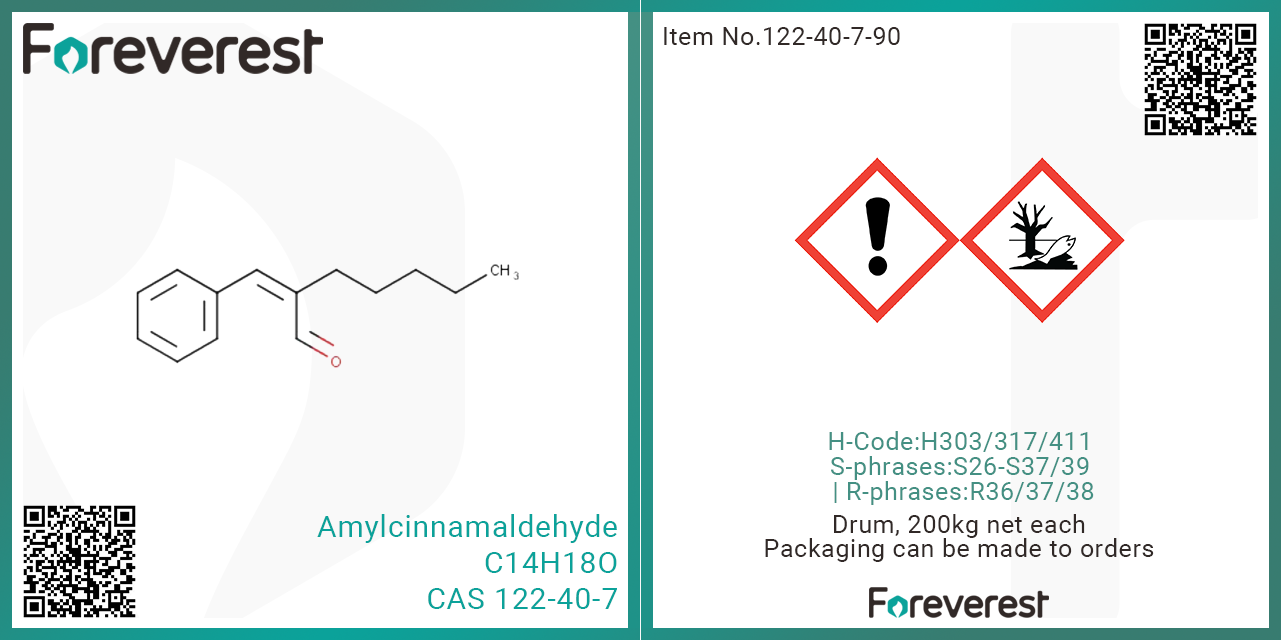
Amylcinnamaldehyde
Amyl cinnamaldehyde is one of common ingredient in perfumery. It is synthesized from benzaldehyde and n- heptanal by aldol condensation with catalyst potassium hydroxide in solvent ethylene glycol. It’s end applications include soap, detergent, beauty care product,and household products.
Substance Identification
| Synonyms | Amyl cinnamaldehyde | alpha-Amylcinnamaldehyde | 2-Benzylideneheptanal |
| CAS | 122-40-7 |
| EINECS | 204-541-5 |
| FEMA | 2061 |
| HS.CODE | 290600 |
| Molecular Formula | C14H18O |
| Molecular Weight | 202.297 |
Toxicological Information
| LD50 oral, rat | 3730mg/kg |
Application & Uses
- used as fragrance formulation of soap, detergent, beauty care product,and household product
- used as excellent fixative in perfume
- used as pharmaceutical intermediate
- used as food flavor to prepare apple, apricot, peach, strawberry and other edible flavor
- used as biochemical reagent
Sales Specification
| ITEM | VALUE | TEST METHOD & UNIT |
|---|---|---|
| Appearance | Yellow Liquid | |
| Odor | Sweet, floral jasmine aroma | |
| Purity | 95 min | @GC, % |
Q&A
Why is amyl cinnamal particularly suitable for soap and detergent fragrances rather than relying only on other jasmine-type aroma materials?
Amyl cinnamal is useful as a jasmine-floral body note in soap and detergent fragrances because it combines alkaline-system suitability, substantivity contribution, and a more controllable cost than natural jasmine materials. First, it is generally regarded as suitable for conventional alkaline soap perfumery, helping to retain a warm, sweet floral structure through manufacture and storage; performance should nevertheless be verified under the actual process temperature, alkalinity, and storage conditions. Second, its hydrophobic character and reported odour persistence can provide a lasting floral background on fabric, skin, or washed substrates, although actual deposition and substantivity depend on the surfactant system, fragrance carrier, deposition aids, and wash conditions. Third, as a scalable single aroma chemical, it provides a cost-effective and more consistent way to build a jasmine-type floral accord, whereas jasmine absolute is constrained by flower harvesting, low extraction yield, and origin-dependent supply; it is better used to add natural, indolic, or animalic complexity. Amyl cinnamal is IFRA-restricted and associated with skin-sensitisation concerns, so the final use level must be calculated for the finished-product category, complete fragrance formula, and intended market (Api et al., 2015, Food and Chemical Toxicology; IFRA, 2023, 51st Amendment Standards).
What evidence supports evaluating amyl cinnamal in pharmaceutical research synthesis, and which chemical transformations can it support without implying drug activity?
Available public evidence supports evaluating amyl cinnamal as an α,β-unsaturated aldehyde building block in research-oriented organic synthesis, not as an established pharmaceutical intermediate or pharmacologically active ingredient. Its conjugated enal structure can participate in transformations that assemble complex heterocyclic frameworks; for example, an amyl-cinnamaldehyde-derived substrate was used in a palladium-catalysed [5+2] annulation to prepare spirobarbiturate–tetrahydrooxepine products (Gao et al., 2020, Organic Letters). This demonstrates synthetic compatibility only and does not establish a therapeutic effect, a defined drug class, or clinical development of the starting material or resulting products. Published antimicrobial screening concerns α-amylcinnamaldehyde oxime against Enterococcus hirae, rather than amyl cinnamal against Staphylococcus aureus, Escherichia coli, or cancer cell lines; those in-vitro findings cannot be interpreted as drug efficacy or clinical potential (Surowiak et al., 2022, Scientific Reports). For pharmaceutical process development, assay, isomeric composition, related substances, residual solvents, and elemental impurities should be controlled against the intended route; ICH Q3A(R2) defines impurity-identification and qualification principles for new drug substances, rather than a universal purity requirement for this intermediate (ICH, 2006, Q3A(R2) Impurities in New Drug Substances).
GHS Hazard Statements
| H-Code | H315/H317/H319/H335/H411 |
| P-Code | P261/P264/P271/P272/P273/P280 |
| Response | P302+P352 P304+P340 P305+P351+P338 P312 P333+P313 P337+P317 P362+P364 P391 |
| Storage | P403+P233 P405 |
| Disposal | P501 |
| Signal Word | Warning |
| Pictograms | GHS07, GHS09 |
Storage
- flammable materials should be stored in a separate safety storage cabinet or room
- ground all equipment containing material
- keep away from heat
- keep away from sources of ignition
- keep container tightly closed
- keep in a cool, well-ventilated place
Relation Articles
Remark
The above information is believed to be accurate and represents the best explanation currently available to us. However, no liability is assumed for any consequences arising from the use of this content. The technical standards for our products are developed and updated jointly by our customers and ourselves; where any changes occur, the latest specification shall prevail and will be confirmed in the relevant contract.All suggestions and data provided are based on information we consider to be reliable and are offered in good faith, but without any guarantee, as the conditions and methods of use of our products are beyond our control. Foreverest® makes no warranties, whether express or implied, regarding the accuracy, completeness or suitability of this information, and expressly disclaims any implied warranty of fitness for a particular purpose. Prospective users should conduct their own tests and evaluations to determine the suitability of Foreverest® materials and any recommendations for their intended applications before adoption, and, where appropriate, should obtain confirmation or approval from the relevant regulatory authorities.Any references in this page to patents or patented technologies, including descriptive material derived from patents or citations of specific patent numbers, are provided for information only. They must not be interpreted as a recommendation to use our products in a manner that could infringe any third‑party patent, nor as a grant of any licence or permission to use patents owned by Foreverest®.
Start Purchasing
-

Minimum Order Quantity
Quote required -

Lead Time
Quote required -

Available Incoterms
Quote required -

Regional Availability
Quote required