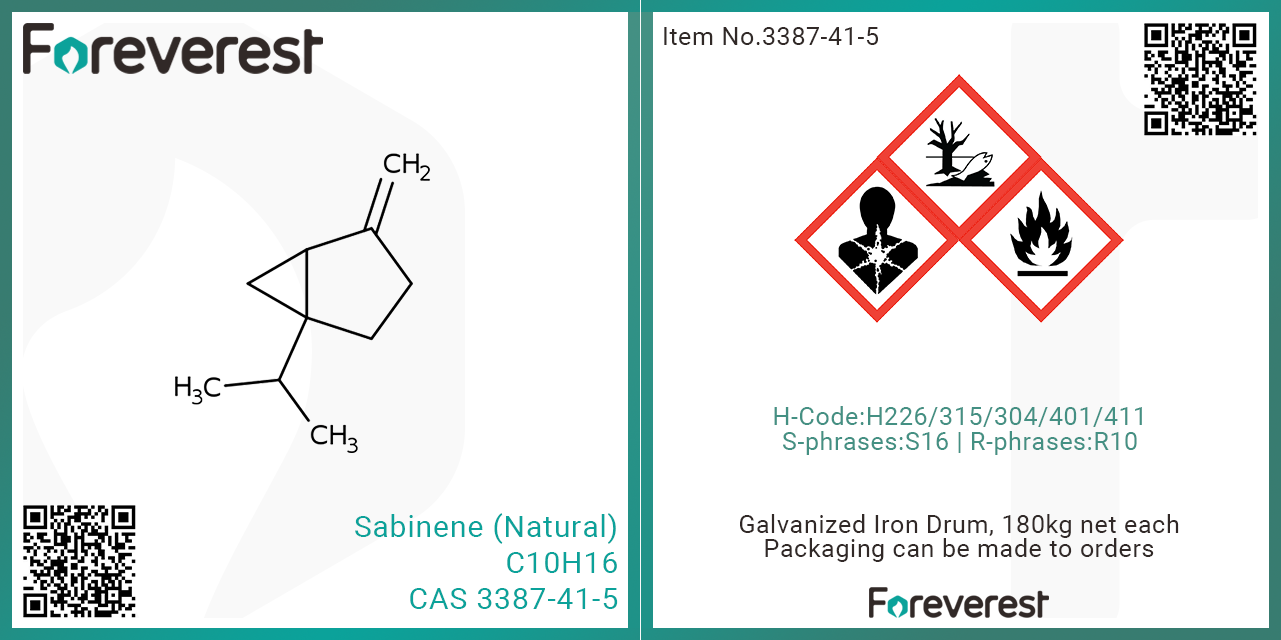
Natural Sabinene
Sabinene is a natural bicyclic monoterpene. It is a major constituent of carrot seed oil and one of the chemical compounds that contribute to the spiciness of black pepper.
It is mainly used for flavor and fragrance.
Substance Identification
| Synonyms | 4-thujene |
| CAS | 10408-16-9, 3387-41-5 |
| EINECS | 222-212-4 |
| FEMA | N/A |
| HS.CODE | 29021990 |
| Molecular Formula | C10H16 |
| Molecular Weight | 136.236 |
Application & Uses
- used as flavor and fragrance
- used as perfume additives
- used as fine chemicals
- used as advanced biofuels
- used for massage and spa
Features & Benefits
- Anti-inflammatory5– Studies noted its presence in the Oenanthe crocata L essential oil and counted it responsible for the oils anti-inflammatory capabilities.
- Anti-Cancer compound6– Multiple studies looked at its effectiveness in combatting tumors in leukemia and found it effective.
- Antioxidant7– This is the study that determined that sabinene had radical scavenging activities making it a potent antioxidant compound
- Antifungal – More than a dozen studies point to it as having fungicidal abilities.
Sales Specification
| ITEM | VALUE | TEST METHOD & UNIT |
|---|---|---|
| Appearance | Colorless Liquid | |
| Odor | Woody, spicy, citrus and terpy with green, oily and camphoreous nuances | |
| Purity | 75 min | % |
| Optical Rotation | -60 to -70 | ° |
Q&A
What anti-inflammatory mechanism has sabinene shown in macrophage models?
In LPS-stimulated RAW 264.7 macrophages, sabinene mainly reduced MAPK-mediated inflammatory signalling by lowering the phosphorylation of JNK and p38 MAPK (Hong et al., 2024, Molecules). This was accompanied by lower iNOS expression and nitric-oxide production, with IL-6 mRNA reduced by more than half; however, sabinene did not significantly reduce IL-1β mRNA under the same conditions, indicating that its effect is not uniform across all inflammatory mediators (Hong et al., 2024, Molecules). The overall effect is a dampened macrophage-driven inflammatory cascade without the broad immunosuppression associated with corticosteroid-class drugs, making sabinene an attractive candidate for topical and systemic anti-inflammatory product development where a plant-derived, MAPK-targeted mechanism is desired.
Can natural sabinene 75% serve as a supporting antioxidant ingredient in cosmetic and topical formulations?
Natural sabinene 75% can provide supportive antioxidant value in cosmetic and topical formulations, particularly in natural essential-oil systems where it can work alongside other terpenes and phenolic constituents to support overall antioxidant performance. Sabinene-rich botanical oils have shown radical-scavenging activity in DPPH, ABTS and FRAP assays, but results vary substantially among oils, indicating that sabinene’s practical contribution depends on co-constituents, oxidation state and the test matrix (Xie et al., 2024, Scientific Reports; Medeiros et al., 2018, Molecules). Natural sabinene 75% is therefore best used where a woody-spicy natural odour and supportive antioxidant contribution are both useful; when the main objective is to protect oils or sensitive actives from oxidation, it should be combined with a validated primary antioxidant system and confirmed in the target emulsion, oil phase or balm (Olszowy & Dawidowicz, 2016, Food Chemistry; Lin et al., 2009, Journal of Food and Drug Analysis).
What does a −60° to−70° optical-rotation specification mean for natural sabinene in chiral pharmaceutical-intermediate development?
An optical rotation of −60° to −70° indicates a consistent levorotatory chiral bias in the natural sabinene material and can support source and lot-consistency control; however, optical-rotation values are comparable only when temperature, solvent, concentration and wavelength are defined, and they do not replace a direct enantiomeric-excess measurement (Finefield et al., 2012, Natural Product Reports; Miyali et al., 2022, Plants). For pharmaceutical-intermediate or asymmetric-synthesis routes that depend on stereochemical control, buyers should request chiral GC or chiral HPLC data to verify the target enantiomer ratio and detect drift in the opposite enantiomer (Miyali et al., 2022, Plants). Sabinene has shown anti-inflammatory potential associated with JNK/p38 MAPK inhibition in LPS-stimulated macrophages (Hong et al., 2024, Molecules), and animal and cell studies have reported effects on AKT/mTOR and Bcl-2/Bax signalling; however, these studies have not established that the activity is exclusive to one sabinene enantiomer and do not support therapeutic claims.
GHS Hazard Statements
| H-Code | H226/H302/H304/H315/H317/H411 |
| P-Code | P210/233/240/241/261/264/272/273/280 |
| Response | P301+P310 P331 P301+P312 P330 P302+P352 P332+P313 P362+P364 P333+P313 |
| Storage | P403+P235 P405 |
| Disposal | P501 |
| Signal Word | Danger |
Storage
- flammable materials should be stored in a separate safety storage cabinet or room
- ground all equipment containing material
- keep away from heat
- keep away from sources of ignition
- keep container tightly closed
- keep in a cool, well-ventilated place
Relation Products
Relation Articles
- Herbicidal composition and method
- Terpenes (C5H8)-medicinal molecules and important building blocks in nature
- The benefits of Terpenes on health and well-being
- Analysis of Essential Oil on Antimicrobial Resistance
- TERPENE ESSENTIAL OILS: The research and development direction of anti-virus drugs is concerned
- Terpenes from Forests and Human Health
- Terpinen-4-ol is the Most Active Ingredient of Tea Tree Oil to Kill Demodex Mites
Remark
The above information is believed to be accurate and represents the best explanation currently available to us. However, no liability is assumed for any consequences arising from the use of this content. The technical standards for our products are developed and updated jointly by our customers and ourselves; where any changes occur, the latest specification shall prevail and will be confirmed in the relevant contract.All suggestions and data provided are based on information we consider to be reliable and are offered in good faith, but without any guarantee, as the conditions and methods of use of our products are beyond our control. Foreverest® makes no warranties, whether express or implied, regarding the accuracy, completeness or suitability of this information, and expressly disclaims any implied warranty of fitness for a particular purpose. Prospective users should conduct their own tests and evaluations to determine the suitability of Foreverest® materials and any recommendations for their intended applications before adoption, and, where appropriate, should obtain confirmation or approval from the relevant regulatory authorities.Any references in this page to patents or patented technologies, including descriptive material derived from patents or citations of specific patent numbers, are provided for information only. They must not be interpreted as a recommendation to use our products in a manner that could infringe any third‑party patent, nor as a grant of any licence or permission to use patents owned by Foreverest®.
Start Purchasing
-

Minimum Order Quantity
Quote required -

Lead Time
Quote required -

Available Incoterms
Quote required -

Regional Availability
Quote required