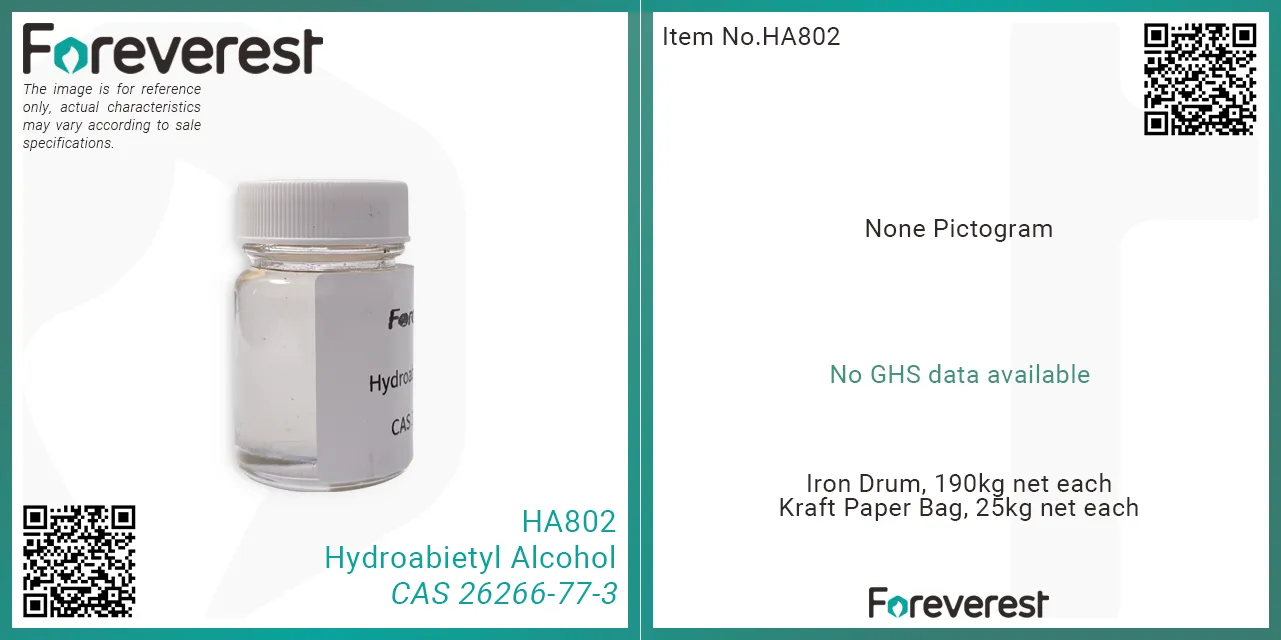
Hydroabietyl Alcohol
Hydroabietyl Alcohol is a colorless, tacky, balsamic resin ester.
It is a high molecular weight, primary, monohydric alcohol made from Methyl Hydrogenated Rosinate.
Its tackiness and extremely pale color, combined with its solubility in common organic solvents and compatibility with resins, film-formers, and oils, have led to its use as a resinous plasticizer and/or tackifier in plastics, lacquers, inks and adhesives.
Substance Identification
| Synonyms | Dihydroabietyl Alcohol, Abietyl alcohol, Abitol™ |
| CAS | 26266-77-3 |
| EINECS | 247-574-0 |
| FEMA | N/A |
| HS.CODE | 3806 |
| Molecular Formula | C20H32O (25%), C20H36O (45%), C20H32O (30%) |
| Molecular Weight | 290.8 |
Application & Uses
- Caulks and Sealants
- Contact Adhesives
- Hot Melt Adhesives
- Pressure Sensitive Adhesives
- Solvent borne Adhesives
- SKL wax
- Depliatories
Features & Benefits
- Alcohol Soluble
- Light color. Low odor, high refractive index
- High viscous tackifer resin with excellent agening characteristics
- Reactive functionality
- Wide solubility and compatibility range
Sales Specification
| ITEM | VALUE | TEST METHOD & UNIT |
|---|---|---|
| Appearance | Colorless, tacky, balsamic resin ester | |
| Color | 2 max | @Gardner |
| Acid Value | 60 to 70 | mgKOH/g |
| Viscosity | 4000 to 5000 | @Brookfield viscosity at 50 °C, cP (mPa·s) |
| Refractive Index | 1.5100 to 1.5290 | @20°C |
| Ash content | 0.5 max | % |
Q&A
Why is commercial hydroabietyl alcohol described as a “high molecular weight” resin when its individual diterpene alcohol components have molecular weights around 290–293 g/mol?
Commercial hydroabietyl alcohol behaves as a high molecular weight resin in an engineering sense—exhibiting high melt viscosity, tack and film‑forming character—even though each C₂₀ diterpene alcohol molecule has a molecular weight of only about 290 g/mol. The material is a mixture of abietane‑type alcohols with different saturation levels, all sharing a rigid tricyclic diterpene backbone and a primary hydroxyl group, so intermolecular hydrogen bonding and tight hydrophobic packing generate a transient physical network that gives resin‑like flow and film properties. Industrial grades often retain some residual carboxylic acid functionality, further reinforcing their classification as resinous mixtures, and Brookfield viscosities in the range of several thousand cP at elevated temperatures (for example around 4000–5000 cP at 50 °C) place them close to low‑molecular‑weight oligomeric plasticizers in rheological behaviour without actual polymerisation. In this context, the term “high molecular weight” is used by the resin industry to describe macroscopic flow and film‑forming behaviour rather than a single, narrowly defined molecular‑weight value.
For adhesive formulators, how does Foreverest HA802 compare to commercially refined hydroabietyl alcohol benchmark products, given the pronounced difference in acid value?
Commercially refined hydroabietyl alcohol benchmark grades typically feature very low acid values (around 0.1 mg KOH/g), relatively high hydroxyl content and Gardner colour near 1, and exhibit high, resin‑like melt viscosity at 50 °C; they are positioned as neutral, non‑reactive plasticizers and tackifiers for colour‑critical adhesives, lacquers and inks where residual acidity could interfere with acid‑sensitive pigments, isocyanate crosslinkers or alkaline fillers. Foreverest HA802 retains the hydrogenated diterpene backbone’s tack, pale colour and oxidative stability but carries an acid value in the range of about 60–70 mg KOH/g, making it closer to a resin‑type diterpene alcohol mixture with meaningful carboxylic functionality. In adhesive systems that tolerate or even benefit from acid groups—such as rosin ester‑based hot melts, solvent‑borne polychloroprene contact adhesives or hydrocarbon‑tackified pressure‑sensitive adhesives where acid functionality can enhance wetting and adhesion to polar substrates—HA802 offers a more cost‑efficient hydrogenated rosin‑backbone option. The residual carboxylic acid groups may also be exploited for specific uses, such as adhesion promotion to metal or glass through acid–base interactions or aiding emulsification in partially neutralised waterborne formulations, but formulators must verify compatibility, stability and odour acceptability in their own systems.
What antioxidant mechanisms does the hydrogenated diterpene structure of hydroabietyl alcohol confer, and how are they exploited in colour‑stable and radical‑related applications?
Hydroabietyl alcohol’s main antioxidant advantage lies in the intrinsic stability of its hydrogenated abietane skeleton: catalytic hydrogenation of the rosin acid precursor saturates the conjugated diene region and removes highly autoxidation‑prone allylic and bis‑allylic C–H sites, making it significantly more resistant to discoloration and oxidative degradation than non‑hydrogenated rosin derivatives. In formulated products, this high resistance to yellowing is exploited in clear adhesives, non‑yellowing lacquers and colour‑critical pressure‑sensitive adhesives, where a resin‑type tackifier with good oxidative stability helps maintain long‑term clarity and colour. Structurally, the rigid hydrogenated diterpene framework contains C–H bonds that could, in principle, participate in peroxyl‑radical chain termination, but current cosmetic ingredient classifications list hydroabietyl alcohol primarily as a binding and viscosity‑controlling agent rather than a dedicated antioxidant, and its radical‑scavenging contribution has not yet been quantified in detail. Available databases assess its irritation and comedogenic risk as low, supporting its use in skin, hair and colour cosmetics, but safety and any ancillary antioxidant benefits should be confirmed within specific formulations and target user groups.
When should a formulator select hydroabietyl alcohol over petrochemical plasticizers for adhesive, ink, or coating formulations?
Hydroabietyl alcohol becomes a particularly attractive plasticizer choice when three needs coincide: very low initial colour and good colour retention under thermal ageing, a primary alcohol function that can optionally participate in crosslinking, and good compatibility with polar film‑formers such as nitrocellulose, ethylcellulose or polyurethane binders. Most conventional phthalate and benzoate ester plasticizers are cost‑effective and broadly compatible with PVC and related systems, but they tend to yellow under heat and generally do not provide hydroxyl groups that can be covalently incorporated into isocyanate‑ or melamine‑crosslinked networks, while purely aliphatic hydrocarbon plasticizers lack the polarity needed for strong interaction with highly polar binders. In alcohol‑borne lacquer or ink systems where a plasticizer must dissolve in alcohol, maintain low yellowing after accelerated ageing and optionally be locked into a thermoset matrix via its –OH reacting with isocyanate or melamine–formaldehyde crosslinkers, hydroabietyl alcohol satisfies all three criteria in a single additive and, with a refractive index of roughly 1.5–1.53, can boost gloss in clear overprint varnishes and vehicles. It is also well suited to solder flux formulations, combining alcohol solubility, thermal stability at soldering temperatures and relatively low corrosivity compared with activated rosin fluxes, and its pine‑rosin origin offers biobased carbon content that traditional petrochemical phthalate and many adipate plasticizers do not provide.
GHS Hazard Statements
| H-Code | H315/H317/H319/H413 |
| P-Code | P261/P264/P272/P273/P280 |
| Response | P302+P352 P305+P351+P338 P333+P313 P337+P313 P362+P364 |
| Storage | P403+P233 |
| Disposal | P501 |
| Signal | Warning |
Storage
- avoid contact with light
- keep separated from incompatible substances
- store and handle in accordance with all current regulations and standards
- store in a cool, dry place
- store in a tightly closed container
Relation Products
Remark
The above information is believed to be accurate and represents the best explanation currently available to us. However, no liability is assumed for any consequences arising from the use of this content. The technical standards for our products are developed and updated jointly by our customers and ourselves; where any changes occur, the latest specification shall prevail and will be confirmed in the relevant contract.All suggestions and data provided are based on information we consider to be reliable and are offered in good faith, but without any guarantee, as the conditions and methods of use of our products are beyond our control. Foreverest® makes no warranties, whether express or implied, regarding the accuracy, completeness or suitability of this information, and expressly disclaims any implied warranty of fitness for a particular purpose. Prospective users should conduct their own tests and evaluations to determine the suitability of Foreverest® materials and any recommendations for their intended applications before adoption, and, where appropriate, should obtain confirmation or approval from the relevant regulatory authorities.Any references in this page to patents or patented technologies, including descriptive material derived from patents or citations of specific patent numbers, are provided for information only. They must not be interpreted as a recommendation to use our products in a manner that could infringe any third‑party patent, nor as a grant of any licence or permission to use patents owned by Foreverest®.
Start Purchasing
-

Minimum Order Quantity
Quote required -

Lead Time
Quote required -

Available Incoterms
Quote required -

Regional Availability
Quote required