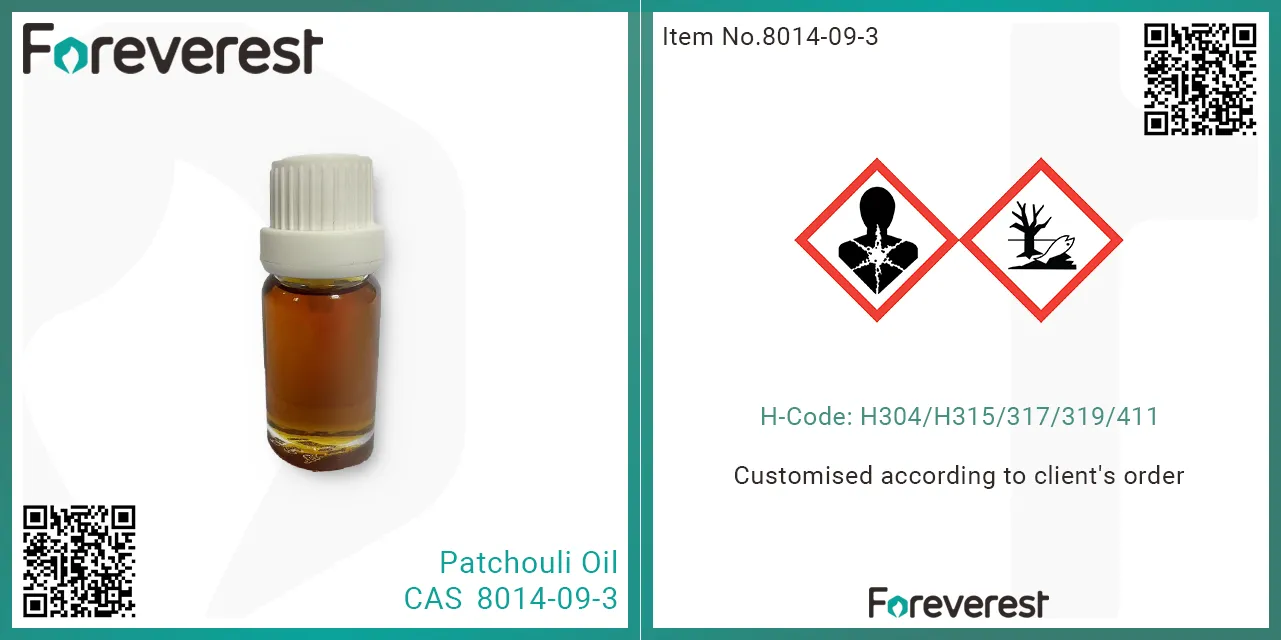
Patchouli Oil
Patchouli oil is a significant pharmaceutical raw material and a valuable natural flavouring in the spice industry. It emanates a distinctive woody, earthy, and herbaceous aroma. The raw material, patchouli (Pogostemon cablin), is native to Indonesia and the Philippines. Fresh patchouli leaves are almost odourless; their persistent woody aroma, complemented by notes of hay, spices, earth, and camphor, only emerges after fermentation and drying.
The patchouli oil we supply is obtained by distilling fresh patchouli leaves harvested by farmers after drying them in the sun.
Substance Identification
| Synonyms | |
| CAS | 8014-09-3 |
| EINECS | 282-493-4 |
| FEMA | 2838 |
| HS.CODE | 330129 |
| Molecular Formula | n/a |
| Molecular Weight | n/a |
Application & Uses
- Fragrance & Cosmetics:
- Patchouli oil is widely used as a fragrance in soaps and various cosmetics, imparting a long-lasting and distinctive aroma to products.
- Food & Beverages:
- It can be used as a food and beverage additive, contributing a unique flavour profile to various products.
- Pharmaceutical Uses:
- It serves as an important pharmaceutical raw material.
- In traditional or specific applications, it is utilised as a renowned antidote against insect and snake bites.
- Skincare:
- Extensively applied in the treatment of skin diseases and daily skincare. Its unique botanical attributes make it particularly beneficial for acne, aged and chapped skin, and skin redness.
Features & Benefits
Distinctive And Lasting Aroma For Premium Fragrance & Food Applications
- Patchouli oil emits a persistent woody, earthy, and herbaceous aroma, with complex undertones of hay, spices, and camphor. This unique fragrance makes it an ideal choice for the flavour and fragrance industries, widely used in high-quality soaps and cosmetics to impart a long-lasting scent, and also as a valuable natural flavour additive in food and beverages.
Diverse Bioactivity For Comprehensive Pharmaceutical & Skin Health Support
- Beyond its role as a significant pharmaceutical raw material, Patchouli oil has traditionally been used as an antidote against insect and snake bites due to its botanical properties. Its application in skincare is particularly noteworthy, proving beneficial for various skin concerns including acne, aged, and chapped skin, as well as skin redness, demonstrating its versatile potential for health and wellness.
Sales Specification
| ITEM | VALUE | TEST METHOD & UNIT |
|---|---|---|
| Appearance | Reddish brown or greenish brown liquid | |
| Odour | Deep, lasting woody aroma with herbaceous and earthy undertones. | |
| Refractive Index | 1.505 to 1.515 | |
| Relative Density | 0.963 g/mL | @25 °C |
| Patchouli Alcohol Content | 23 min | % |
Q&A
Why do we dry and condition harvested patchouli leaves and stems before distilling patchouli oil, and how do these post-harvest steps affect oil quality?
Before distillation, our patchouli material is normally dried and then, depending on its condition, briefly stacked or conditioned; this follows the traditional post-harvest approach described by PROSEA and is consistent with the importance that Van Aroma sourcing documentation places on raw-material handling. PROSEA reports that patchouli leaves and stems are commonly dried for 2–5 days, with well-ventilated shade drying preferred for preserving material quality; sun drying is widespread, but excessive drying can make leaves brittle and may reduce oil recovery, while subsequent storage or stacking under suitable humidity can provide a curing effect. Proper drying and conditioning make the herb easier to load and distil and can support a fuller woody, earthy, and balsamic profile; insufficient conditioning may reduce oil recovery, whereas over-fermentation can introduce mouldy or otherwise off-note character. GB 1886.124-2015 defines food-additive patchouli oil as material obtained by steam distillation of leaves and stems of Pogostemon cablin grown in southern China; to compare batches meaningfully, specifications should state botanical source, drying and conditioning method, patchouli-alcohol level, and GC profile rather than simply describing the material as "sun-dried leaves" (National Health and Family Planning Commission of China, 2015, GB 1886.124-2015 National Food Safety Standard—Food Additive Patchouli Oil).
When sourcing patchouli oil, what practical differences should buyers expect among Indonesian supply origins, Chinese chemotypes, and the Philippines as a botanical origin?
Indonesia is the principal global source of patchouli oil, with Sulawesi, Sumatra, and Java as important producing regions; Indonesian oils generally derive their deep woody-earthy profile from sesquiterpenes including patchouli alcohol, δ-guaiene, and α-guaiene, but patchouli-alcohol content can vary substantially between islands and batches—for example, one study reported 19.69% in Maluku oil and 35.86% in Aceh oil (Smith et al., 2021, AIP Conference Proceedings). Chinese patchouli can be differentiated by volatile-oil chemotype: Shi Pai and Gaoyao materials are generally classified as pogostone-type, whereas Zhanjiang and Wanning, Hainan materials are generally classified as patchouli-alcohol-type; this difference has practical consequences for herbal-material selection, oil odour, and GC profile (Zhang et al., 2010, Journal of Tropical and Subtropical Botany). The Philippines is one of the botanical native ranges of Pogostemon cablin, rather than a single commercial grade with a predictable chemical profile; material from the Philippines, Indonesia, or China should be qualified by batch data rather than country name alone (Swamy & Sinniah, 2015, Molecules). For food-additive patchouli oil, GB 1886.124-2015 requires not less than 23.0% patchouli alcohol, so procurement specifications should include botanical source, origin, patchouli alcohol, pogostone, complete GC/GC-MS profile, and sensory description to convert labels such as "Indonesian perfumery type," "Chinese alcohol type," or "Chinese ketone type" into measurable acceptance criteria.
What evidence links patchouli oil to traditional uses for insect and snake bites, and what are the limits of modern evidence?
In traditional medicine across China, Japan, Malaysia, and India, patchouli has been used as a local preparation after insect and snake bites, but this is an ethnomedical practice rather than a clinically validated antidotal treatment (Swamy & Sinniah, 2015, Molecules). Modern research more clearly supports preventive mosquito-repellent potential: in human-forearm tests, undiluted patchouli oil provided approximately two hours of complete protection against Aedes aegypti, while 20% patchouli oil provided about 55 minutes of protection; patchouli alcohol at 2.0 mg/cm² showed complete protection for up to 280 minutes against Ae. aegypti, Anopheles stephensi, and Culex quinquefasciatus (Trongtokit et al., 2005, Phytotherapy Research; Gokulakrishnan et al., 2013, Parasitology Research). These findings support evaluation of patchouli oil or patchouli alcohol as repellent-formulation ingredients, but actual protection depends on concentration, formulation, application rate, volatility control, and target insect species and does not substantiate a treatment claim for established bites or a broad-spectrum insecticidal claim. There is no reliable in-vivo or clinical evidence that patchouli oil neutralises snake venom; any suspected venomous snakebite requires urgent medical evaluation and appropriate antivenom treatment, not reliance on patchouli oil or another plant oil for first aid.
GHS Hazard Statements
| H-Code | H304/H315/H317/H319/H411 |
| P-Code | P261/264/272/273/280 |
| Response | P301+P310 P302+P352 P305+P351+P338 P331 P332+P313 P333+P313 P337+P313 P362+P364 P391 |
| Storage | P405 |
| Disposal | P501 |
| Signal Word | Danger |
| Pictograms | GHS08, GHS09 |
Storage
- Environmental & Temperature Control:
- Store in a cool, dry, well-ventilated area, and protect from light.
- Avoid high temperatures to maintain product stability and prevent decomposition or volatilisation.
- Keep in a cool, well-ventilated place.
- Container Management & Prevention:
- Ensure containers are tightly closed to prevent volatilisation and external contamination, and are clearly labelled.
- Ground all equipment containing the material to prevent static build-up.
- Hazard Isolation:
- Keep storage areas away from heat, sparks, open flames, and all sources of ignition.
- This combustible liquid should be stored in a separate safety storage cabinet or room.
- Keep away from incompatible materials to prevent hazardous reactions.
- Safe Handling & Inspection:
- Handle carefully, and stack stably.
- After prolonged storage, always check quality before use.
- Compliance & Emergency Preparedness:
- Strictly comply with all safety regulations, particularly those pertaining to combustible liquid storage.
- Ensure emergency plans are in place for unforeseen circumstances.
Remark
The above information is believed to be accurate and represents the best explanation currently available to us. However, no liability is assumed for any consequences arising from the use of this content. The technical standards for our products are developed and updated jointly by our customers and ourselves; where any changes occur, the latest specification shall prevail and will be confirmed in the relevant contract.All suggestions and data provided are based on information we consider to be reliable and are offered in good faith, but without any guarantee, as the conditions and methods of use of our products are beyond our control. Foreverest® makes no warranties, whether express or implied, regarding the accuracy, completeness or suitability of this information, and expressly disclaims any implied warranty of fitness for a particular purpose. Prospective users should conduct their own tests and evaluations to determine the suitability of Foreverest® materials and any recommendations for their intended applications before adoption, and, where appropriate, should obtain confirmation or approval from the relevant regulatory authorities.Any references in this page to patents or patented technologies, including descriptive material derived from patents or citations of specific patent numbers, are provided for information only. They must not be interpreted as a recommendation to use our products in a manner that could infringe any third‑party patent, nor as a grant of any licence or permission to use patents owned by Foreverest®.
Start Purchasing
-

Minimum Order Quantity
Quote required -

Lead Time
Quote required -

Available Incoterms
Quote required -

Regional Availability
Quote required