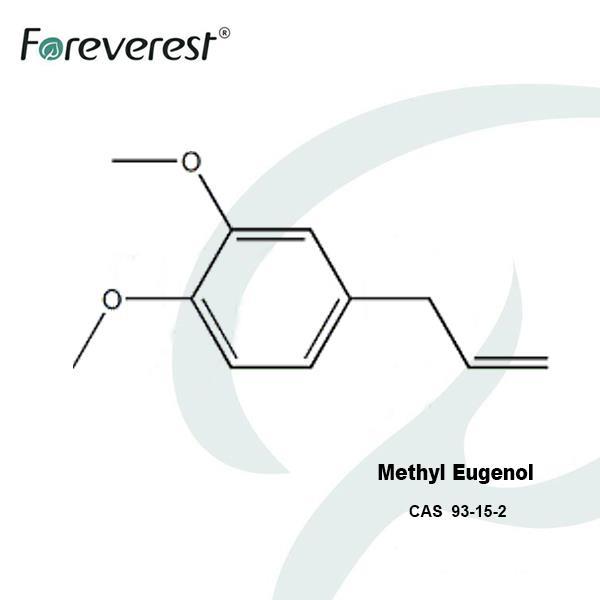
Methyl Eugenol
Methyl Eugenol (allylveratrol) is a natural chemical compound classified as a phenylpropene. It plays an important role in insect behaviour and pollination, and is naturally found in various spices such as clove oil and nutmeg.
Substance Identification
| Synonyms | Allyl veratrole | 1,2-dimethoxy-4-prop-2-enylbenzene | Eugenyl methyl ether |
| CAS | 93-15-2 |
| EINECS | 202-223-0 |
| FEMA | 2475 |
| HS.CODE | 2909.30 |
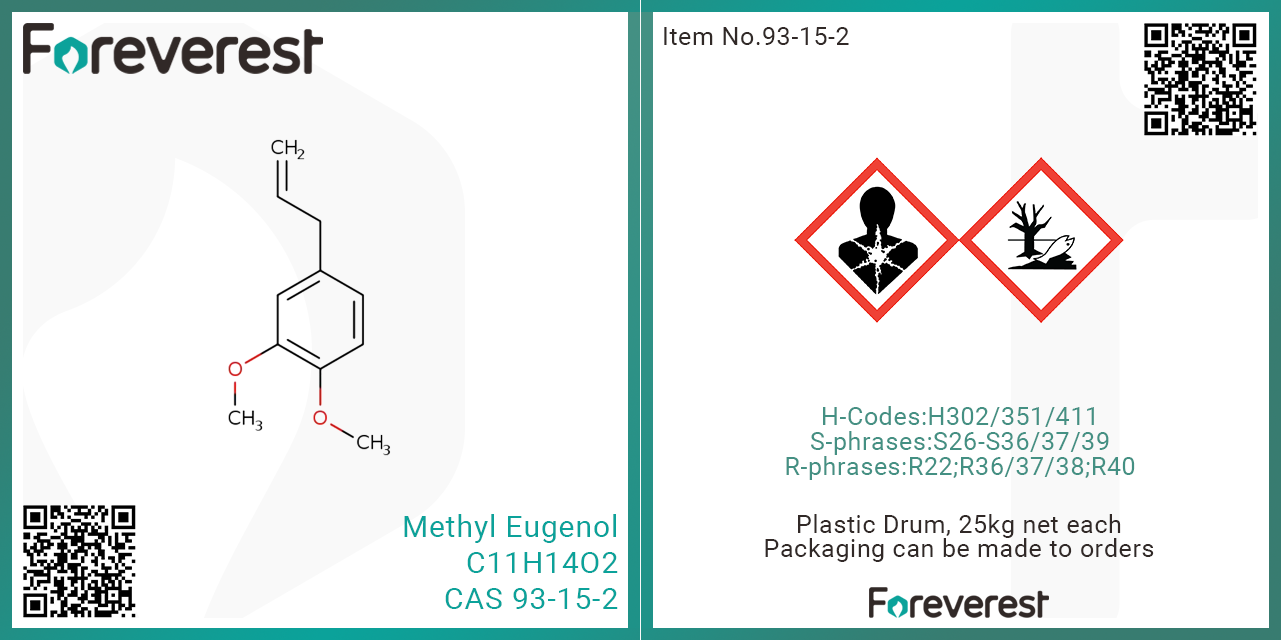
| Molecular Formula | C11H14O2 |
| Molecular Weight | 178.23 |
Toxicological Information
| LD50 oral, rat | 810mg/kg |
| LD50 dermal, rabbit | 2025mg/kg min |
Application & Uses
- Pharmaceutical Applications: Widely utilised in pharmaceutical preparations, particularly for developing drugs that leverage its antibacterial and blood pressure regulating properties.
- Flavour, Fragrance & Cosmetics: A key ingredient in formulating perfume essences, various cosmetic fragrances, and soap fragrance compositions.
- Food Additive: Functions as a food additive for flavouring, enhancing and enriching the taste of food products.
- Pest & Insect Control:
- Used as a pesticide and fungicide.
- Serves as an insect attractant, notably for fruit flies, often combined with insecticides to enhance pest control effectiveness.
Sales Specification
| ITEM | VALUE | TEST METHOD & UNIT |
|---|---|---|
| Appearance | Colorless to light yellow liquid | |
| Odor | Colove, camation aroma, spicy with herbal and tea-like nuances | |
| Refractive Index | 1.0380 to 1.0389 | |
| Specific Gravity | 1.5385 to 1.5389 | |
| Purity | 99 min | % |
Q&A
How does methyl eugenol influence the behaviour and pollination of oriental fruit flies and related dacine fruit flies, and why is this natural function relevant to pest surveillance and control?
Methyl eugenol (ME) is a volatile plant phenylpropene and a highly effective plant-derived parapheromone for male oriental fruit flies (Bactrocera dorsalis) and several related dacine fruit flies; males are strongly attracted to and consume ME, whereas females do not normally show the same direct attraction (Nishida et al., 1988, Experientia; Liu et al., 2018, Frontiers in Physiology). After feeding, males can convert ME into metabolites including (E)-coniferyl alcohol and 2-allyl-4,5-dimethoxyphenol, which accumulate in the rectal gland and are released during dusk courtship, increasing the attractiveness of male leks to females and improving mating competitiveness (Zhang et al., 2024, Nature Communications). In some Bulbophyllum orchids, flowers release ME to attract male fruit flies, which transfer pollen during flower visits and form a highly specialised plant–insect pollination relationship; Bulbophyllum cheiri flowers were reported to attract more wild male oriental fruit flies than an equivalent quantity of commercial ME lure (Tan et al., 2021, Journal of Asia-Pacific Entomology). ME therefore functions in pest management by mimicking a natural floral signal to attract target males for surveillance, male annihilation, or sterile-insect programmes; its primary action is behavioural attraction, while actual insect mortality depends on trap design, associated killing components, and the wider area-wide IPM programme.
What are the natural sources and key specifications of methyl eugenol, and how should buyers distinguish it from eugenol and methyl isoeugenol?
Methyl eugenol (CAS 93-15-2; 4-allyl-1,2-dimethoxybenzene) is a naturally occurring phenylpropene found in herbs, spices, and essential oils including basil, tarragon, nutmeg, clove, mace, bay, and citronella, although its actual concentration varies substantially by botanical source and chemotype (IARC, 2024, IARC Monographs Volume 134). The pure material is normally a colourless to pale-yellow liquid with a boiling point of approximately 254–255°C, melting point of approximately −4°C, density of approximately 1.036 g/mL, and refractive index 𝑛20/D of approximately 1.534; it is sparingly soluble in water and soluble in ethanol and oil phases, so the page values should be corrected to RI 1.532–1.535 and SG 1.032–1.040 rather than the currently transposed values. Eugenol (CAS 97-53-0) has a free phenolic hydroxyl group, whereas methyl eugenol has two aromatic methoxy groups; methyl isoeugenol (CAS 93-16-3) has a different double-bond position, so the three materials must never share CAS numbers, COAs, SDSs, or regulatory documentation. Methyl eugenol is classified by IARC as probably carcinogenic to humans (Group 2A), while isoeugenol is classified as Group 2B; a 99% GC result establishes chemical assay only and does not replace regulatory review and exposure assessment for food, fragrance, cosmetic, lure, or other final uses (IARC, 2024, IARC Monographs Volume 134).
What is the regulatory status of methyl eugenol as a food flavouring, and how should the 2024 IARC Group 2A classification be managed?
In China, methyl eugenol remains listed as S0093 with FEMA number 2475 in Appendix B.3, "List of Permitted Synthetic Food Flavouring Substances," of GB 2760-2024, with a technical requirement of not less than 95% content; its use must follow the applicable principles for food flavourings and compounded food flavours and should not be interpreted as unrestricted direct addition to every food. The EU and United States prohibit methyl eugenol as a directly added food flavouring; the U.S. FDA has removed methyl eugenol and five other synthetic flavouring substances from the food-additive regulations, although naturally occurring methyl eugenol from herbs and spices such as basil, nutmeg, and clove may still enter foods (U.S. FDA, 2024, FDA Removes 7 Synthetic Flavoring Substances from Food Additives List). In 2024, IARC classified methyl eugenol as probably carcinogenic to humans, Group 2A, based on sufficient evidence of carcinogenicity in experimental animals and strong mechanistic evidence, while evidence in humans was inadequate; this is a hazard-identification conclusion, not an automatic change to Chinese GB 2760 permission or a quantitative risk determination for every low-dose exposure (IARC Working Group, 2024, IARC Monographs Volume 134). For Chinese food-flavour customers, raw-material identity, purity, and final-food use should be managed under GB 2760-2024; for EU or U.S. markets, methyl eugenol should not be positioned as a directly added food flavouring, and botanical oils containing naturally occurring methyl eugenol should be quantitatively tested and checked against target-market requirements.
Similar Specs
GHS Hazard Statements
| H-Code | H302/H315/H319/H335/H351/H411 |
| P-Code | P201/202/261/264/270/271/273/280 |
| Response | P301+P312+P330 P302+P352 P304+P340 P305+P351+P338 P308+P313 P332+P313 P337+P313 P362+P364 P391 |
| Storage | P403+P233 P405 |
| Disposal | P501 |
| Signal Word | Warning |
| Pictograms | GHS07 GHS08 |
Storage
- flammable materials should be stored in a separate safety storage cabinet or room
- ground all equipment containing material
- keep away from heat
- keep away from sources of ignition
- keep container tightly closed
- keep in a cool, well-ventilated place
Relation Articles
- The Future of Artificial Flavors & Ingredients
- Essential Oils: The Market And Its Issues Analysed
- Natural compounds as potential algaecides for waterborne paints
- Development and Management of Biopesticides in China
- ANTI-VIRUS FUNCTION of ESSENTIAL OILS and PLANT EXTRACTS
- Citronella-More Than Spices
- Effects of Cinnamon in Chronic Diseases
- The development trend of food flavor
- The composition of the essential oil
Remark
The above information is believed to be accurate and represents the best explanation currently available to us. However, no liability is assumed for any consequences arising from the use of this content. The technical standards for our products are developed and updated jointly by our customers and ourselves; where any changes occur, the latest specification shall prevail and will be confirmed in the relevant contract.All suggestions and data provided are based on information we consider to be reliable and are offered in good faith, but without any guarantee, as the conditions and methods of use of our products are beyond our control. Foreverest® makes no warranties, whether express or implied, regarding the accuracy, completeness or suitability of this information, and expressly disclaims any implied warranty of fitness for a particular purpose. Prospective users should conduct their own tests and evaluations to determine the suitability of Foreverest® materials and any recommendations for their intended applications before adoption, and, where appropriate, should obtain confirmation or approval from the relevant regulatory authorities.Any references in this page to patents or patented technologies, including descriptive material derived from patents or citations of specific patent numbers, are provided for information only. They must not be interpreted as a recommendation to use our products in a manner that could infringe any third‑party patent, nor as a grant of any licence or permission to use patents owned by Foreverest®.
Start Purchasing
-

Minimum Order Quantity
Quote required -

Lead Time
Quote required -

Available Incoterms
Quote required -

Regional Availability
Quote required