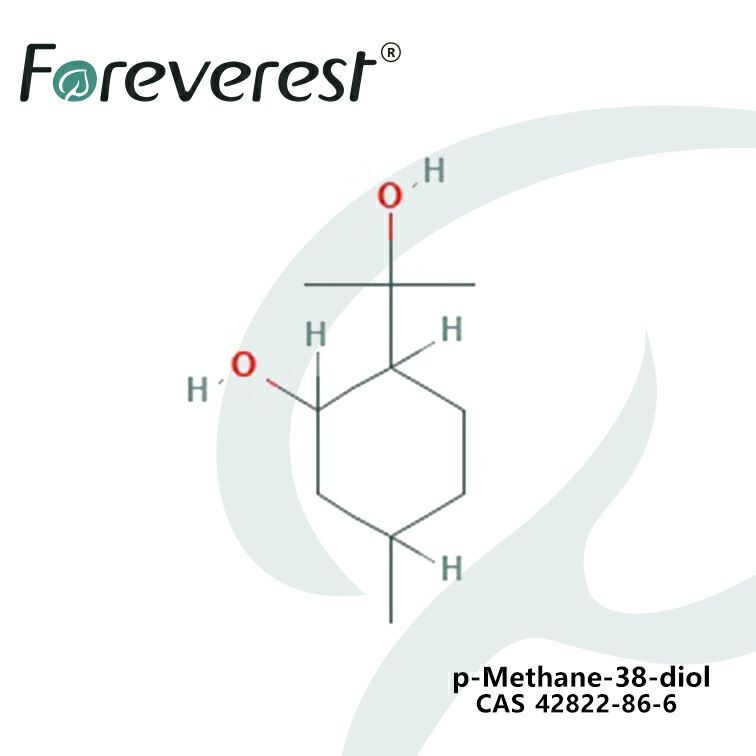
p-Menthane-3,8-diol
p-Menthane-3,8-diol, also known as para-menthane-3,8-diol, PMD, or menthoglycol. It is an organic compound classified as a diol and a terpinoid.
p-Menthane-3,8-diol is extracted from the essential oil of Eucalyptus citriodora or obtained by emi-synthesis from natural citronellal (from Eucalyptus citriodora oil).
It is used mainly as an insect repellent.
Substance Identification
| Synonyms | Menthoglycol | para-menthane-3,8-diol | PMD | Geranodyle | Geranium cyclohexane |
| CAS | 42822-86-6 |
| EINECS | 255-953-7 |
| FEMA | 4053 |
| HS.CODE | N/A |
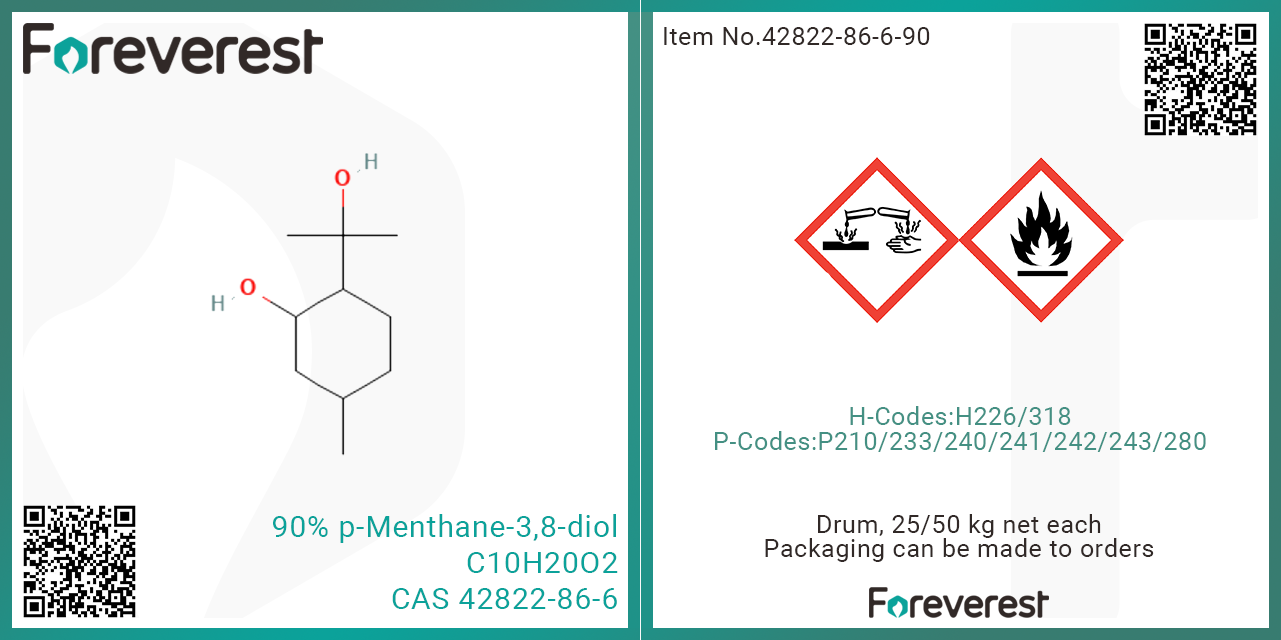
| Molecular Formula | C10H20O2 |
| Molecular Weight | 172.27 |
Application & Uses
- mainly used as insect repellents, especially natural culicifuge
- used as food additive to create cooling flavor
- used in cosmetics
- being one of alcohol organic substances, it can be used as medicine raw material
Features & Benefits
- S1335 (GB 2760-2011)
Sales Specification
| ITEM | VALUE | TEST METHOD & UNIT |
|---|---|---|
| Appearance | Yellow viscosity liquid or semi solid | |
| Odor | Minty, herbaceous, like Eucalyptus aroma | |
| Purity | 90 min | @GC, % |
Q&A
What is the semi-synthetic route from natural citronellal to p-menthane-3,8-diol (PMD), and which Chinese patent processes are available for industrial development?
When natural-source citronellal is used as the feedstock, PMD can be prepared through acid-catalysed intramolecular Prins cyclisation–hydration, normally forming a cis/trans isomer mixture; because isopulegol and PMD are linked by a reversible hydration/dehydration equilibrium, acidity, temperature, residence time, and aqueous-phase mass transfer jointly affect PMD yield and isomer distribution (Cheng et al., 2009, Green Chemistry). Chinese patent CN103570501B describes cyclisation–hydration of lemon-eucalyptus oil and/or citronellal in acidic water using an immobilised quaternary-ammonium catalyst, while CN103193598A describes natural citronella-derived 75–85% citronellal in an aqueous acid and phase-transfer-catalyst system followed by vacuum distillation and low-temperature crystallisation to enrich cis-PMD. CN108341740B further describes graphene-oxide-catalysed cyclisation–hydration in water with crystallisation-based cis/trans isomer separation; its lower-waste or recyclable-catalyst advantages remain patent claims that require validation of catalyst lifetime, metal or solid residues, batch reproducibility, and scale-up economics. Lemon-eucalyptus oil can be a citronellal-rich feedstock, but its composition varies with botanical origin and batch, so we recommend specifying citronellal assay, optical rotation, full GC profile, and the target PMD isomer ratio for both feedstock qualification and final-product release rather than relying only on a “natural” or botanical-origin description.
Why is p-menthane-3,8-diol (PMD) an important insect-repellent formulation active, and which regulatory recognitions support its use?
PMD is a plant-derived active ingredient that can be used in mosquito-repellent products, and its relatively low volatility can support persistence on skin; however, CDC-related recommendations apply only to EPA-registered repellent products containing oil of lemon eucalyptus (OLE) or PMD, not to unregistered pure lemon-eucalyptus oil or any PMD raw material (Maia & Moore, 2011, Malaria Journal). The U.S. EPA identifies p-menthane-3,8-diol as a biochemical-pesticide active ingredient under PC Code 011550, and Canada’s PMRA has also evaluated registration of repellents containing PMD and related oil-of-lemon-eucalyptus compounds; each marketed product must nevertheless hold the appropriate authorisation for its label, formulation, concentration, and intended use. In the EU, hydrated and cyclised lemon-eucalyptus oil is being supported under the BPR Product Type 19 framework as Eucalyptus citriodora oil, hydrated, cyclized (EC Oil (H/C), CAS 1245629-80-4); this does not mean that every synthetic PMD or PMD-rich material has EU-wide biocidal-product authorisation, and market-entry requirements must be confirmed with the competent authority in the target Member State. In a Swiss outdoor field comparison, 15% PMD and 15% DEET both achieved a median complete-protection time of at least six hours, whereas PMD protection times were shorter under laboratory conditions; actual performance therefore depends on concentration, formulation, application rate, sweating, mosquito species, and test conditions rather than supporting a fixed-duration claim (Colucci & Müller, 2018, Scientific Reports).
Which target pests can PMD repel, and to what extent does current evidence support a broad-spectrum efficacy position?
The strongest evidence for PMD concerns mosquito repellency, including Aedes aegypti, Anopheles stephensi, and Culex quinquefasciatus; in Swiss outdoor human-landing trials, 15% PMD achieved a median complete-protection time of at least six hours against local biting mosquitoes, although laboratory-cage protection times against An. stephensi and Cx. quinquefasciatus were shorter than for the same concentration of DEET (Colucci & Müller, 2018, Scientific Reports). Field work also supports repellent activity of PMD-containing eucalyptus-derived products against Anopheles spp. (Trigg, 1996, Journal of the American Mosquito Control Association), while other research indicates that PMD-containing lemon-eucalyptus oil can reduce attachment or feeding by Ixodes ricinus nymphs (Elmhalli et al., 2009, Experimental and Applied Acarology). PMD can therefore be positioned as a mosquito-focused repellent active with supporting evidence for selected ticks and other blood-feeding arthropods, but claims for black flies, biting midges, fleas, bed bugs, or additional tick species should rely on registration-supporting data for the target species and final formulation. PMD reduces the likelihood of landing, biting, or feeding rather than acting as an insecticide, and actual protection time depends on concentration, formulation, application rate, sweating, environmental conditions, and the target species; it must be verified against the finished-product label and local regulatory requirements.
What is the regulatory status of PMD as a food additive in China under GB 2760-2011 encoding S1335, and what does this mean for customers?
p-Menthane-3,8-diol is listed in the GB 2760-2011 National Food Safety Standard for Uses of Food Additives under encoding S1335 (Chinese name: 对-[䓝]-3,8-二醇) within Table B.3 — the permitted list of synthetic food flavourings. As a food flavouring substance in Table B.3, PMD is permitted for use in all food categories except those explicitly excluded from flavour use under GB 2760 (e.g., fresh milk, fresh fruit and vegetables, raw meat and fish, honey, table sugar, and salt); it carries no numerical maximum use limit, with dosage being self-limiting by organoleptic properties under good manufacturing practice. PMD's food-flavouring status is reinforced by FEMA GRAS No. 4053 (Flavor and Extract Manufacturers Association of the United States) and JECFA No. 1416 (Joint FAO/WHO Expert Committee on Food Additives). Note that the GB 2760 S1335 listing authorises PMD solely as a food flavouring — imparting a cooling, minty sensation — and does not extend to insect-repellent use in food-contact applications; food-grade and repellent-grade specifications should be managed separately. With the transition from GB 2760-2011 to GB 2760-2014 and subsequently GB 2760-2024 (effective 8 February 2025), the encoding S1335 and the substance entry have been carried forward without change, so the listing remains current under the latest revision of the standard.
Similar Specs
GHS Hazard Statements
| H-Code | H318 |
| P-Code | P280 |
| Response | P305+P351+P338 P310 |
| Storage | - |
| Disposal | P501 |
| Signal Word | Danger |
| Pictograms | GHS05 |
Storage
- flammable materials should be stored in a separate safety storage cabinet or room
- ground all equipment containing material
- keep away from heat
- keep away from sources of ignition
- keep container tightly closed
- keep in a cool, well-ventilated place
Relation Articles
Remark
The above information is believed to be accurate and represents the best explanation currently available to us. However, no liability is assumed for any consequences arising from the use of this content. The technical standards for our products are developed and updated jointly by our customers and ourselves; where any changes occur, the latest specification shall prevail and will be confirmed in the relevant contract.All suggestions and data provided are based on information we consider to be reliable and are offered in good faith, but without any guarantee, as the conditions and methods of use of our products are beyond our control. Foreverest® makes no warranties, whether express or implied, regarding the accuracy, completeness or suitability of this information, and expressly disclaims any implied warranty of fitness for a particular purpose. Prospective users should conduct their own tests and evaluations to determine the suitability of Foreverest® materials and any recommendations for their intended applications before adoption, and, where appropriate, should obtain confirmation or approval from the relevant regulatory authorities.Any references in this page to patents or patented technologies, including descriptive material derived from patents or citations of specific patent numbers, are provided for information only. They must not be interpreted as a recommendation to use our products in a manner that could infringe any third‑party patent, nor as a grant of any licence or permission to use patents owned by Foreverest®.
Start Purchasing
-

Minimum Order Quantity
Quote required -
Lead Time
Quote required -
Available Incoterms
Quote required -
Regional Availability
Quote required