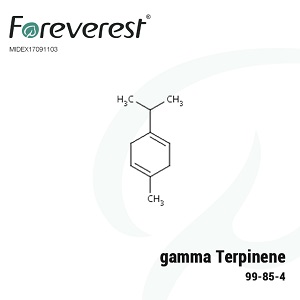
gamma-Terpinene
γ-Terpinene (Gamma-terpinene) is an isomer belonging to the terpinenes family, classified as one of three primary isomeric hydrocarbons, alongside alpha-Terpinene and beta-Terpinene. It appears as a colourless liquid and possesses a distinctive turpentine-like odour. γ-Terpinene is primarily extracted from various plant sources, notably as a significant component of essential oils derived from citrus fruits. This compound is renowned for its strong antioxidant activity. Our γ-Terpinene is available with purity levels of 97% or 95%.
Substance Identification
| Synonyms | 99-85-4-97E | γ Terpinene | p-Mentha-1,4-diene |
| CAS | 99-85-4 |
| EINECS | 202-794-6 |
| FEMA | 3559 |
| HS.CODE | 29021900 |
| Molecular Formula | C10H16 |
| Molecular Weight | 136.23 |
Application & Uses
- Food Industry:
- Widely utilised as a food ingredient, imparting unique flavours to various food products.
- Fragrance and Perfumery Industry:
- Serves as a crucial perfume material in perfume and fragrance products.
- Frequently used in the preparation of artificial lemon and peppermint essential oils, contributing fresh and natural aromatic profiles.
- Pharmaceutical Industry:
- Extensively employed in the pharmaceutical industry, potentially as an active ingredient or an intermediate.
Features & Benefits
- Potent Natural Antioxidant Activity:
- γ-Terpinene is primarily extracted from various natural plant sources, including citrus fruits, and is renowned for its strong antioxidant activity, offering significant application potential in products requiring oxidative protection.
- Versatile Aroma & Flavour Customiser:
- With its distinctive turpentine-like odour, γ-Terpinene is not only a vital component in perfumes and fragrance products but also plays a key role in the preparation of artificial lemon and peppermint essential oils. It is widely used as a food ingredient, providing flexible aroma and flavour customisation for various products.
- High Purity for Superior Performance:
Sales Specification
| ITEM | VALUE | TEST METHOD & UNIT |
|---|---|---|
| Appearance | Colorless to pale yellow clear liquid | |
| Odor | Fruity, Citrus | |
| Refractive Index | 1.470 to 1.481 | @n20/D |
| Relative Density | 0.830 to 0.870 | @d20/20 |
| Assay | 97 | % |
| ITEM | VALUE | TEST METHOD & UNIT |
|---|---|---|
| Appearance | Colorless to pale yellow clear liquid | |
| Odor | Fruity, Citrus | |
| Refractive Index | 1.473 to 1.477 | @n20/D |
| Relative Density | 0.830 to 0.870 | @d20/20 |
Q&A
Why is γ‑terpinene regarded as a more challenging and less common terpinene isomer in industrial practice, and how does this influence sourcing decisions compared with other terpinene isomers?
In industrial terpenes processing, γ‑terpinene is considered a more difficult and less common isomer because standard turpentine or limonene isomerisation routes over solid acid or Ti‑SBA catalysts mainly yield α‑terpinene, terpinolene and related monoterpenes, with γ‑terpinene typically appearing only as a minor product rather than a thermodynamically favoured isomer (Wróblewska et al., 2016, Reaction Kinetics, Mechanisms and Catalysis). To obtain commercial γ‑terpinene at high purity, Chinese producers use dedicated processes such as specialised falling‑film or climbing‑film fractionation towers that separate γ‑terpinene from eucalyptus oil streams rich in 1,8‑cineole and p-cymene, as disclosed in patents for eucalyptus‑oil fractionation devices (CN101270318, CN101307058, Yunnan Lvbao, 2008). This combination of low natural selectivity in bulk isomerisation and the need for tailored separation equipment means γ‑terpinene has a smaller qualified supplier base and higher unit cost than more readily produced terpinene isomers, so procurement teams treating γ‑terpinene as a key functional ingredient should place greater emphasis on supplier capability, process stability and batch‑to‑batch consistency when making sourcing decisions
How do the four terpinene isomers differ in their main commercial uses, and what makes γ‑terpinene stand out among them?
The four terpinene isomers share a p‑menthane skeleton but play different roles in commercial use: α‑terpinene and terpinolene (δ‑terpinene) are mainly used as fragrance ingredients and intermediates in industrial solvents, while β‑terpinene has little practical relevance because it does not occur naturally and is only prepared from sabinene in small quantities. By contrast, γ‑terpinene stands out because it combines a pleasant citrus‑herbaceous aroma, used in flavour and fragrance applications such as artificial lemon and peppermint oils under FEMA 3559 and JECFA evaluations, with an unusual hydrocarbon antioxidant mechanism in lipids, where its pro‑aromatic 1,4‑diene structure generates hydroperoxyl radicals that help terminate peroxidation chains in a way that differs from classical phenolic antioxidants (Foti & Ingold, 2003, Journal of Agricultural and Food Chemistry; Mollica et al., 2022, ACS Food Science & Technology). This combination of recognised flavour/fragrance use and distinctive non‑phenolic antioxidant behaviour makes γ‑terpinene a more specialised and differentiated ingredient than the other terpinene isomers, which are primarily valued for their odour and more conventional reactivity.
Why do formulators specifically choose γ-terpinene for reconstructed lemon and peppermint oils rather than simply increasing limonene?
Formulators choose γ‑terpinene because it provides the warm herbaceous‑citrus background that makes reconstructed lemon and peppermint oils smell closer to natural oils, rather than the flat, single‑note character of limonene‑only blends. In cold‑pressed lemon peel oil, γ‑terpinene typically contributes around 6–12% of the volatile fraction, and its presence is one of the features that distinguishes genuine lemon oil from simple limonene extensions, so leaving it out tends to make the fragrance smell thinner and less "juicy". In peppermint‑type profiles, γ‑terpinene softens the transition between menthol and menthone and adds a subtle warmth that reduces the harsh, "chemical" edge of high‑limonene systems, while the 97% grade with controlled fenchone and limonene levels gives perfumers a cleaner, more predictable building block for premium fragrance and flavour work.
GHS Hazard Statements
| Signal Word | Warning |
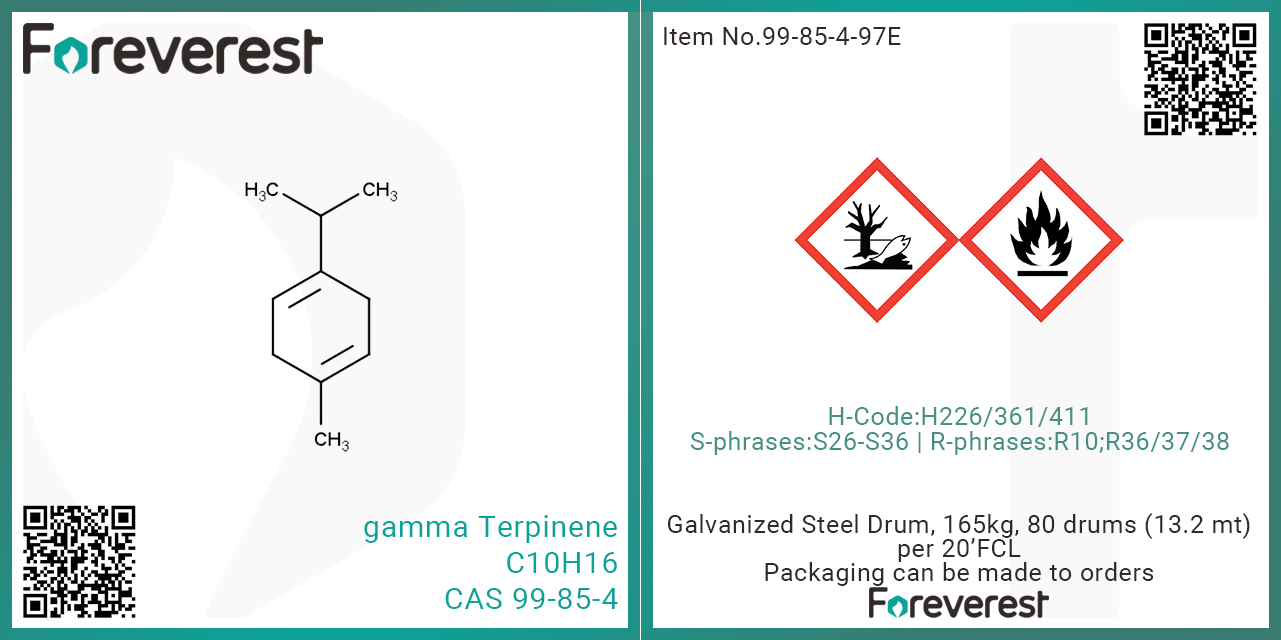
| H-Code | H226/361/411 |
| P-Code | P201/202/210/233/240/241/242/243/273/280 |
| Response | P303+P361+P353 P308+P313 P370+P378 P391 |
| Storage | P403+P235 P405 |
| Disposal | P501 |
| UN Number | UN 2319 3/PG 3 |
Storage
- Environmental & Temperature Control:
- Store in a cool, dry, well-ventilated area, and protect from light.
- Avoid high temperatures to maintain product stability and prevent decomposition or volatilisation.
- Keep in a cool, well-ventilated place.
- Container Management & Prevention:
- Ensure containers are tightly closed to prevent volatilisation and external contamination, and are clearly labelled.
- Ground all equipment containing the material to prevent static build-up.
- Hazard Isolation:
- Keep storage areas away from heat, sparks, open flames, and all sources of ignition.
- This combustible liquid should be stored in a separate safety storage cabinet or room.
- Keep away from incompatible materials to prevent hazardous reactions.
- Safe Handling & Inspection:
- Handle carefully, and stack stably.
- After prolonged storage, always check quality before use.
- Compliance & Emergency Preparedness:
- Strictly comply with all safety regulations, particularly those pertaining to combustible liquid storage.
- Ensure emergency plans are in place for unforeseen circumstances.
Relation Products
Relation Articles
- Herbicidal composition and method
- Insecticidal and synergistic effects of Majoranahortensis essential oil and some of its major constituents
- Benefits of lemon essential oil and its practical formulation
- Biological function and mechanism of plant extracts(2)
- Dipentene, an effective, safe, biodegradable cleaning and degreasing material
- How does pine oil work in disinfectant cleaners?
- The Antitranspirant Adjuvants Also Effect The Plant Diseases Control
Remark
The above information is believed to be accurate and represents the best explanation currently available to us. However, no liability is assumed for any consequences arising from the use of this content. The technical standards for our products are developed and updated jointly by our customers and ourselves; where any changes occur, the latest specification shall prevail and will be confirmed in the relevant contract.All suggestions and data provided are based on information we consider to be reliable and are offered in good faith, but without any guarantee, as the conditions and methods of use of our products are beyond our control. Foreverest® makes no warranties, whether express or implied, regarding the accuracy, completeness or suitability of this information, and expressly disclaims any implied warranty of fitness for a particular purpose. Prospective users should conduct their own tests and evaluations to determine the suitability of Foreverest® materials and any recommendations for their intended applications before adoption, and, where appropriate, should obtain confirmation or approval from the relevant regulatory authorities.Any references in this page to patents or patented technologies, including descriptive material derived from patents or citations of specific patent numbers, are provided for information only. They must not be interpreted as a recommendation to use our products in a manner that could infringe any third‑party patent, nor as a grant of any licence or permission to use patents owned by Foreverest®.
Start Purchasing
-

Minimum Order Quantity
Quote required -
Lead Time
Quote required -
Available Incoterms
Quote required -
Regional Availability
Quote required