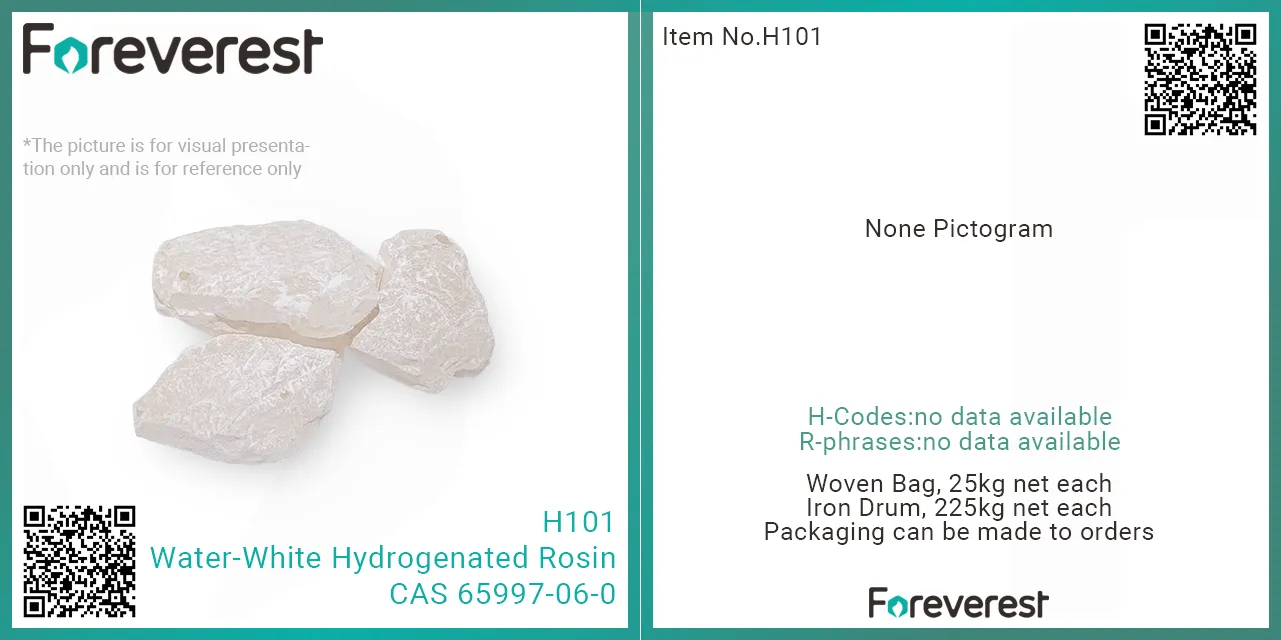
Water-White Hydrogenated Rosin
Water-White Hydrogenated Rosin is one of the dominant varieties of modified rosin with a light color, high oxidation resistance and high thermal stability.
It is soluble in ketones, esters, hydrocarbons, alcohols and chlorinated solvents and insoluble in water.
Conjugated unsaturation of abietic resin acids can be removed through catalytic hydrogenation to overcome the shortcomings of oxidation and color degradation in rosin, is compatible in useful proportions with alkyds; natural and synthetic rubbers; natural resins, ethylcellulose; waxes; plastic polymers; elastomeric polymers; metallic pigments; and many other raw materials.
This series of products are refined from hydrogenated rosin or high-hydrogenated rosin that are eliminated foreign matter and the coloring radical. Used in solid or liquid solder flux, hot melt adhesive and for the raw material of light-colored rosin resin.
Substance Identification
| Synonyms | Refined Hydrogenated Rosin |
| CAS | 65997-06-0 |
| EINECS | 266-041-3 |
| FEMA | N/A |
| HS.CODE | 38069000 |
| Molecular Formula | N/A |
| Molecular Weight | N/A |
Application & Uses
- used as solid or liquid solder flux for electronic industry
- used as raw material of light-colored rosin resin.
- used as raw material for food industry, adhesive, synthetic rubber, coating and paint, ink, cosmetic, paper industry.
Features & Benefits
- Low odor
- light color
Sales Specification
| ITEM | VALUE | TEST METHOD & UNIT |
|---|---|---|
| Colour | Y ≤1.5, R ≤0.3 | @Lovibond |
| Acid Value | 170.0 min | mgKOH/g |
| Softening Point | 78.0 min | @R&B, °C |
| Tetrahydro-resin Acid | 30.0 to 40.0 | % |
| Hydro-resin Acid | 92.0 min | % |
| Dehydroabietic Acid | 10.0 max | % |
| Ash | 0.008 max | % |
| Test of heat stability | X max | @20°C |
| Unsaponifiabe Matter | 5.0 max | @2 hours, % |
| Abietic Acid | 1.0 max | % |
| ITEM | VALUE | TEST METHOD & UNIT |
|---|---|---|
| Colour | Y ≤1.5, R ≤0.3 | @Lovibond |
| Acid Value | 170.0 min | mgKOH/g |
| Softening Point | 78.0 min | @R&B, °C |
| Tetrahydro-resin Acid | 10.0 min | % |
| Hydro-resin Acid | 90.0 min | % |
| Dehydroabietic Acid | 10.0 max | % |
| Ash | 0.008 max | % |
| Test of heat stability | X max | @20°C |
| Unsaponifiabe Matter | 5.0 max | @2 hours, % |
| Abietic Acid | 1.0 max | % |
Q&A
What does a Lovibond colour rating of Y ≤1.5 and R ≤0.3 mean in practical terms for formulators, and how does this colour performance compare with standard hydrogenated rosin grades?
A Lovibond colour of yellow no more than 1.5 and red no more than 0.3 corresponds to a water‑white hydrogenated rosin, much paler than standard hydrogenated rosin grades that typically show several units of Lovibond yellow and a visible amber tint in transparent systems. For solder flux formulators, this near‑colourless starting point means post‑reflow flux residues on a PCB are effectively invisible, helping no‑clean fluxes meet cosmetic expectations on assemblies where a yellow or brown residue would be unacceptable. In hot‑melt adhesives, a water‑white tackifier with this Lovibond profile allows truly clear adhesive films for transparent packaging tapes and laminates, avoiding the slight yellow cast that conventional pale rosin tackifiers can introduce. The very low red component (R ≤0.3) is especially important because red absorbance drives the brownish undertone that can make rosin‑based materials look “dirty” in clear or very light‑coloured formulations, and reducing this red contribution is technically more demanding than simply lowering the yellow value, which is why water‑white hydrogenated rosin generally sits in a higher specification tier than standard hydrogenated grades.
Why does a higher tetrahydro-resin acid content in hydrogenated rosin generally translate into better oxidation resistance and thermal stability, and how does this chemistry affect product performance in high-temperature applications?
Tetrahydro‑resin acids are the more fully hydrogenated forms of abietic‑type resin acids, where most of the double bonds that normally serve as oxidation and colour‑forming sites have been saturated with hydrogen, while dihydro species still retain residual unsaturation that can slowly oxidise and darken over time. Grades such as H301 that specify 30–40% tetrahydro‑resin acid show higher oxidation resistance and thermal colour stability than water‑white hydrogenated rosins with only about 10% tetrahydro, which is critical in high‑temperature uses like lead‑free solder flux where peak reflow temperatures around 250–260 °C can otherwise drive discolouration, off‑gassing or charring on the PCB surface. In hot‑melt adhesives, inks or high‑temperature coatings, a higher proportion of tetrahydro‑resin acid extends the temperature window over which the resin maintains low colour, manageable viscosity and cohesive strength, helping clear films or pale coatings stay visually clean and mechanically reliable under heat. Commercial specifications therefore often distinguish hydrogenated rosins into tiers by tetrahydro content (for example, around 10% minimum, 30–40%, or 40–60% for “fully hydrogenated” types), and formulators use this tetrahydro number as a practical indicator of the heat and oxidation headroom they can expect, while still confirming performance in their own flux or tackifier systems.
For which end-use applications is H301 (30–40% tetrahydro-resin acid) preferred over H101 (minimum 10% tetrahydro), and what cost–performance trade-offs should buyers expect between these two specifications?
H301, with 30–40% tetrahydro‑resin acid, is the higher‑hydrogenation grade and is typically specified where heat and oxidation resistance are critical, such as lead‑free solder flux for fine‑pitch electronics, where peak reflow temperatures around 250–260 °C drive strong demands on resin colour stability and resistance to charring, and high‑end hot‑melt adhesives that must stay water‑white during prolonged melt residence in the applicator. H101, with a minimum of 10% tetrahydro and at least 90% total hydro‑resin acid, offers the same Lovibond Y ≤1.5 / R ≤0.3 colour, the same ≥170 mg KOH/g acid value and similar softening point at a lower hydrogenation cost, so it is usually the more economical choice for moderate‑temperature processes and less demanding colour windows, such as general light‑coloured rosin ester manufacture, standard hot‑melt adhesive tackification or use as a raw material in food‑contact rosin resins. Because the acid value specifications are aligned, downstream esterification reactivity is broadly comparable between the two grades, meaning buyers can often substitute H101 for H301 in esterification feedstock when the application does not require the extra thermal headroom of the higher tetrahydro content. In practice, the choice is a cost–performance decision: H101 tends to be priced more competitively and fits most light‑colour applications, while H301 justifies its premium in high‑temperature or long‑hold‑time systems where the additional tetrahydro‑resin acid content provides a measurable margin in colour stability and odour control under heat.
Can water-white hydrogenated rosin such as H301 or H101 serve as the starting material for producing colourless rosin esters, and what specification features determine the quality of the downstream ester?
The colour and purity of a hydrogenated rosin feedstock largely set the upper limit for the colour of the resulting ester, because esterification with polyols such as glycerol or pentaerythritol does not inherently bleach the rosin acids and typically preserves or slightly deepens the hue inherited from the starting material. A water‑white hydrogenated rosin like H101 or H301 with Lovibond Y ≤1.5 and R ≤0.3 therefore provides the base needed to make extra light‑colour hydrogenated rosin esters in the Hazen 150–200 range, as required in applications such as screen‑protection films, medical patches and clear pressure‑sensitive adhesives. Foreverest’s Colorless Hydrogenated Rosin Derivatives (CHRD) series, including 400 Colorless Fully Hydrogenated Rosin and the GEHR/PEHR ester lines, are built on refined hydrogenated rosin with tetrahydro‑resin acid contents around 35–60% and total hydro‑resin acid ≥92%, which gives very low initial colour (for example, Hazen 50–100 for 400 and up to 150–200 for the esters) and excellent colour stability under heat. H301, with 30–40% tetrahydro‑resin acid and ≥92% total hydro‑resin acid, sits just below this fully hydrogenated tier and can yield very pale esters that meet most light‑colour adhesive and coating requirements, while H101 offers the same water‑white Lovibond colour at a lower hydrogenation degree for less colour‑critical systems. Specification items such as a high acid value (around ≥170 mg KOH/g), low ash (≤0.008%) and low unsaponifiable matter (≤5%) indicate a clean, reactive feedstock that supports efficient esterification with minimal residual rosin acids or non‑reactive impurities, helping limit tack inconsistency and long‑term colour drift in the finished ester.
How can water-white hydrogenated rosin with high tetrahydro-resin acid content support the cleanliness and thermal stability requirements of flux for advanced semiconductor packaging such as 2.5D/3D integration or flip-chip assembly, and what further qualification is needed?
Advanced packaging technologies such as 2.5D/3D integration, wafer‑level packaging and fine‑pitch flip‑chip subject flux residues to much tighter controls than conventional PCB soldering, because packages may see several reflow cycles and any colour shift, ionic contamination or outgassing in very small gaps can contribute to electrochemical migration or signal integrity loss. A water‑white hydrogenated rosin with high tetrahydro‑resin acid content, for example an H301‑type grade, offers a specification profile that is consistent with what advanced packaging fluxes typically demand: higher hydrogenation (around 30–40% tetrahydro‑resin acid) improves thermal and oxidative stability across multiple reflows, Lovibond Y ≤1.5 and R ≤0.3 keep any resin‑based residue visually unobtrusive, and very low ash (around ≤0.008%) together with low abietic acid and controlled dehydroabietic acid help limit inorganic and polar organic species that can contribute to ionic contamination. At present, water‑white hydrogenated rosin and fully hydrogenated rosin are promoted mainly for solder flux, hot‑melt adhesives and light‑colour coatings, and are not usually labelled explicitly as “semiconductor packaging grade,” so any move into 2.5D/3D or flip‑chip applications would need to be backed by full flux‑level and package‑level qualification rather than by raw‑material specifications alone. Semiconductor packaging houses and flux formulators typically require extensive reliability data — including HAST or Biased HAST, thermal cycling, high‑temperature storage and electrochemical migration evaluations — before accepting a new flux chemistry, which means early co‑development with a packaging R&D team and a specialist flux supplier is the realistic route to demonstrate that a hydrogenated rosin‑based flux can meet advanced packaging cleanliness and thermal stability requirements.
GHS Hazard Statements
| Not classified |
Storage
- the product can't be co-stored and mix-carried with spontaneous-articles, strong oxidizer, strong-acid, it can be only handled according to the stipulations of inflammables.
Relation Products
Relation Articles
Remark
The above information is believed to be accurate and represents the best explanation currently available to us. However, no liability is assumed for any consequences arising from the use of this content. The technical standards for our products are developed and updated jointly by our customers and ourselves; where any changes occur, the latest specification shall prevail and will be confirmed in the relevant contract.All suggestions and data provided are based on information we consider to be reliable and are offered in good faith, but without any guarantee, as the conditions and methods of use of our products are beyond our control. Foreverest® makes no warranties, whether express or implied, regarding the accuracy, completeness or suitability of this information, and expressly disclaims any implied warranty of fitness for a particular purpose. Prospective users should conduct their own tests and evaluations to determine the suitability of Foreverest® materials and any recommendations for their intended applications before adoption, and, where appropriate, should obtain confirmation or approval from the relevant regulatory authorities.Any references in this page to patents or patented technologies, including descriptive material derived from patents or citations of specific patent numbers, are provided for information only. They must not be interpreted as a recommendation to use our products in a manner that could infringe any third‑party patent, nor as a grant of any licence or permission to use patents owned by Foreverest®.
Start Purchasing
-

Minimum Order Quantity
Quote required -

Lead Time
Quote required -

Available Incoterms
Quote required -

Regional Availability
Quote required