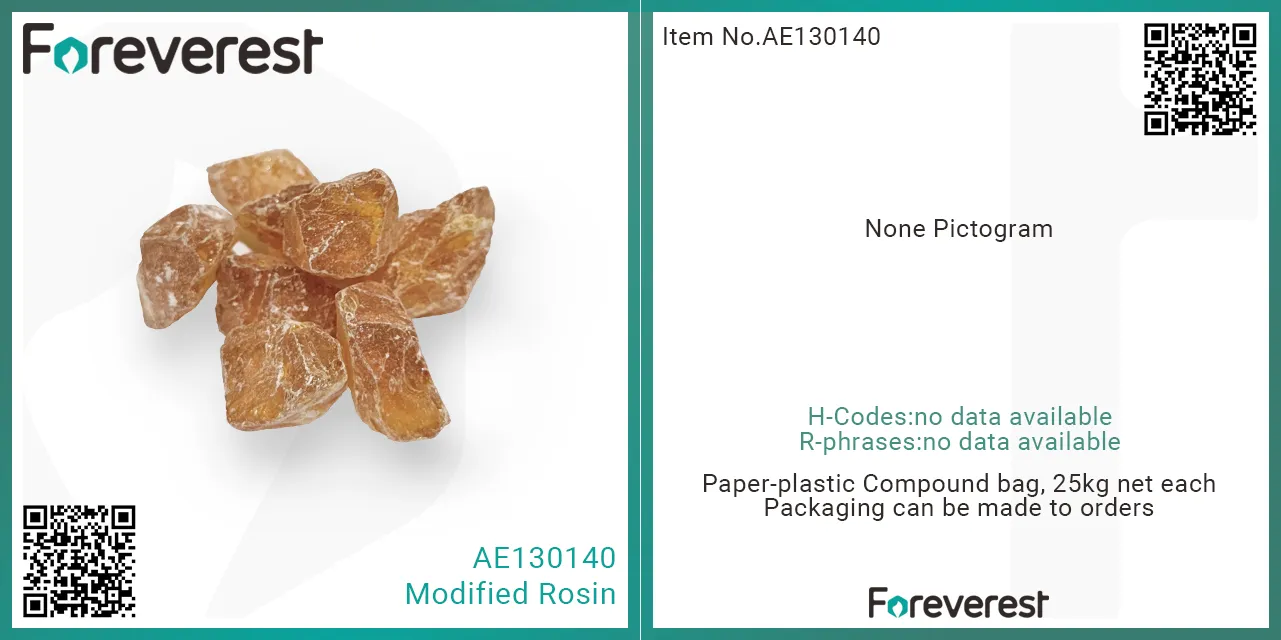
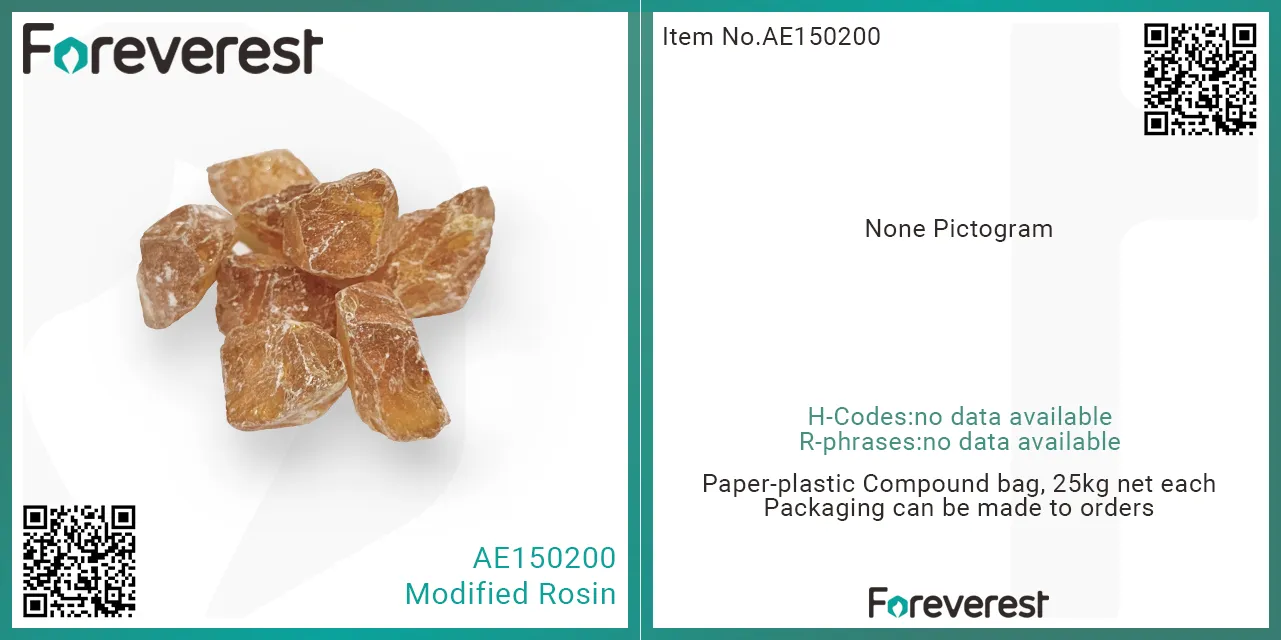
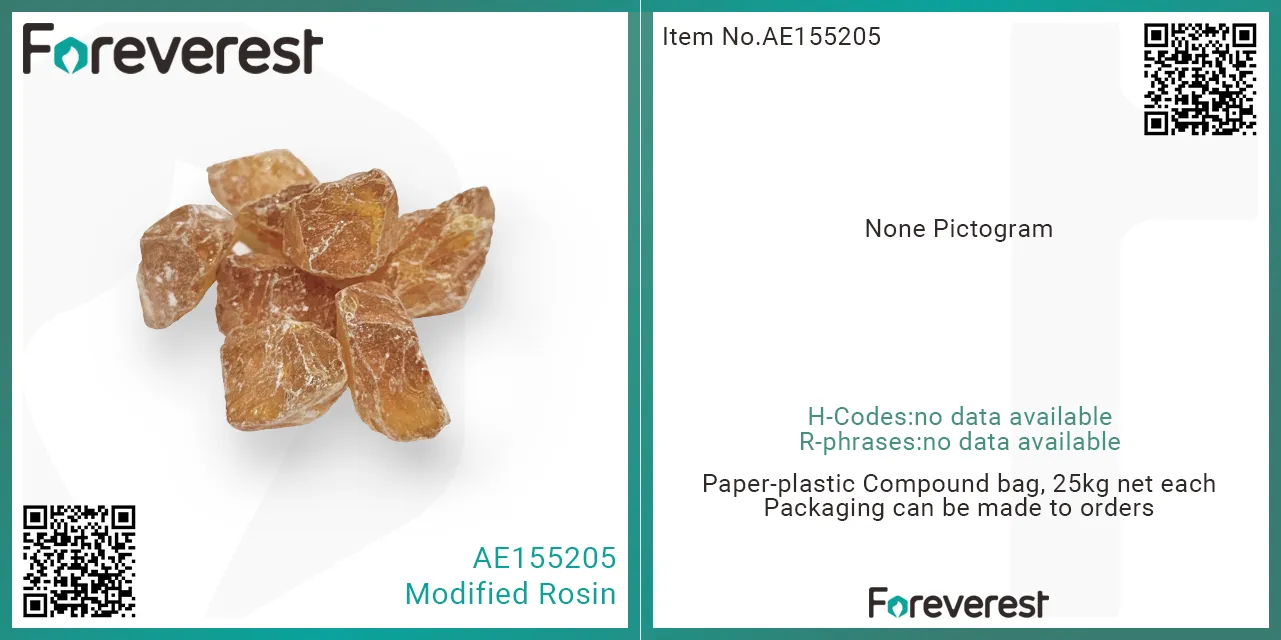
Modified Rosin
Foreverest AE-Series Modified rosin, broadly referring to a class of ester-based resins, is prepared through fumaric acid and other dibasic acid modifications, specifically designed for use in ‘E’-type gravure and flexographic inks. It is compatible with nitrocellulose, polyketone resins, shellac and other modifiers commonly used in alcohol based printing inks.
Foreverest® AE-Series can be used as liquid ink resins and fruits fresh keeping agent.
Substance Identification
| Synonyms | Rosin Modified Resin as Fresh Keeping Agent for Fruits |
| CAS | N/A |
| EINECS | N/A |
| FEMA | N/A |
| HS.CODE | 38069090 |
| Molecular Formula | N/A |
| Molecular Weight | N/A |
Application & Uses
- a substitute for "A company" liquid ink resins (view all the "A" resins for printing inks)
- use in “E” type gravure and flexographic inks
- packaging-gravure inks
- aqueous flexo and gravure inks for paper and board substrates
- fruits fresh keeping agent
Features & Benefits
- AE can be used as fruits fresh keeping agent.
- Forms flexible, semi-permeable films to regulate respiration and moisture
- Excellent film clarity, adhesion, and anti-cracking performance
- Water-dispersible for spray or dip applications
- Plant-derived and biodegradable for food-safe use
Sales Specification
| ITEM | VALUE | TEST METHOD & UNIT |
|---|---|---|
| Acid Value | 190 to 215 | mgKOH/g |
| Colour | 12 max | @Gardner, 60% resin in Ethanol |
| Softening Point | 150 to 160 | @R&B, °C |
| PH | 9 to 10 | |
| Viscosity | K to V | @GH 60% resin in Ethanol, 25°C |
| Solubility | Clear | @Alcohol solvent, 1:1 |
| ITEM | VALUE | TEST METHOD & UNIT |
|---|---|---|
| Acid Value | 135 to 145 | mgKOH/g |
| Colour | 9 max | @Gardner, 60% resin in Ethanol |
| Softening Point | 125 to 135 | @R&B, °C |
| PH | n/a | |
| Viscosity | n/a | @GH 60% resin in Ethanol, 25°C |
| Solubility | Clear | @Alcohol solvent, 1:1 |
| ITEM | VALUE | TEST METHOD & UNIT |
|---|---|---|
| Acid Value | 180 to 215 | mgKOH/g |
| Colour | 10 max | @Gardner, 60% resin in Ethanol |
| Softening Point | 145 to 160 | @R&B, °C |
| PH | 9 to 10 | |
| Viscosity | F to K | @GH 60% resin in Ethanol, 25°C |
| Solubility | Clear | @Alcohol solvent, 1:1 |
| ITEM | VALUE | TEST METHOD & UNIT |
|---|---|---|
| Acid value | 110 min | mgKOH/g |
| Colour | 10 max | @Gardner |
| Softening Point | 112 to 140 | @R&B, °C |
| Solubility | Soluble in Alkali water | |
| Alcohol solvent, 1:1 | Clear |
GHS Hazard Statements
| No GHS data available |
Storage
- Storage Temperature:
- Ensure temperature stability, avoiding drastic fluctuations to maintain resin quality and stability.
- Light Protection:
- Resins should be stored in a dark place, away from direct sunlight and strong artificial light, to prevent product degradation.
- Airtight Sealing:
- All containers must be tightly sealed to prevent ingress of air, moisture, and other contaminants, which is crucial for maintaining purity and preventing oxidation.
- Inert Gas Protection (Recommended):
- For particularly sensitive resins, it is advisable to store them under a blanket of nitrogen or other inert gas to minimise the risk of oxidation.
- Storage Area:
- Choose a cool, dry, and well-ventilated area for storage.
- Keep away from heat sources, sparks, and any potential ignition sources.
- Container Requirements:
- Use original or chemically compatible containers that meet storage standards.
- Containers should be clearly labelled with product name, batch number, and storage date.
- Avoid Contamination:
- When dispensing resin, always use clean and dry tools to avoid cross-contamination.
- Regular Inspection:
- Periodically check storage conditions and product status to ensure no abnormalities.
Relation Products
Relation Articles
- GLYCEROL ESTER OF WOOD ROSIN (Food and Beverage Grade)
- How to choose tackifier resins for Non-woven adhesives
- Progress on the patents about the modifications of gum rosin and their applications
- Role of Resin in Printing Ink
- TACKIFIERS: MARKET EVOLVES WITH DEMAND FOR ADHESIVES SEALANTS AND LABELS
- Choosing the Correct Soldering Flux Types and Their Advantages/Disadvantages
Remark
— Disclaimer —
The above information is believed to be accurate and represents the best explanation currently available to us. However, no liability is assumed for any consequences arising from the use of this content. The technical standards for our products are developed and updated jointly by our customers and ourselves; where any changes occur, the latest specification shall prevail and will be confirmed in the relevant contract.All suggestions and data provided are based on information we consider to be reliable and are offered in good faith, but without any guarantee, as the conditions and methods of use of our products are beyond our control. Foreverest® makes no warranties, whether express or implied, regarding the accuracy, completeness or suitability of this information, and expressly disclaims any implied warranty of fitness for a particular purpose. Prospective users should conduct their own tests and evaluations to determine the suitability of Foreverest® materials and any recommendations for their intended applications before adoption, and, where appropriate, should obtain confirmation or approval from the relevant regulatory authorities.Any references in this page to patents or patented technologies, including descriptive material derived from patents or citations of specific patent numbers, are provided for information only. They must not be interpreted as a recommendation to use our products in a manner that could infringe any third‑party patent, nor as a grant of any licence or permission to use patents owned by Foreverest®.
The above information is believed to be accurate and represents the best explanation currently available to us. However, no liability is assumed for any consequences arising from the use of this content. The technical standards for our products are developed and updated jointly by our customers and ourselves; where any changes occur, the latest specification shall prevail and will be confirmed in the relevant contract.All suggestions and data provided are based on information we consider to be reliable and are offered in good faith, but without any guarantee, as the conditions and methods of use of our products are beyond our control. Foreverest® makes no warranties, whether express or implied, regarding the accuracy, completeness or suitability of this information, and expressly disclaims any implied warranty of fitness for a particular purpose. Prospective users should conduct their own tests and evaluations to determine the suitability of Foreverest® materials and any recommendations for their intended applications before adoption, and, where appropriate, should obtain confirmation or approval from the relevant regulatory authorities.Any references in this page to patents or patented technologies, including descriptive material derived from patents or citations of specific patent numbers, are provided for information only. They must not be interpreted as a recommendation to use our products in a manner that could infringe any third‑party patent, nor as a grant of any licence or permission to use patents owned by Foreverest®.
Start Purchasing
-

Minimum Order Quantity
Quote required -

Lead Time
Quote required -

Available Incoterms
Quote required -

Regional Availability
Quote required