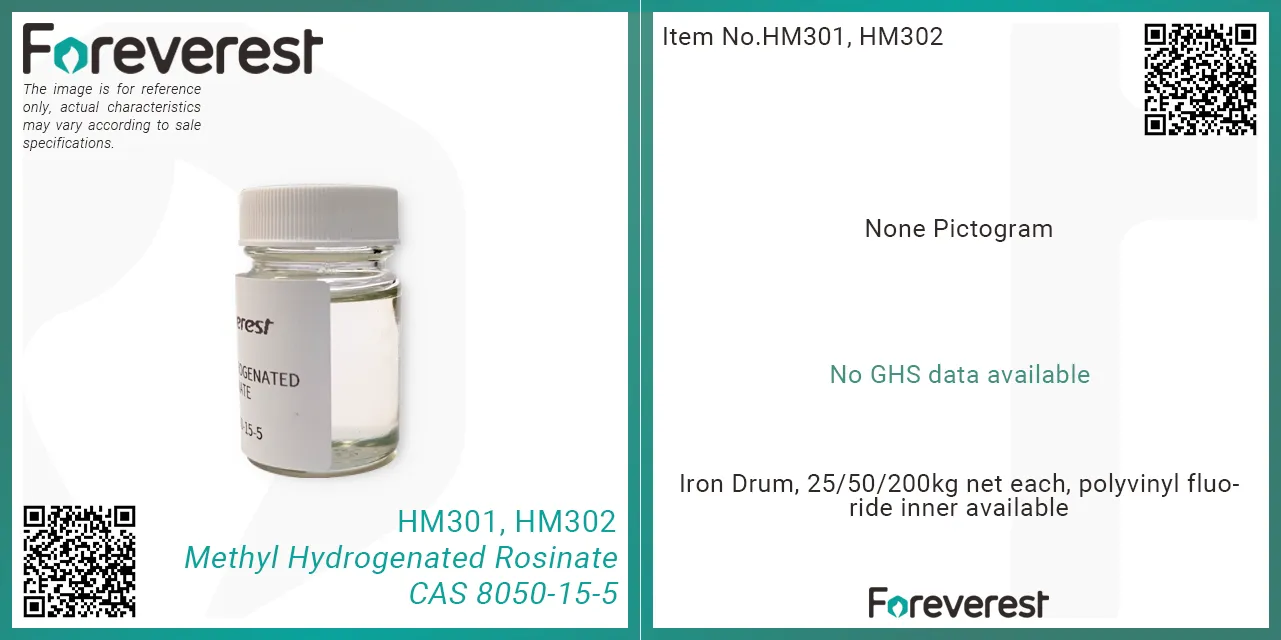
Methyl Hydrogenated Rosinate
Methyl Hydrogenated Rosinate, a cosmetic-grade resin, is the methyl ester of hydrogenated gum rosin. This liquid resin undergoes a special steam-sparging treatment to ensure minimum odour and low vapour pressure, making it particularly useful as a fragrance fixative. It exhibits excellent solubility and compatibility with non-polar and many polar ingredients in cosmetic applications, contributing to both adhesion and gloss. This product serves as a substitute product.
It is a light amber liquid resinous tackifier and plasticizer, being hydrogenated, having marked resistance to aging. A consistent mild odor is assured after giving a special steam purification treatment. It is soluble in usual apolar organic solvents, alcohols and ethyl and butyl acetates, has a superior cold resistance ability and may maintain a valid viscosity under -40 deg C circumstance, forms a continuous film on skin, hair or nails.
Substance Identification
| Synonyms | Methanol Ester of Hydrogenated Rosin | Hydrogenated Methyl Abietate | MEHR |
| CAS | 8050-15-5 |
| EINECS | 232-476-2 |
| FEMA | N/A |
| HS.CODE | 380690 |
| Molecular Formula | C19H31COOCH3 |
| Molecular Weight | 318.49 |
Application & Uses
Fragrance &Amp; Flavour Industry
- Due to its low odour and low vapour pressure, it is an ideal fragrance fixative and carrier in fragrance compounds, effectively prolonging scent longevity.
Cosmetics &Amp; Personal Care
- Widely applied in various personal care products such as lipsticks, lip gloss, depilatory waxes, and nail polish, providing excellent adhesion and gloss , and functioning as a film-former, plasticiser, skin conditioning agent , and viscosity controlling agent .
Adhesives &Amp; Chewing Gum Base
- Can be used as an effective tackifier and plasticiser in the production of adhesives and chewing gum base, helping to adjust their hardness, plasticity, and chew characteristics .
Other Industrial Applications
- As a key resin component, it is also used in inks, floor tiles, vinyl plastics, rubber compositions, solder flux, surface active agents, and other related industrial applications.
Features & Benefits
Exceptional Stability &Amp; Low Odour
- A light amber liquid resin, it is hydrogenated, imparting marked resistance to ageing and oxidation, ensuring long-term product stability. A special steam purification treatment assures a consistent mild odour and low vapour pressure.
Superior Solubility &Amp; Compatibility
- Possesses wide solubility and compatibility ranges, being soluble in common apolar organic solvents, alcohols, and ethyl and butyl acetates.
Excellent Cold Resistance
- Exhibits superior cold resistance ability, maintaining effective viscosity even under -40°C circumstances .
Effective Film Formation
- Capable of forming a continuous film on skin, hair, or nails, providing protection and sheen to products.
Other Key Properties
- Features excellent pigment wetting properties, a high boiling point, and a high refractive index.
Sales Specification
| ITEM | VALUE | TEST METHOD & UNIT |
|---|---|---|
| Appearance | Colorless transparent viscous liquid | |
| Acid Value | 9 max | mgKOH/g |
| Colour | 2 max | @Gardner |
| Freezing Point | 3 | °C |
| Viscosity | 3000 to 7000 | |
| Halogen Content | 0.01 max |
Q&A
What practical specification differences are most relevant for a purchasing team when comparing HM302 with typical cosmetic-grade methyl hydrogenated rosinate products on the market?
Publicly available data for cosmetic-grade methyl hydrogenated rosinates show Gardner colour values typically at 2 and acid values in the 2–8 mg KOH/g range, while HM302 is specified with a Gardner colour of 2 max and an acid value limit of 9 mg KOH/g, so its colour window is aligned with these references and its acid value tolerance is only slightly wider. In lightly pigmented or translucent systems—such as tinted lip glosses, sheer nail bases or fragrance concentrates—keeping the resin at Gardner 2 and below helps avoid adding a noticeable yellow cast to the bulk phase, which makes HM302 suitable for the same visual performance envelope as the established grades. The modestly higher acid value ceiling suggests that, in very acid‑sensitive applications (for example fragrance bases containing acid‑labile notes or colour cosmetics where shade drift is closely monitored), formulators may want to check fragrance stability and colour hold during their standard stability protocol, rather than assuming full interchangeability purely from specifications. Like other methyl hydrogenated rosinates, HM302 is a low‑odour, liquid resin produced by esterifying hydrogenated gum rosin with methanol and then steam‑purifying it, and it shows similar viscosity and solubility behaviour in non‑polar oils, esters and many polar solvents, so purchasing teams can generally evaluate it within existing solvent systems and process conditions. In practice, a side‑by‑side evaluation would normally include measuring Gardner colour, acid value and viscosity on retained samples of the current resin and an HM302 trial lot, and then checking key application tests—such as film clarity and tack in lipsticks or depilatory waxes, or odour and fixation performance in fragrance concentrates—to confirm that performance remains within the established internal quality window.
Why is methyl hydrogenated rosinate well suited to serve as both a fragrance fixative and a carrier in fine fragrance compounds, especially when olfactory neutrality is critical?
Methyl hydrogenated rosinate is widely used as a fragrance fixative because it combines very low vapour pressure with a high boiling point, so it slows the evaporation of volatile top and middle notes and helps a perfume last longer on skin. Perfumery references describe this material as a highly substantive resin fixative that can be used from trace levels up to relatively high dosages in fine fragrance and other perfumed products, reflecting its ability to extend odour persistence without dominating the olfactory profile. Hydrogenation of the rosin acids, followed by steam‑sparging during manufacture, removes most of the sharp pine‑like notes associated with unmodified rosin and yields a low‑odour, low‑colour liquid resin that is often described as “virtually odourless” or only faintly balsamic‑woody, making it suitable when the fixative should not interfere with the creative fragrance accord. In addition to fixation, methyl hydrogenated rosinate has good solubility and compatibility with many non‑polar oils, esters and heavier aroma materials, so it can also act as a carrier or diluent in fragrance concentrates, helping dissolve essential oils, absolutes and resinoids while contributing adhesion and gloss in applications such as perfumes, lip products and depilatory waxes. For formularies where olfactory neutrality is critical, the key suitability factors are this combination of low odour, low vapour pressure and broad solvency, and good practice is to confirm that the chosen grade consistently meets low‑odour specifications through hydrogenation and steam‑purification before relying on it as a primary fixative–carrier base.
Why is methyl hydrogenated rosinate particularly valued in long-wear lipstick and mascara formulations compared with non-hydrogenated rosin derivatives?
Methyl hydrogenated rosinate is valued in long-wear lipsticks and mascaras because its hydrogenated rosin backbone gives much better resistance to oxidation and thermal discolouration than non-hydrogenated rosin esters, so the film it forms on lips or lashes is less likely to yellow, harden or crack during hours of wear at body temperature. INCI and supplier data classify this ingredient as a film former and plasticiser for colour cosmetics, and it does form a flexible, continuous film that improves adhesion to lips or lashes, supports transfer resistance and helps colour lay down smoothly without drag. As a viscosity-controlling plasticiser, it helps tune the rheology of the wax–oil–pigment matrix so that a lipstick bullet or mascara gel loads evenly on the applicator, glides on without skipping, and then sets to a film that resists flaking or crumbling through the wear period. Its relatively high refractive index (typically around 1.51–1.52) adds gloss to the film, which allows formulators to reach a glossy or satin finish with fewer additional shine agents in long-wear lip products. The combination of hydrogenation and steam-sparging used in manufacturing keeps colour and odour low, making the resin’s own scent and background tone much less noticeable than that of non-hydrogenated rosin derivatives in products that sit very close to the nose for extended periods.
Which properties of methyl hydrogenated rosinate make it a practical film-forming plasticiser in solvent-based nail polish, and how does it compare with conventional phthalate or citrate plasticisers in this application?
Methyl hydrogenated rosinate is a practical film-forming plasticiser for solvent-based nail polish because it combines high refractive index with film-forming and plasticising action in a single resin: it helps create a continuous, flexible film on the nail, adds gloss and contributes adhesion, all functions that nitrocellulose-based lacquers typically achieve with separate resins and plasticisers. Its good solubility in esters, ketones and alcohols matches the solvent families used in classical nitrocellulose nail polish bases, and rosin ester data specifically note compatibility with nitrocellulose, so it can usually be introduced without upsetting solvent evaporation or film formation. Compared with monomeric plasticisers such as phthalates or citrates, methyl hydrogenated rosinate is a higher‑molecular‑weight resin with lower volatility and migration tendency, which helps the cured film retain flexibility and gloss through repeated hand‑washing and solvent exposure instead of gradually embrittling as the plasticiser leaches out. A low colour specification (for example Gardner 2 max for HM302) keeps the resin’s own tint below the level where it would noticeably shift the shade of pastel or sheer polishes, which is important in light and translucent shades. In practice, formulators comparing a rosin-based plasticiser with conventional phthalate or citrate options would focus on measuring film hardness, gloss retention, adhesion and cracking/peeling behaviour after dry–wet cycling on nail substrates, and confirm that dry time and the hardness–flexibility balance remain within the expected range for the target product line.
Package
- Iron Drum, 25kg net each, polyvinyl fluoride inner available
- Iron Drum, 50kg net each, polyvinyl fluoride inner available
- Iron Drum, 200kg net each, polyvinyl fluoride inner available
GHS Hazard Statements
| H-Code | H412 H413 |
| P-Code | P273 |
| Disposal | P501 |
Storage
- Environmental & Temperature Control:
- Specified Temperature Range: Store within the specific temperature range recommended on the product's Technical Data Sheet (TDS) or by the supplier, typically in a cool, dry place. Avoid extreme heat or cold to prevent polymerization or crystallization.
- Moisture Protection: Resins, especially moisture-curing types, are highly sensitive to humidity. Always store in a dry environment, away from moisture.
- Light Protection: Avoid direct sunlight and strong light exposure to prevent UV-induced polymerization or degradation.
- Good Ventilation: Ensure the storage area is well-ventilated to prevent the accumulation of harmful vapours or odours.
- Container Management & Sealing:
- Sealed Containers: Resins must be stored in their original, tightly sealed containers. Once opened, use as quickly as possible or re-seal securely to prevent air and moisture ingress.
- Inert Gas Protection: For certain oxygen-sensitive resins, it's advisable to purge the container with dry inert gas (e.g., nitrogen) before re-sealing after opening.
- Clear Labelling: Ensure all containers are clearly labelled with product name, batch number, production date, and expiry date.
- Safety & Isolation:
- Keep Away from Ignition Sources: The storage area should be away from heat, sparks, open flames, and all sources of ignition, especially for flammable resins.
- Avoid Incompatibles: Avoid co-storage with hardeners, accelerators, or other incompatible chemicals to prevent unintended reactions.
- Grounding: For flammable liquid resins, ensure equipment used for storage and transfer is earthed to prevent static build-up.
- Handling & Inspection:
- Careful Handling: Handle resins with care, avoiding vigorous shaking or tipping.
- Regular Inspection: Periodically check containers for leaks, damage, or bulging. After prolonged storage, always check the resin's quality (e.g., viscosity, appearance) before use to ensure it meets requirements.
- Compliance & Emergency Preparedness:
- Regulatory Compliance: Strictly comply with all national and local safety and environmental regulations.
- Emergency Preparedness: Have necessary emergency equipment (e.g., absorbent materials, fire extinguishers) on hand and ensure emergency plans are in place for spills, fires, etc.
Relation Products
Relation Articles
Remark
The above information is believed to be accurate and represents the best explanation currently available to us. However, no liability is assumed for any consequences arising from the use of this content. The technical standards for our products are developed and updated jointly by our customers and ourselves; where any changes occur, the latest specification shall prevail and will be confirmed in the relevant contract.All suggestions and data provided are based on information we consider to be reliable and are offered in good faith, but without any guarantee, as the conditions and methods of use of our products are beyond our control. Foreverest® makes no warranties, whether express or implied, regarding the accuracy, completeness or suitability of this information, and expressly disclaims any implied warranty of fitness for a particular purpose. Prospective users should conduct their own tests and evaluations to determine the suitability of Foreverest® materials and any recommendations for their intended applications before adoption, and, where appropriate, should obtain confirmation or approval from the relevant regulatory authorities.Any references in this page to patents or patented technologies, including descriptive material derived from patents or citations of specific patent numbers, are provided for information only. They must not be interpreted as a recommendation to use our products in a manner that could infringe any third‑party patent, nor as a grant of any licence or permission to use patents owned by Foreverest®.
Start Purchasing
-

Minimum Order Quantity
Quote required -

Lead Time
Quote required -

Available Incoterms
Quote required -

Regional Availability
Quote required