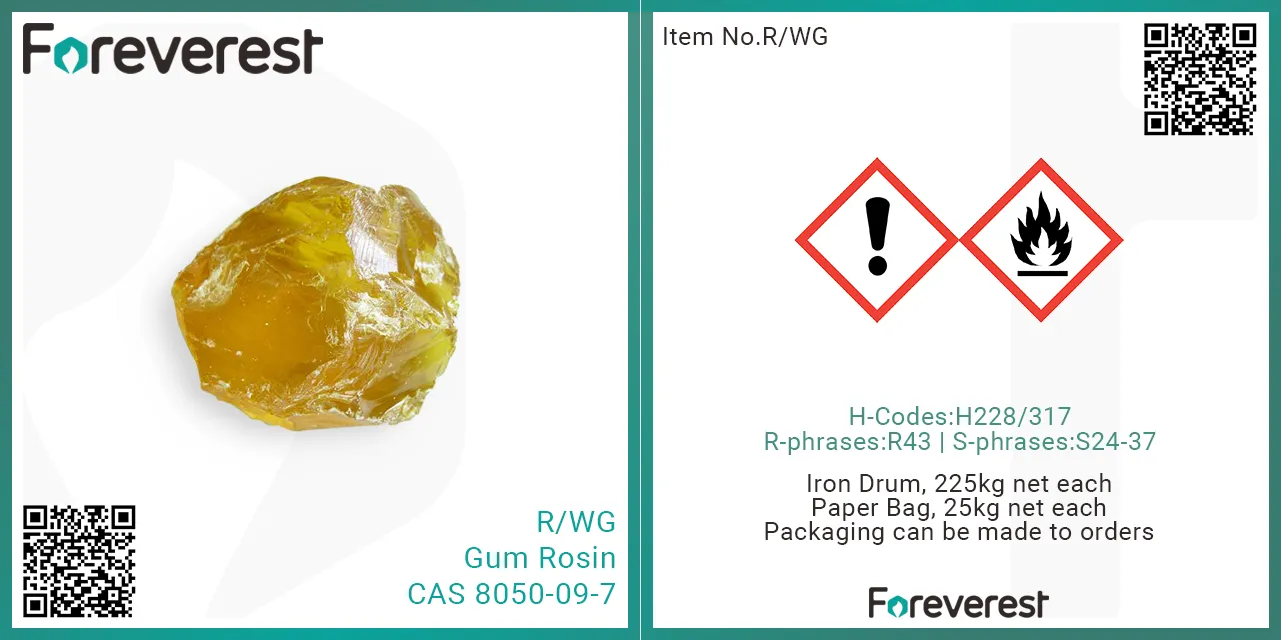
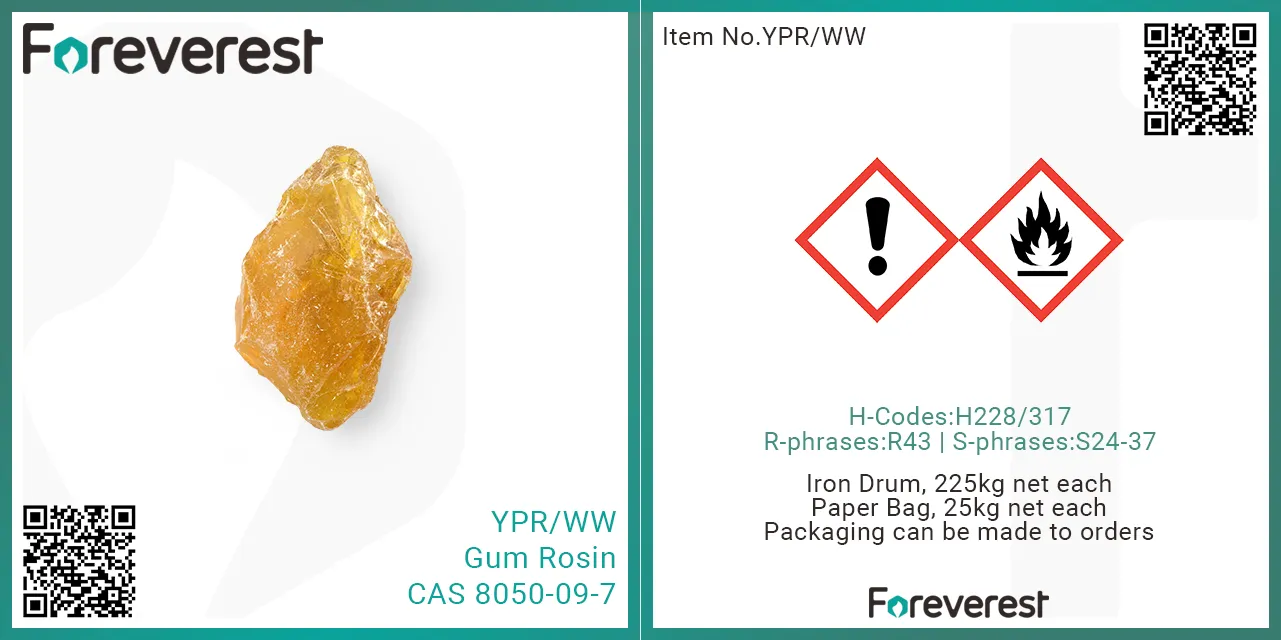
Gum Rosin
Gum Rosin, also known as colophony or Greek pitch, is a solid resin derived from pine trees and some other plants, primarily conifers. It is produced by heating fresh liquid resin, which causes the volatile terpene components to evaporate. The result is a semi-transparent solid that ranges in color from yellow to black. Rosin is brittle at room temperature but melts at relatively low temperatures, such as those achieved on a stove. Its primary chemical components are resin acids, especially abietic acid.
Gum Rosin which preparated from China is commonly used in industries such as paper production, paint, soap, and printing ink. Since rosin tends to soften and oxidize easily, the oil paint industry often uses carboxylation of resin acids to produce resinates for further use. In the production of synthetic rubber and printing inks, resin acids undergo processes such as disproportionation, polymerization, or hydrogenation to form disproportionated rosin, polymerized rosin, or hydrogenated rosin, respectively. These reactions typically involve altering the double bonds in the resin acids to achieve the desired properties.
Substance Identification
| Synonyms | Colophony |
| CAS | 8050-09-7 |
| EINECS | 232-475-7 |
| FEMA | N/A |
| HS.CODE | 380610 |
| Molecular Formula | C19H29COOH |
| Molecular Weight | 262.4302 |
Application & Uses
- used as a binder component of adhesive, includes rubber based adhesive, synthetic resin based adhesive and plant base adhesives
- used for paper sizing, improving the strength and smoothness, increasing wear resistance,
- used for thermoplastic coating, such like road marking
- used as vehicle body and enhancing the adhesion in ink industry
- as film forming material for controlled-release fertilisers
Sales Specification
| ITEM | VALUE | TEST METHOD & UNIT |
|---|---|---|
| Colour | Slight Yellow | |
| Softening Point | 75 min | @R&B, °C |
| Acid Value | 165 min | mgKOH/g |
| Ash | 0.04 max | % |
| Insoluble in alcohol | 0.03 max | % |
| Unsaponifiable matter | 5 max | % |
| ITEM | VALUE | TEST METHOD & UNIT |
|---|---|---|
| Colour | Light Yellow | |
| Softening Point | 76 min | @R&B, °C |
| Acid Value | 166 min | mgKOH/g |
| Ash | 0.03 max | % |
| Insoluble in alcohol | 0.03 max | % |
| Unsaponifiable matter | 5 max | % |
| ITEM | VALUE | TEST METHOD & UNIT |
|---|---|---|
| Colour | Deep Yellow | |
| Softening Point | 75 min | @R&B, °C |
| Acid Value | 165 min | mgKOH/g |
| Ash | 0.04 max | % |
| Insoluble in alcohol | 0.03 max | % |
| Unsaponifiable matter | 5 max | % |
Q&A
What distinguishes gum rosin from the other rosin types available on the market?
Gum rosin is tapped from living pine trees and distilled, yielding a product with naturally lighter colour and higher purity compared with tall oil rosin, which is a by-product of kraft pulping, and wood rosin, which is solvent-extracted from pine stumps. This direct harvesting from living trees tends to give gum rosin better oxidative stability and more consistent batch-to-batch composition.
What advantage does gum rosin offer as a tackifier in adhesive formulations compared with petroleum-derived alternatives?
Gum rosin provides natural tackifying performance in hot-melt and pressure-sensitive adhesives, with the pine-tapped origin offering a renewable sourcing dimension that petroleum-derived C5 or C9 resins do not possess. The higher acid value of gum rosin also tends to facilitate subsequent esterification when a lower-acid tackifier is required.
Rosin is a very traditional raw material. Are there any newer applications being explored for it?
Gum rosin is typically perceived as a commodity raw material for traditional industries. However, its resin acid structure (conjugated double bonds + carboxyl group) can be functionalised for cutting-edge UV-curable coatings and 3D printing resins — repositioning gum rosin from a legacy industrial input to a bio-based platform for next-generation materials.
GHS Hazard Statements
| No data available |
Storage
- avoid contact with light
- keep separated from incompatible substances
- store and handle in accordance with all current regulations and standards
- store in a cool, dry place
- store in a tightly closed container
Relation Products
Relation Articles
- Application of Gum Rosin
- Application of Nonionic Surfactants based on Rosin As Corrosion Inhibitor for Tubing Steel During Acidization of Petroleum Oil and Gas Wells
- Progress on the patents about the modifications of gum rosin and their applications
- Frequently asked questions about new transparent tackifiers Hydrogenated terpene/polyterpene resins
- Role of Resin in Printing Ink
- Choosing the Correct Soldering Flux Types and Their Advantages/Disadvantages
Remark
The above information is believed to be accurate and represents the best explanation currently available to us. However, no liability is assumed for any consequences arising from the use of this content. The technical standards for our products are developed and updated jointly by our customers and ourselves; where any changes occur, the latest specification shall prevail and will be confirmed in the relevant contract.All suggestions and data provided are based on information we consider to be reliable and are offered in good faith, but without any guarantee, as the conditions and methods of use of our products are beyond our control. Foreverest® makes no warranties, whether express or implied, regarding the accuracy, completeness or suitability of this information, and expressly disclaims any implied warranty of fitness for a particular purpose. Prospective users should conduct their own tests and evaluations to determine the suitability of Foreverest® materials and any recommendations for their intended applications before adoption, and, where appropriate, should obtain confirmation or approval from the relevant regulatory authorities.Any references in this page to patents or patented technologies, including descriptive material derived from patents or citations of specific patent numbers, are provided for information only. They must not be interpreted as a recommendation to use our products in a manner that could infringe any third‑party patent, nor as a grant of any licence or permission to use patents owned by Foreverest®.
Start Purchasing
-

Minimum Order Quantity
Quote required -

Lead Time
Quote required -

Available Incoterms
Quote required -

Regional Availability
Quote required