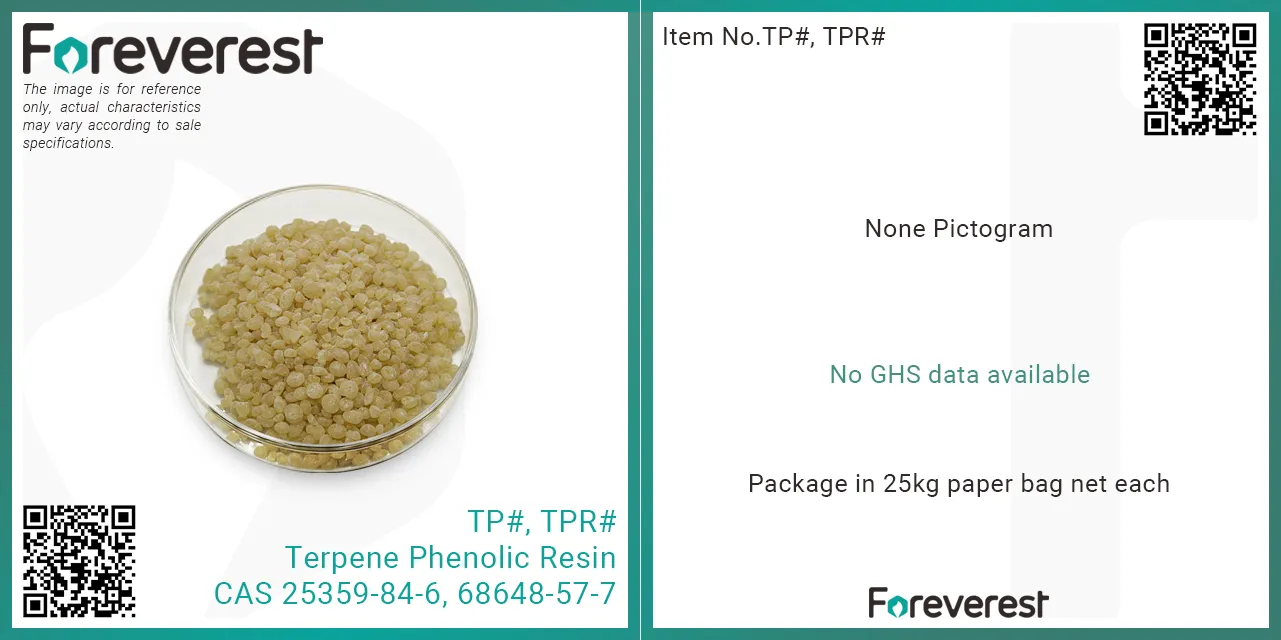
Terpene Phenolic Resin

Terpene Phenolic Resin (TPR) with high softening point and good stickability, particularly suitable to be used in making chloronorgutta rubber (graft polychloroprene rubber) adhesive for PVC artificial leathers. When once used, they can keep effective for much longer time as solvent adhesive because of their good quality of heat-resistance and better solvency for various kinds of flexible matter and resins.

TPR are also widely used in all kinds of solvent adhesive, dismodule type of CR adhesive, heat solvent adhesive, heat solvent adhesive stick & adhesive tape, and sole adhesive of high grade shoes.

Substance Identification

Synonyms
CAS 68648-57-7
EINECS N/A
FEMA N/A
HS.CODE 391110
Molecular Formula C16H22O
Moleclar Weight 230.3453

Application & Uses

  • Adhesives
    • PSAs for medical, electronic and flexible packaging applications
  • Rubber Compounding
    • Partially replacing petroleum-derived tackifier resins in SSBR, BR and NR systems
    • Softening point and acid value comparable to industrial-grade phenolic resins; suitable for complex vulcanisation systems
# The above summary covers the latest applications of this product category (as of 2026); traditional applications are no longer displayed separately.

Features & Benefits

  • high softening point
  • good compatibility with many other resins
  • higher heat resistance
  • good adhesive for acrylic resin, natural rubber and synthetic rubber

Sales Specification

ITEM VALUE TEST METHOD & UNIT
Appearance Irregular-shaped solid cakes with yellow to light yellow colors
Acid Value 20 to 30 mgKOH/g
Colour 7 max @Gardner
Softening Point 140 to 160 @R&B, °C
ITEM VALUE TEST METHOD & UNIT
Appearance Irregular-shaped solid cakes with yellow to light yellow colors
Acid Value 1.0 mgKOH/g
Colour 7 max @Gardner
Softening Point 92 to 98 @R&B, °C

Package

  • Paper Bag, 25kg net each, 12 months shelf life

Preview all the spec of packaging

GHS Hazard Statements

No GHS data available

Storage

  • guard against dust accumulation of this material
  • keep away from heat, sparks and open flame
  • keep containers closed when not in use

Remark

— Disclaimer —
The above information is believed to be accurate and represents the best explanation currently available to us. However, no liability is assumed for any consequences arising from the use of this content. The technical standards for our products are developed and updated jointly by our customers and ourselves; where any changes occur, the latest specification shall prevail and will be confirmed in the relevant contract.All suggestions and data provided are based on information we consider to be reliable and are offered in good faith, but without any guarantee, as the conditions and methods of use of our products are beyond our control. Foreverest® makes no warranties, whether express or implied, regarding the accuracy, completeness or suitability of this information, and expressly disclaims any implied warranty of fitness for a particular purpose. Prospective users should conduct their own tests and evaluations to determine the suitability of Foreverest® materials and any recommendations for their intended applications before adoption, and, where appropriate, should obtain confirmation or approval from the relevant regulatory authorities.Any references in this page to patents or patented technologies, including descriptive material derived from patents or citations of specific patent numbers, are provided for information only. They must not be interpreted as a recommendation to use our products in a manner that could infringe any third‑party patent, nor as a grant of any licence or permission to use patents owned by Foreverest®.

Start Purchasing

  • Minimum Order Quantity

    Quote required
  • Lead Time

    Quote required
  • Available Incoterms

    Quote required
  • Regional Availability

    Quote required