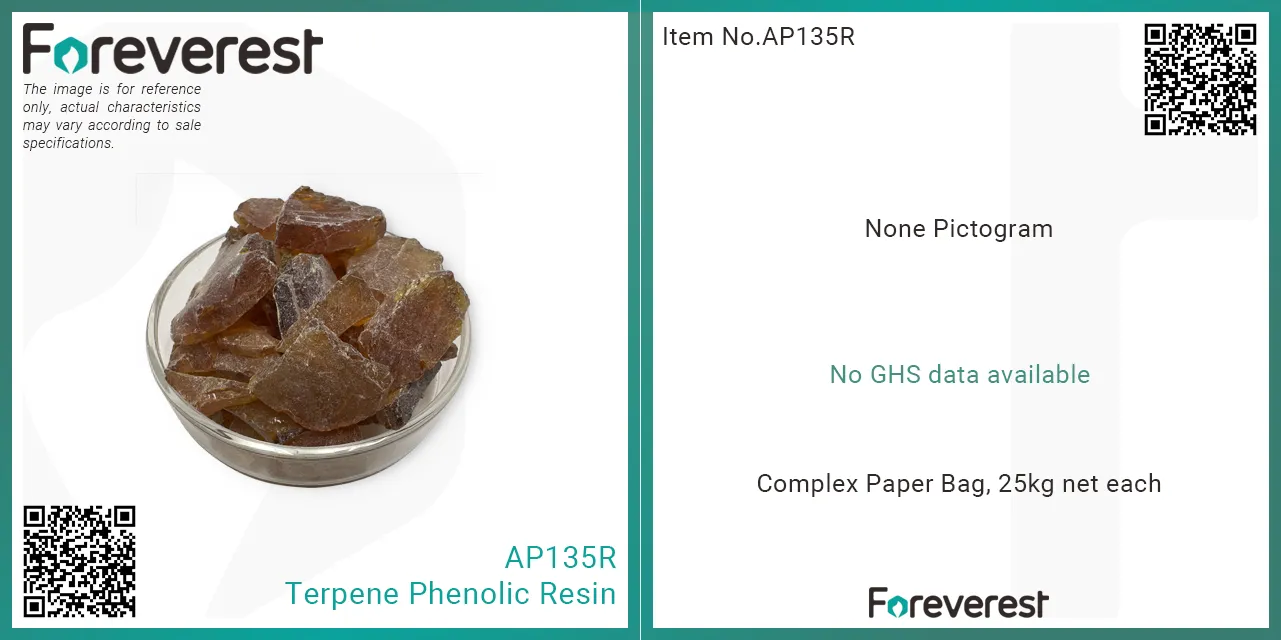
Terpene Phenolic Resin AP
Terpene phenolic resin, a variety of terpene raw materials were polymerized and reacted with phenol in a certain proportion. It is a certain polarity and good compatible with rubber of high strength and high density. It is suitable for hot melt pressure sensitive adhesive with high temperature and high strength, the initial adhesion and stripping force is at high level. and better than monomer alpha terpene resin.
Substance Identification
| Synonyms | polyterpene resin |
| CAS | Proprietary |
| EINECS | N/A |
| FEMA | N/A |
| HS.CODE | 391110 |
| Molecular Formula | Proprietary |
| Molecular Weight | Proprietary |
Application & Uses
- It is suitable for hot melt pressure sensitive adhesive with high temperature and high strength.
Features & Benefits
- 90% Bio-based.
- A certain polarity
- This series resin can replace A135, A125, and A115 in terms of performance.
- Good compatible with rubber of High strength and high density.
Sales Specification
| ITEM | VALUE | TEST METHOD & UNIT |
|---|---|---|
| Appearance | Irregular-shaped solid cakes with yellow to light yellow colors | |
| Color | 6 max | @Gardner |
| Acid Value | 20 to 30 | mgKOH/g |
| Softening Point | 130 to 140 | @R&B, °C |
| ITEM | VALUE | TEST METHOD & UNIT |
|---|---|---|
| Appearance | Irregular-shaped solid cakes with yellow to light yellow colors | |
| Color | 6 max | @Gardner |
| Acid Value | 20 to 30 | mgKOH/g |
| Softening Point | 120 to 130 | @R&B, °C |
| ITEM | VALUE | TEST METHOD & UNIT |
|---|---|---|
| Appearance | Irregular-shaped solid cakes with yellow to light yellow colors | |
| Color | 6 max | @Gardner |
| Acid Value | 20 to 30 | mgKOH/g |
| Softening Point | 110 to 120 | @R&B, °C |
Q&A
Why do hot‑melt pressure‑sensitive adhesive formulators often prefer the AP terpene phenolic series over pure α‑pinene polyterpene resins as tackifiers?
The AP series is made by copolymerising terpene units with phenol, introducing phenolic hydroxyl groups into the terpene backbone and giving the resin a level of polarity that pure α‑pinene polyterpene resins do not have. This added polarity improves specific adhesion to more polar or hard‑to‑bond substrates and helps maintain peel strength at elevated service temperatures, which is important for high‑strength hot‑melt PSA tapes and labels. AP grades also show a consistently higher acid value in the 20–30 mgKOH/g range and softening points between roughly 110 and 140 °C, signalling a controlled phenolic modification level and providing a balance of initial tack and cohesive strength that is harder to achieve with low‑acid, unmodified α‑pinene resins. Together, these features explain why AP‑type terpene phenolic resins are often selected when PSAs must combine high temperature resistance and strong adhesion with good compatibility to high‑strength, high‑density rubber backbones.
In which hot‑melt pressure‑sensitive adhesive applications does the AP terpene phenolic series provide the most benefit over standard tackifiers?
The AP series is most valuable in hot‑melt PSAs that must carry high loads and maintain adhesion at elevated temperatures, such as industrial and construction tapes, automotive interior attachment, appliance labels and other high‑performance label stock rather than short‑life, low‑stress consumer labels. Its combination of phenolic polarity and softening points in the 110–140 °C range helps the adhesive resist softening, creep and peel‑strength loss during heat ageing or thermal cycling, while remaining compatible with high‑strength, high‑density rubber backbones like SIS and SBS. The three softening‑point bands (roughly 110–120, 120–130 and 130–140 °C) allow formulators to bias the formulation toward higher heat resistance at the top end or greater initial tack and conformability at the lower end, depending on the service temperature and substrate flexibility. Even so, formulators should confirm performance in their specific SIS, SBS or EVA systems, because the final balance of tack, peel and shear will still depend on how the chosen AP grade interacts with the elastomer phase structure and any co‑tackifiers or plasticisers in the formulation.
How should buyers use the AP115R, AP125R and AP135R softening‑point grades when specifying this terpene phenolic resin for adhesive applications?
All three AP grades share the same acid value range of 20–30 mgKOH/g and a Gardner colour limit of 6, so the main selection lever is softening point, which steps from about 110–120 °C for AP115R up to 130–140 °C for AP135R. Lower‑softening‑point grades like AP115R generally melt and flow more easily and build higher initial tack, making them suitable for general‑purpose hot‑melt PSAs where fast grab and good conformability to substrates are priorities. Higher‑softening‑point grades such as AP135R contribute greater cohesive strength and heat resistance, so they are better suited to tapes and labels that must withstand elevated service temperatures without creeping or losing bond integrity. Because the AP115R, AP125R and AP135R grades are designed to correspond to the performance brackets of A115, A125 and A135 type terpene phenolic resins, buyers should always specify the exact grade code on the purchase order to avoid inadvertent substitutions that could shift the tack‑to‑cohesion balance in the final adhesive.
GHS Hazard Statements
No GHS data availableStorage
- Store in a cool and ventilated warehouse.
Relation Products
Relation Articles
- [Internal Sharing Session Memo] Differences between Terpene Resins Synthesised from Different Pinene Monomers, Their Applications, and a Discussion on Resin Supply Chain Stability
- Formulation Approaches for Polyterpene Resins, SBS Elastomers and Petroleum Resins
- How to choose tackifier resins for Non-woven adhesives
- TACKIFIERS: MARKET EVOLVES WITH DEMAND FOR ADHESIVES SEALANTS AND LABELS
- Coating Resins Supplier Guide
Remark
The above information is believed to be accurate and represents the best explanation currently available to us. However, no liability is assumed for any consequences arising from the use of this content. The technical standards for our products are developed and updated jointly by our customers and ourselves; where any changes occur, the latest specification shall prevail and will be confirmed in the relevant contract.All suggestions and data provided are based on information we consider to be reliable and are offered in good faith, but without any guarantee, as the conditions and methods of use of our products are beyond our control. Foreverest® makes no warranties, whether express or implied, regarding the accuracy, completeness or suitability of this information, and expressly disclaims any implied warranty of fitness for a particular purpose. Prospective users should conduct their own tests and evaluations to determine the suitability of Foreverest® materials and any recommendations for their intended applications before adoption, and, where appropriate, should obtain confirmation or approval from the relevant regulatory authorities.Any references in this page to patents or patented technologies, including descriptive material derived from patents or citations of specific patent numbers, are provided for information only. They must not be interpreted as a recommendation to use our products in a manner that could infringe any third‑party patent, nor as a grant of any licence or permission to use patents owned by Foreverest®.
Start Purchasing
-

Minimum Order Quantity
Quote required -

Lead Time
Quote required -

Available Incoterms
Quote required -

Regional Availability
Quote required