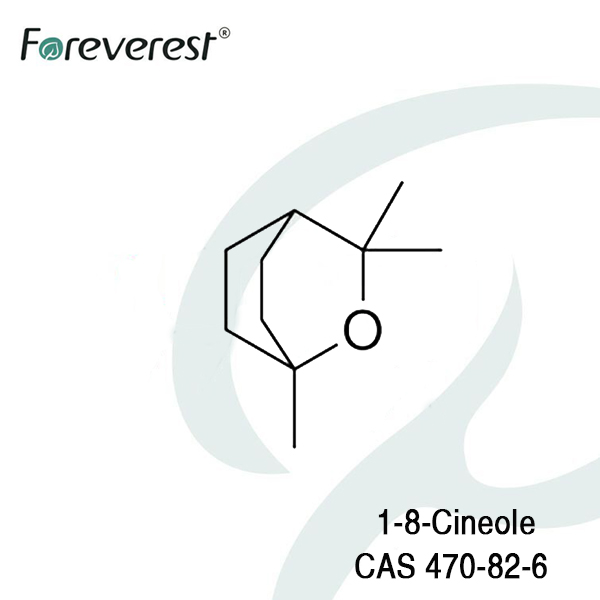
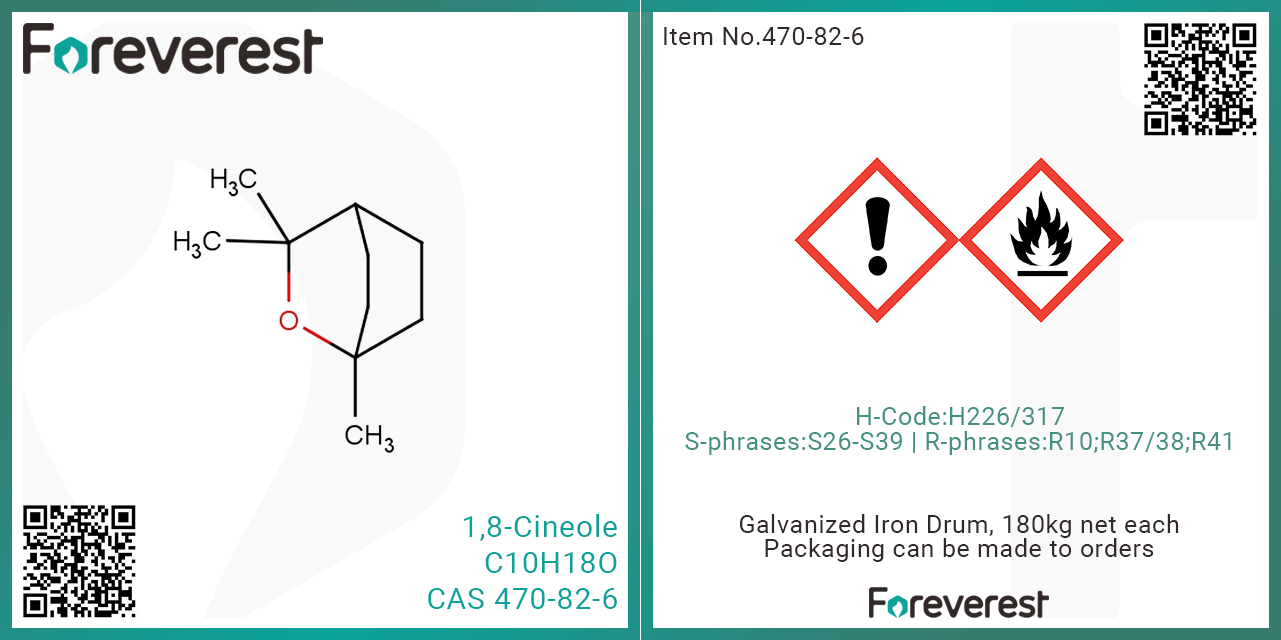
1,8-Cineole
1,8-Cineole, commonly known as Eucalyptol, is a colourless to light yellow liquid with a distinctive camphoraceous spicy odour. It constitutes up to 90% of eucalyptus oil, from which it derives its common name. 1,8-Cineole is also widely found in the foliage of various other aromatic plants, including camphor laurel, bay leaves, tea tree, mugwort, sweet basil, wormwood, rosemary, and sage.
Substance Identification
| Synonyms | Eucalyptol |
| CAS | 470-82-6 |
| EINECS | 207-431-5 |
| FEMA | 2465 |
| HS.CODE | 29092000 |
| Molecular Formula | C10H18O |
| Molecular Weight | 154.25 |
Application & Uses
- Food Industry:
- As an important food ingredient and flavouring agent, 1,8-Cineole is widely used to provide distinct flavour and aroma profiles, enhancing the sensory experience of food products.
- Pharmaceutical Industry:
- In the pharmaceutical industry, 1,8-Cineole is broadly applied, often as an active ingredient in medicines for respiratory conditions or as a carrier in other medicinal preparations.
Features & Benefits
Exceptional Purity & Distinctive Camphoraceous Aroma
- Through a meticulous fractional distillation process, 1,8-Cineole achieves an outstanding purity of 99.6% to 99.8%. Its unique cool, camphoraceous, and spicy aroma makes it an ideal flavouring and active ingredient for both food and pharmaceutical products.
Broad Pharmaceutical & Food Application Versatility
- As the primary active component of eucalyptus oil, 1,8-Cineole demonstrates proven efficacy in alleviating respiratory conditions and serves as a vital carrier in medicinal preparations. Concurrently, it is extensively used in the food industry as an ingredient to impart unique flavour and aroma.
Sales Specification
| ITEM | VALUE | TEST METHOD & UNIT |
|---|---|---|
| Appearance | Colorless to light yellow liquid | |
| Odor | Camphor spicy | |
| Purity | 99 min | @GC, % |
| Content of Eucalyptol | 99 max | % |
| Refractive Index | 1.458 to 1.468 | @n20/D |
| Relative Density | 0.895 to 0.920 | @d20/20 |
| Optical Rotation | 0 to +5 | @20°C, ° |
| Solubility | Soluble in 5 times of 50% ethanol, assume clarified solution |
Q&A
What does the page claim that "careful fractional distillation can achieve 99.6–99.8% purity" for 1,8-cineole involve, and how does it differ from standard commercial-grade production?
For eucalyptus-oil-derived 1,8-cineole, production normally begins with vacuum rectification to remove lighter components such as pinenes, limonene, and p-cymene, followed by collection of a cineole-rich fraction and further rectification, low-temperature crystallisation, or separation steps to raise purity. China's GB 1886.119-2015 specifies that food-additive 1,8-cineole (isolated) is prepared from eucalyptus oil by rectification, freezing, and separation, with a minimum content of 98.0% (National Health and Family Planning Commission of China, 2015, GB 1886.119-2015 National Food Safety Standard—Food Additive 1,8-Cineole). A published Chinese recovery process first used packed-column rectification at approximately 2.4 kPa to remove low-boiling impurities from low-grade eucalyptus-oil by-product, then applied steam rectification to obtain a 1,8-cineole fraction; one patent example reported 99.2% purity at 70.5% recovery, illustrating that final performance depends on feed composition, column efficiency, reflux ratio, and separation sequence (CN201210241199.8). China also discloses a synthetic route that dehydrates α-terpineol over a solid-acid catalyst to form 1,8-cineole, so customers should select material by natural versus synthetic origin, target purity, food-standard applicability, and complete GC impurity profile; our 99% minimum GC specification is a standard commercial release criterion, while 99.6–99.8% must be confirmed by the COA for the individual batch.
Which marketed pharmaceutical products contain pure 1,8-cineole, and what clinical evidence supports its use in respiratory conditions?
In Germany, Soledum® Capsules (100 mg) and Soledum® forte (200 mg) are enteric capsule products containing cineole, while Sinolpan® 100 mg and Sinolpan® forte 200 mg also use pure cineole as the active ingredient for symptomatic or adjunctive treatment of bronchitis, cold-related respiratory symptoms, and sinusitis; the approved indication must be confirmed from the product information in the country of sale. In a double-blind placebo-controlled trial of 32 patients with steroid-dependent asthma, 1,8-cineole at 600 mg/day for 12 weeks was associated with a larger prednisolone reduction, but this small study supports further assessment as medically supervised adjunctive treatment rather than replacement of standard asthma care (Juergens et al., 2003, Respiratory Medicine). A randomised double-blind study in 242 patients with acute bronchitis found that 600 mg/day cineole improved the bronchitis-sum score and cough-fit frequency versus placebo after four days (Fischer & Dethlefsen, 2013, Cough), while a six-month adjunctive study in 242 patients with stable COPD reported reductions in exacerbation frequency, severity, and duration (Worth et al., 2009, Respiratory Research). The EMA position on eucalyptus oil is a traditional-use conclusion for cough associated with colds and localised muscle pain, and the EMA specifically notes that bronchitis and asthma studies used 1,8-cineole rather than eucalyptus oil itself; bulk 1,8-cineole therefore cannot claim a medicinal indication from these studies alone and still requires separate formulation, dose, safety, and market-authorisation development.
Which Eucalyptus species are primary feedstocks for 1,8-cineole production, and what should buyers consider when specifying botanical origin?
Eucalyptus globulus, Eucalyptus polybractea, and Eucalyptus smithii are the principal botanical sources of medicinal and commercial 1,8-cineole-type eucalyptus oils; both the European Pharmacopoeia and the EMA identify these species as eucalyptus-oil sources rich in 1,8-cineole (EMA HMPC, 2024, European Union Herbal Monograph on Eucalyptus Oil). Species, origin, chemotype, leaf maturity, and distillation conditions can materially change crude-oil composition; EMA-reviewed data report 1,8-cineole typically at 70–85% in E. globulus oil and 70–77% in E. smithii oil, so botanical name alone does not establish the actual assay. For medicinal eucalyptus oil, the European Pharmacopoeia requires not less than 70% 1,8-cineole, whereas China's GB 1886.119-2015 requires not less than 98.0% for isolated food-additive 1,8-cineole; these are specifications for different material levels and intended uses (National Health and Family Planning Commission of China, 2015, GB 1886.119-2015 National Food Safety Standard—Food Additive 1,8-Cineole). We recommend specifying Latin botanical name, plant part, origin, distillation method, and full GC/GC-MS profile when purchasing crude eucalyptus oil, while isolated-product procurement should focus on target assay, impurity limits, and the regulatory standard for the intended application.
GHS Hazard Statements
| H-Code | H226/317 |
| P-Code | P210/233/240/241/243/280/261/272 |
| Response | P303+P361+P353 P370+P378 P302+P352 P333+P313 P321 P362+P364 |
| Storage | P403+P235 |
| Disposal | P501 |
| Signal Word | Warning |
| Pictograms | GHS02, GHS07 |
Storage
- Environmental & Temperature Control:
- Store in a cool, dry, well-ventilated area, and protect from light.
- Avoid high temperatures to maintain product stability and prevent decomposition or volatilisation.
- Keep in a cool, well-ventilated place.
- Container Management & Prevention:
- Ensure containers are tightly closed to prevent volatilisation and external contamination, and are clearly labelled.
- Ground all equipment containing the material to prevent static build-up.
- Hazard Isolation:
- Keep storage areas away from heat, sparks, open flames, and all sources of ignition.
- This combustible liquid should be stored in a separate safety storage cabinet or room.
- Keep away from incompatible materials to prevent hazardous reactions.
- Safe Handling & Inspection:
- Handle carefully, and stack stably.
- After prolonged storage, always check quality before use.
- Compliance & Emergency Preparedness:
- Strictly comply with all safety regulations, particularly those pertaining to combustible liquid storage.
- Ensure emergency plans are in place for unforeseen circumstances.
Relation Products
Relation Articles
Remark
The above information is believed to be accurate and represents the best explanation currently available to us. However, no liability is assumed for any consequences arising from the use of this content. The technical standards for our products are developed and updated jointly by our customers and ourselves; where any changes occur, the latest specification shall prevail and will be confirmed in the relevant contract.All suggestions and data provided are based on information we consider to be reliable and are offered in good faith, but without any guarantee, as the conditions and methods of use of our products are beyond our control. Foreverest® makes no warranties, whether express or implied, regarding the accuracy, completeness or suitability of this information, and expressly disclaims any implied warranty of fitness for a particular purpose. Prospective users should conduct their own tests and evaluations to determine the suitability of Foreverest® materials and any recommendations for their intended applications before adoption, and, where appropriate, should obtain confirmation or approval from the relevant regulatory authorities.Any references in this page to patents or patented technologies, including descriptive material derived from patents or citations of specific patent numbers, are provided for information only. They must not be interpreted as a recommendation to use our products in a manner that could infringe any third‑party patent, nor as a grant of any licence or permission to use patents owned by Foreverest®.
Start Purchasing
-

Minimum Order Quantity
Quote required -

Lead Time
Quote required -

Available Incoterms
Quote required -

Regional Availability
Quote required