
Industry News, Cosmetics & Personal Cares
Upcycling Meets Natural Waxes: Sustainable Innovations in Natural Cosmetics
Industry News, Cosmetics & Personal Cares
End consumers are becoming increasingly environmentally conscious, and sustainability is becoming an essential subject with high priority in the cosmetic industry as well. Based on the responsibility that consumers feel towards the environment and nature, their preferences are changing, and the cosmetics industry is obliged to adapt. The increasing demands of consumers have given rise to the trend of upcycling ingredients, which significantly contributes to a lower environmental impact while maintaining quality and enabling the development of sustainable natural cosmetic formulations. Some natural waxes, best known for their role as structuring and stabilizing agents, also serve as upcycled ingredients in sustainable product development. This article outlines a selection of different natural waxes from Kahl’s portfolio, which are obtained as by-products in existing processes in the agricultural, food, and perfume industries.
Upcycling is the process of transforming by-products, waste materials, or unwanted products into new materials or products of higher quality. Unlike recycling or downcycling, upcycling increases the value of materials. This reduces the need for newly produced raw materials, thus helping to preserve resources.
Due to the limited availability of natural resources and social transformation, upcycling is becoming increasingly important. It not only offers environmental advantages, but also financial, economic, educational, and creative benefits. Evident positive effects include reduced waste and energy consumption, as well as fresh marketing opportunities. Furthermore, upcycling encourages the mindful use of resources and stimulates creativity.
Most of the raw materials used to produce our natural waxes are by-products of other industries, making them classic examples of upcycled products. These include sunflower seed wax, rice bran wax, and flower waxes, as well as seabuckthorn wax, which is contained in our most recent product, KahlBase 7040 Seabuckthorn.
Both rice bran wax and sunflower seed wax are upcycled products from the food industry. Our COSMOS-certified KahlWax 6607WOA Sunflower and KahlWax 2811 Rice are extracted during the refining of their respective vegetable oils.
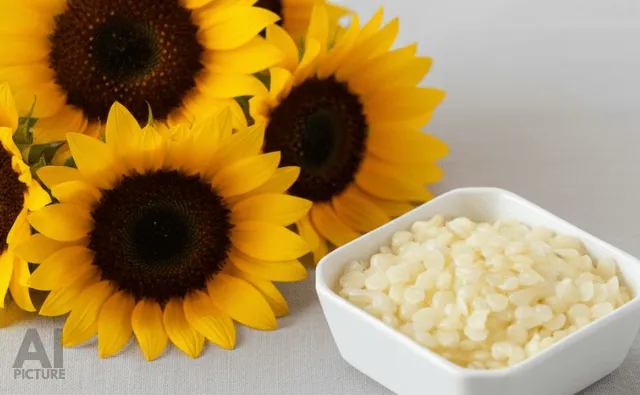
Sunflowers are mainly cultivated for their oleiferous seeds, which are either consumed on their own or used for oil production. After the oil is pressed from the seeds, the crude sunflower oil undergoes further refining, which includes the removal of the wax. KahlWax 6607WOA Sunflower has a high melting point, high hardness, and an outstanding oil-binding capacity. It is mainly used to harden hot-poured, anhydrous systems and provides a dry yet velvety skin feel in emulsions. With its high oil-binding capacity and the ability to enhance stability and heat resistance in final formulations, it is a perfect alternative to carnauba wax.
Rice is an extremely important staple food that feeds over half of the world’s population. During the production of white rice, the grain is milled to remove the bran. Subsequently, the bran is pressed to extract raw rice bran oil, which is further refined, including the removal of wax. Overall, this process yields two food products – white rice and rice bran oil – and rice bran wax, which is now used as a valuable material in the cosmetic industry. KahlWax 2811 Rice is a light-colored, hard wax with a high melting point. It is an established by-product available in large quantities. It forms hard matte oleogels with a pleasant, non-sticky texture that is suitable for anhydrous systems such as lipsticks, balms, and hair styling formulations. It is also an excellent thickener for emulsion systems. In emulsions, it helps to reduce greasiness and improve absorption, making it highly recommended for sun care formulations.
Flower waxes are a prime example of upcycling because they are by-products of the perfume industry obtained during the production of absolutes (essential oils). During the first step of production, fresh blossoms are extracted, yielding a semi-solid mass called concrete, which contains a mixture of essential oils, waxes, resins, and other plant remains. The concrete is extracted again to obtain the absolute and the crude wax. After further refining steps, the flower waxes are complete.
KahlWax 6684 Jasmine, derived from the blossoms of Jasminum grandiflorum (royal jasmine), is a soft wax that features a pleasant floral fragrance. Ideal for skin care formulations, this COSMOS-certified natural wax creates very creamy and rich emulsions, with an impact similar to that of an emollient. It forms a protective film on the skin that supports the activity of moisturizers and emollients. Jasmin wax is also recommended for color cosmetics preparations, providing excellent pay-off.
KahlWax 6692 Rose is a medium-hard wax derived from the Damask rose, which is named after the Syrian city of Damascus. Its graceful fragrance, combined with its viscosity-enhancing properties, adds a feeling of luxury and an elegant touch to formulations. Rose wax is easily incorporated into emulsions, increasing smoothness and texture for a richer, more substantial skin feel. It is perfect for elegant hand creams and hydrating face and body creams.
Seabuckthorn wax is a natural plant wax derived from the thorny, deciduous seabuchthorn shrub. The plant is known for its bright orange berries, which are regarded as a superfood due to their rich content of vitamins, carotenoids, and minerals. The berries and their seeds are also used to obtain seabuckthorn oil, a valued dietary supplement and cosmetic ingredient. Seabuckthorn wax is derived from seabuckthorn oil as an upcycled by-product of the food industry.
Seabuckthorn wax consists mainly of triglycerides of various fatty acids, including high proportion of unsaturated fatty acids or omega acids, mainly palmitoleic, oleic, and linoleic acid. Palmitoleic acid has strong anti-inflammatory properties and promotes skin regeneration. Oleic and linoleic acids strengthen the skin barrier and protect against transepidermal water loss, keeping skin hydrated and healthy. The contained saturated acids ensure high stability and resistance to oxidation. On the skin, they form a protective occlusive layer and provide softening properties. On a sensory level, seabuckthorn wax boosts the pay-off, spreadability, texture, and skin feel.
Seabuckthorn wax is included in our latest product: KahlBase 7040 Seabuckthorn. This multifunctional base ingredient is made from natural waxes and oils and offers endless application possibilities. It contains castor oil, which is well-known for its moisturizing and skin conditioning benefits, as well as crambe oil, which has a silky texture and is easily absorbed. To improve hardness and stability, sunflower seed wax is also included in the base.
KahlBase 7040 Seabuckthorn can be used as the structural basis for a variety of different cosmetic products, ranging from skin care to color cosmetics. It provides an excellent pay-off and a silky-smooth skin feel without being too heavy. It is especially suitable for anhydrous stick formulations. Additionally, 7040 can be used as a booster ingredient to enhance the pay-off, spreadability, skin feel, and texture of formulations.
Upcycling is one of the most important topics in the cosmetic industry today. It is a trend that allows both manufacturers and consumers to opt for more environmentally friendly ingredients in their cosmetics. Kahl´s natural, upcycled waxes are an excellent example of how a by-product can play a leading role as a multipurpose ingredient in natural cosmetic products. The valuable types described, ranging from sunflower seed wax and rice bran wax to flower and seabuckthorn wax, each have different properties that can contribute to texture, stability, and skin feel across various systems. This demonstrates how upcycling can be used to combine innovation and performance with sustainability, contributing to a more resource-conscious future.