Industry News Tracker | Adhesives & Sealants Industry | January 15, 2026
Read Original Full Article at Adhesives & Sealants Industry
Executive Brief
Improper use of flashing tape remains one of the most common causes of premature window failure, leading to water ingress, hidden rot and costly callbacks for builders and remodelers. In this article, “Rich the Remodeler” distils decades of jobsite experience into three critical, recurring mistakes: skipping or misplacing sill flashing, reversing the shingle-style sequencing of tapes and housewrap, and relying on incompatible or low-quality tapes that cannot maintain adhesion over time. By following best-practice sequencing—pre-flashing the sill, taping jambs before the head, and integrating the top flashing with the weather-resistive barrier—contractors can create a durable, drainable window opening that manages water rather than trapping it in the wall.
Keywords: Flashing Tape, Window Installation, Water Management, Building Envelope, Sill Flashing, Shingle-Style Detailing.
Technical Intelligence
1. Core Technology / Process
- Water management principle: The window opening must be detailed like a miniature roof, with all membranes and tapes installed in a shingle-style order so water always drains to the exterior.
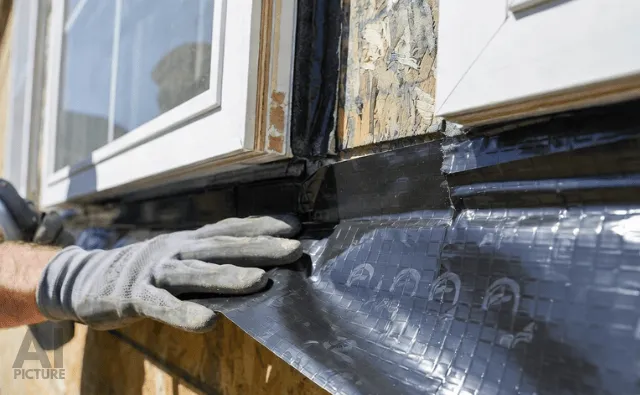
- Sill pre-flashing: A self-adhered flashing tape or flexible sill pan is installed on the rough sill before the window is set, lapped over the sheathing and integrated with the housewrap to direct any incidental water outwards.
- Sequencing basics: After the sill, side jambs are taped, followed by the head flashing, with the housewrap or WRB cut and lapped so the top flashing sits behind the wrap but in front of the sheathing.
2. Key “Ingredients” / Specifications
- Flashing tapes: Pressure-sensitive, self-adhered membranes designed for sheathing, WRB and window flanges; correct selection requires compatibility with substrates and temperature range.
- Housewrap / WRB: Must be cut and lapped to avoid reverse laps that channel water behind the flashing.
- Drip cap / head flashing: Rigid or flexible flashing above the head flange, with the vertical leg tucked under the WRB and taped at the sides for continuity.
3. Performance-Critical Mistakes (and Fix Logic)
- Mistake 1 – Taping the bottom flange: Fully sealing the bottom flange to the WRB traps water in the opening instead of allowing it to drain over the sill flashing.
- Fix: Remove bottom tape where feasible, reinstall sill flashing as a shingle over the sheathing, then reset the window so any water exits at the sill.
- Mistake 2 – Wrong sequencing / reverse laps: Taping head flanges before jambs, or lapping housewrap under rather than over head flashing, creates paths for water to run behind the window.
- Fix: Re-cut WRB to create a top flap, re-tape sides first, then install head flashing with tape over sheathing and under WRB, ensuring all laps shed water.
- Mistake 3 – Poor surface prep and tape choice: Applying tape over dusty, wet or cold substrates, or using off-brand tapes not rated for the conditions, leads to edge lifting and early failure.
- Fix: Clean and dry substrates, use manufacturer-recommended primers for low temperatures, and select flashing tapes tested for the specific sheathing and WRB system.
4. Market / Sustainability
- Risk and liability: Failed window flashing can lead to structural repairs, insurance claims and reputational damage for contractors, especially in high-rain or cold climates.
- System thinking: Adhesive performance of flashing tapes is tied to the entire building envelope system; manufacturers increasingly publish installation details and compatibility matrices to reduce failures.
- Training opportunity: Articles and videos on sill pans, liquid-applied flashing and flexible tapes highlight the push for better installer education as energy codes tighten and moisture performance expectations rise.
Entity & Keyword Index
| Category |
Items |
| Products |
Window flashing tape, Self-adhered flashing, Flexible sill pans |
| Concepts |
Shingle-style lapping, Water management, Building envelope, Drainable openings |
| Issues |
Reverse laps, Trapped moisture, Rot, Callbacks, Adhesion failure |
| Stakeholders |
Contractors, Remodelers, Window manufacturers, Tape manufacturers |
Disclaimer
This content is an independent analysis and summary of public industry news for research purposes. All trademarks and brand names belong to their respective owners. We are not affiliated with the original publisher.
Copyright of this article by Adhesives & Sealants Industry. The copyright and all other rights in the original work reproduced here remain with the original author and/or publisher. Our company republishes this material strictly to facilitate professional information exchange and advance discussion of industry innovation, without any commercial exploitation or intent to infringe. If you like this article, kindly to subscribe www.adhesivesmag.com.